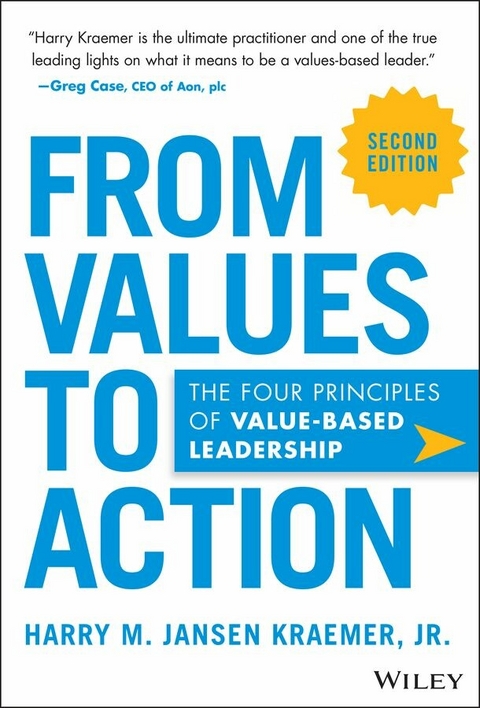
From Values to Action (eBook)
291 Seiten
Wiley (Verlag)
978-1-394-32810-9 (ISBN)
Discover transformative leadership principles and achieve exceptional results by leading with values
In From Values to Action, 2nd edition, Harry Kraemer, esteemed professor of management and strategy at Northwestern University's Kellogg School of Management, delves into the essence of values-based leadership. This compelling book-updated throughout in this second edition-presents practical insights drawn from Kraemer's own celebrated career as well as his interactions with values-based leaders across many organizations. It guides readers in the intricate journey of developing into values-based leaders who not only excel in driving results but also uphold integrity and ethics in how they lead themselves and others. The book provides a roadmap for individuals who aim to be the values-based leaders of the future, capable of navigating our increasingly complex and competitive world.
This updated edition of From Values to Action imparts valuable lessons from Kraemer's extensive executive experience and illustrates how values-based leadership can transform organizations and drive success. The book is packed with actionable strategies and insightful anecdotes relevant for aspiring and practicing leaders across various domains.
Inside the book:
- Learn how to develop self-reflection as a cornerstone for effective leadership
- Gain insights on the importance of a balanced perspective to support holistic decision-making
- Understand the importance of genuine humility and true self-confidence in empowering teams
From Values to Action is tailored for business leaders, executives, managers, and anyone committed to elevating their ability to influence and lead others. Kraemer's seasoned advice, readers will find themselves equipped to lead with conviction and make substantive differences in their organizations and society at large.
HARRY M. JANSEN KRAEMER, JR. is a Professor of Management and Strategy at Northwestern University's Kellogg School of Management. The former chair and CEO of Baxter International, he's currently an executive partner with a private equity firm, and serves on the board of directors of Leidos Corporation, Option Care Health, and Performance Health, and the board of trustees of Northwestern University, The Conference Board, Endeavor Health System, and the Archdiocese of Chicago School Board. He is also a regular contributor to Forbes magazine.
Discover transformative leadership principles and achieve exceptional results by leading with values In From Values to Action, 2nd edition, Harry Kraemer, esteemed professor of management and strategy at Northwestern University's Kellogg School of Management, delves into the essence of values-based leadership. This compelling book updated throughout in this second edition presents practical insights drawn from Kraemer's own celebrated career as well as his interactions with values-based leaders across many organizations. It guides readers in the intricate journey of developing into values-based leaders who not only excel in driving results but also uphold integrity and ethics in how they lead themselves and others. The book provides a roadmap for individuals who aim to be the values-based leaders of the future, capable of navigating our increasingly complex and competitive world. This updated edition of From Values to Action imparts valuable lessons from Kraemer's extensive executive experience and illustrates how values-based leadership can transform organizations and drive success. The book is packed with actionable strategies and insightful anecdotes relevant for aspiring and practicing leaders across various domains. Inside the book: Learn how to develop self-reflection as a cornerstone for effective leadership Gain insights on the importance of a balanced perspective to support holistic decision-making Understand the importance of genuine humility and true self-confidence in empowering teams From Values to Action is tailored for business leaders, executives, managers, and anyone committed to elevating their ability to influence and lead others. Kraemer's seasoned advice, readers will find themselves equipped to lead with conviction and make substantive differences in their organizations and society at large.
INTRODUCTION: DOING THE RIGHT THING
Nearly fifteen years ago, at the encouragement of my students at Northwestern University's Kellogg School of Management, I wrote the first edition of this book. At the time, as I gathered my thoughts for the introduction, I wanted to start with one statement that would capture the essence of what it means to be a values-based leader. It seemed obvious: do the right thing. Little did I know how much importance that one phrase would take on in the years to come.
Today, as I write the introduction to the second edition of From Values to Action, the world is in even greater need of values-based leadership—and leaders who are willing to do the right thing, instead of pursuing their own self-interest. I am of the firm belief, and I'm certainly not alone in this view, that having values is neither old-fashioned nor counterproductive. Taking the time to self-reflect, gaining deeper insight into what you stand for and what matters most to you, is not somehow contrary to profitability and performance or entrepreneurship and innovation. Rather, values-based leadership elevates everyone involved—you as an individual, your team, your organization, your community, and even the world around you.
Values-based leadership is a philosophy I adopted long ago when I joined Baxter International, a global healthcare company. As a new hire fresh out of Kellogg where I received my MBA, I started out working in a cubicle. Back then, I did not know if I would ever be promoted out of “the cube.” It didn't matter, I told myself, remembering the values instilled by my parents and my outlook on life. No matter where my career eventually took me, I would be the best possible team member I could be. With the awareness that we're on this earth for only a very short period of time, I wanted to make a difference with my life—by treating others with respect and not focusing on my own needs and desires ahead of the goals of my team or the organization.
Throughout my years at Baxter, a $12 billion company listed on the New York Stock Exchange, I was promoted to division president, then chief financial officer (CFO), president, and CEO and chair. With each position, my commitment to values-based leadership did not change—in fact, it strengthened. With the help of amazing team members and colleagues, I continually focused on what mattered most and doing the right thing.
Doing the right thing means making choices and decisions that are aligned with your values. When a crisis arises, the values-based leader does not agonize over what to do, but rather focuses on doing the right thing. Choices become clearer to see and decisions easier to make. This requires more than just a grasp of the situation or the players involved. You must know who you are and the values for which you stand.
Leadership is a journey with many twists and turns. For me, one of the most unexpected developments in my career was in 2004 when, at age forty-nine, I left Baxter where I had worked for twenty-three years and served the last six as chair and CEO. Counting my time as CFO, I had spent more than a decade in Baxter's senior leadership.
Closing that chapter in my life opened another one that led to a deeper exploration of leadership and, ultimately, my series of books on values-based leadership. This next phase began when I was contacted by the late Don Jacobs, dean emeritus of Kellogg, to tell me it was time to start teaching. The opportunity to positively influence students who would become the next generation of leaders intrigued me—and with Dean Jacobs asking me, there was no way my answer could be anything but yes.
Today—twenty years later—I am fortunate to teach more than 600 students each year in classes in the MBA and executive MBA programs at Kellogg. This includes students and executives at campuses in Chicago and Evanston, Illinois, as well as in Kellogg programs in Miami (serving South America) and in Hong Kong (serving Asia). I can honestly say that teaching values-based leadership to students and executives has made the concept of leadership even clearer to me.
I teach from firsthand knowledge—the same experiences that I draw from in this book. My understanding of leadership has also been profoundly affected by my service on many boards of public, private, and nonprofit organizations. Today I am an active board member for five public and private companies. I am a long-time board member of Northwestern University and Endeavor Health, which includes the hospital where my five children and my first grandchild were born. In the past, I was also a member and a past chair of the board of trustees of Lawrence University in Appleton, Wisconsin, my undergraduate alma mater.
Through these various experiences, I have grown to appreciate that all of us can exhibit leadership. No matter if you are just starting your career or you are a seasoned executive, how you think and act can positively influence the culture of the organization in both direct and subtle ways. The way you treat team members, collaborate with peers, and interact with colleagues, customers, and shareholders are all reflections of your values.
INFLUENCING OTHERS AT EVERY LEVEL
As I define it, leadership is the ability to influence others. Values-based leadership is the next level. By word, action, and example, values-based leaders seek to inspire and motivate, using their influence to pursue what matters most.
I express this as a leadership formula that you'll see in this book: Leadership, Influence, Relate. As this simple expression shows, your ability as a values-based leader to influence others is the direct result of your relatability. When others know who you are and what you stand for, they will be more likely to trust and follow you.
Values-based leadership is crucial at this time when employee engagement has fallen to decade-lows. Among the reasons for the decline: fewer people feel that someone at work cares for them as a person. Values-based leadership goes right to the heart of this issue, by helping leaders become more relatable to others. The foundation of that relatability is our values and what matters most to us. When leaders are guided by their values in ways that are visible to others, people will notice. They will move out of disengagement and disillusionment.
In so many areas of our world today, the moral compass of leaders is being questioned. Breaches of ethics, betrayal of public trust, and violations of fiduciary responsibility—not to mention greater polarity in the political climate—illustrate the need for a strong commitment to fundamental principles of leadership.
Confidence in leaders has waned and needs to be restored. The 2025 Edelman Trust Barometer found that 61% of people around the world reported having a “moderate or high sense of grievance”—defined as the belief that government and business make their lives harder and that wealthy people benefit unfairly from the system. In addition, Edelman reported an “unprecedented decline for global employer trust”—meaning fewer people believe that their employers are committed to doing the right thing.1 If that's not an outcry for values-based leadership, I don't know what is.
THE FOUR PRINCIPLES OF VALUES-BASED LEADERSHIP
After more than forty-five years in business and having had the opportunity to serve in many leadership roles, I believe that the path to becoming a values-based leader begins with my four principles of values-based leadership. These principles are self-reflection, a balanced perspective, true self-confidence, and genuine humility.
The principles are interconnected, each building on and contributing to the others. Together, they form a solid foundation for values-based leadership. As a lifelong discipline, these principles will challenge you and bring you back to what matters most.
In Part One of this book, we will explore each of the four principles, starting with the first and most important: self-reflection. If you are willing to look within yourself through regular self-reflection and strive for greater self-awareness, you will make significant progress toward reaching your full potential. Here's a simple way to think about the connection between self-reflection and leadership: If you are not self-reflective, how can you truly know yourself? If you do not know yourself, how can you lead yourself? And if you cannot lead yourself, how can you possibly lead others?
In addition, being self-aware helps us move beyond the confines of our job description to view the issues of the world as something we can help address. It's not up to someone else—a.k.a. “those guys” (a gender-neutral term)—with the resources to make a difference. It's up to all of us to do what we can, in our own way. Or, as I like to joke with students and executives, we are those guys! Each of us can help make the world a better place within our sphere of influence, no matter how great or small.
The second principle of a balanced perspective speaks to the importance of understanding all sides of an issue and multiple viewpoints. Leaders who pursue balance realize that their perspective is just that: theirs. By purposefully seeking input from others, especially those who have opposing opinions, you gain a global perspective that enables you to make choices that align with your priorities. When you take the time to reflect and look at issues and situations holistically, the world...
| Erscheint lt. Verlag | 25.11.2025 |
|---|---|
| Sprache | englisch |
| Themenwelt | Wirtschaft ► Betriebswirtschaft / Management ► Unternehmensführung / Management |
| Schlagworte | Business Strategy • Corporate Growth • Ethical Leadership • Executive Management • leadership development • leadership principles • Management Skills • Organizational Transformation • Self-reflection • strategic decision making • values-based leadership |
| ISBN-10 | 1-394-32810-9 / 1394328109 |
| ISBN-13 | 978-1-394-32810-9 / 9781394328109 |
| Informationen gemäß Produktsicherheitsverordnung (GPSR) | |
| Haben Sie eine Frage zum Produkt? |
 EPUB (Adobe DRM)
Kopierschutz: Adobe-DRM
Adobe-DRM ist ein Kopierschutz, der das eBook vor Mißbrauch schützen soll. Dabei wird das eBook bereits beim Download auf Ihre persönliche Adobe-ID autorisiert. Lesen können Sie das eBook dann nur auf den Geräten, welche ebenfalls auf Ihre Adobe-ID registriert sind.
Details zum Adobe-DRM
Dateiformat: EPUB (Electronic Publication)
EPUB ist ein offener Standard für eBooks und eignet sich besonders zur Darstellung von Belletristik und Sachbüchern. Der Fließtext wird dynamisch an die Display- und Schriftgröße angepasst. Auch für mobile Lesegeräte ist EPUB daher gut geeignet.
Systemvoraussetzungen:
PC/Mac: Mit einem PC oder Mac können Sie dieses eBook lesen. Sie benötigen eine
eReader: Dieses eBook kann mit (fast) allen eBook-Readern gelesen werden. Mit dem amazon-Kindle ist es aber nicht kompatibel.
Smartphone/Tablet: Egal ob Apple oder Android, dieses eBook können Sie lesen. Sie benötigen eine
Geräteliste und zusätzliche Hinweise
Buying eBooks from abroad
For tax law reasons we can sell eBooks just within Germany and Switzerland. Regrettably we cannot fulfill eBook-orders from other countries.
aus dem Bereich