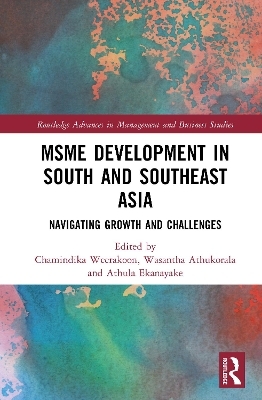
MSME Development in South and Southeast Asia
Routledge (Verlag)
978-1-041-12710-9 (ISBN)
- Noch nicht erschienen (ca. Juni 2026)
- Versandkostenfrei
- Auch auf Rechnung
- Artikel merken
Underpinned by the widely cited Isenberg (2010) Entrepreneurial Ecosystem Framework, this book guides readers through six sections, each focusing on key domains such as finance, human capital, innovation, social impact and marketing, across 25 chapters. With contributions from experts across Sri Lanka, the UK, Australia, Malaysia, India, Indonesia, Bangladesh, and Vietnam, this book combines quantitative and qualitative research methods, providing a strong empirical foundation for examining the cultural and social contexts shaping entrepreneurship in Asia. This offers a nuanced perspective distinct from Western ecosystem dynamics and includes focused analysis of women entrepreneurs. In turn, the book offers actionable guidance and policy solutions to foster resilience, inclusivity, and sustainable growth in the region.
The cross-chapter meta-synthesis reframes the traditional “strengthen MSMEs” policy question to ask: How can we reduce the misalignment between what MSMEs can do and what their environments allow them to achieve? This book is essential for academics, researchers, and students in entrepreneurship, development economics, and business management, as well as policymakers, practitioners, and consultants working to support MSMEs.
Chamindika Weerakoon is a Senior Lecturer in Entrepreneurship and Innovation at Swinburne University of Technology, Australia. Wasantha Athukorala is a Senior Professor and the Director of the Postgraduate Institute of Humanities and Social Sciences, University of Peradeniya, Sri Lanka. Athula Ekanayake is a Professor in the Faculty of Management, University of Peradeniya, Sri Lanka.
Section 1: Policy and Regulatory Environment. 1 Introduction to MSMEs in South and Southeast Asia: Framework and Importance. 2 The Micro, Small, and Medium Enterprises (MSMEs) Research Landscape in the Region: Lessons for Sri Lanka’s Development Path. 3 Positioning Nepal’s MSME Sector in South Asia: A Comparative Study of Economic Contribution and Regional Competitiveness. 4 Effectiveness Gaps in Policy Frameworks and Institutional Support Mechanisms for MSMEs in Vietnam: Insights from Southeast Asian Benchmarking. Section 2: Finance and MSME Resilience. 5 Modelling the Performance of MSMEs: Recent Developments. 6 Returns to Microcredit under External Shocks: Evaluating the Impact of Covid 19 on the Performance of Micro, Small and Medium Enterprises (MSMEs). 7 From Recovery to Sustainability: Perceptions of Impact Investment among MSMEs and Ecosystem Actors in Sri Lanka. 8 Standards and Struggles: Why MSMEs in Emerging Economies Face Hurdles in Accounting Adoption? Section 3: Human Capital, Leadership, and Education. 9 Leadership Dynamics in MSMEs: Key Leadership Challenges Faced by Female Entrepreneurs in Sri Lanka. 10 Comparative Analysis of Gender-Inclusive Incubation and Entrepreneurship Education for MSMEs in South and Southeast Asia. 11 From Survival to Growth: Exploring the Enterprise Development Journeys of Differently Abled MSMEs in Sri Lanka. 12 Women-led MSMEs: Breaking Barriers and Creating Impact (Pakistan) – Designing Resilience: A Conceptual Framework for Women-led MSMEs in Pakistan Using Design Leadership and Workplace Innovation. Section 4: Market Access, Technology, and Innovation. 13 Stitching Beyond Borders: Digital Transformation and International Expansion in MSMEs – The Tailor Store Story. 14 The Role of Social Networks and Mentorship in MSME Growth: Insights from Indonesia. 15 Augmenting SME’s Performance: The Role of Entrepreneurial Orientation and Entrepreneurial Marketing (Indonesia). 16 Understanding Environmental Influences on Advanced Digital Technologies Adoption in MSMEs: Case Study of Indonesia. 17 Leveraging Social Media and Digital Platform for Women-Led Micro and Small Enterprises: Evidence from Bangladeshi Digital Entrepreneurs. Section 5: Social Impact, Inclusivity, and Culture. 18 Bricolage as a Survival Strategy: Embedded Agency of Regional Agro-based Small Businesses amidst Economic Crisis. 19 Understanding Agricultural Commercialisation through Market Participation: A Case Study of Farm Households in Thailand. 20 Empowering Women Social Entrepreneurs in Sabah: Challenges, Ecosystem Gaps, Strengths and Strategic Interventions. 21 From Sunhats to Social Enterprise: Luxury Productisation and Community-Based Rural Tourism in Dalat, Sarawak. Section 6: Policy Innovations, Trade, and Regional Integration. 22 Sri Lankan MSME’s integration with ASEAN: Opportunities and Challenges through the Lens of Free Trade Agreements with Singapore and Thailand. 23 Analysing the Macro-level Determinants of Small & Medium Enterprises’ Participation in Global Value Chains - An Econometric Analysis. 24 Bridging Pedagogy and Practice: A Theory Synthesis of Experiential Entrepreneurship Education Research for Regional MSME Development. 25 Synthesising MSME Development Realities and Strategic Pathways in South and Southeast Asia.
| Erscheint lt. Verlag | 1.6.2026 |
|---|---|
| Reihe/Serie | Routledge Advances in Management and Business Studies |
| Zusatzinfo | 39 Tables, black and white; 30 Line drawings, black and white; 3 Halftones, black and white; 33 Illustrations, black and white |
| Verlagsort | London |
| Sprache | englisch |
| Maße | 156 x 234 mm |
| Themenwelt | Wirtschaft ► Betriebswirtschaft / Management ► Planung / Organisation |
| Wirtschaft ► Betriebswirtschaft / Management ► Unternehmensführung / Management | |
| Wirtschaft ► Volkswirtschaftslehre | |
| ISBN-10 | 1-041-12710-3 / 1041127103 |
| ISBN-13 | 978-1-041-12710-9 / 9781041127109 |
| Zustand | Neuware |
| Informationen gemäß Produktsicherheitsverordnung (GPSR) | |
| Haben Sie eine Frage zum Produkt? |
aus dem Bereich