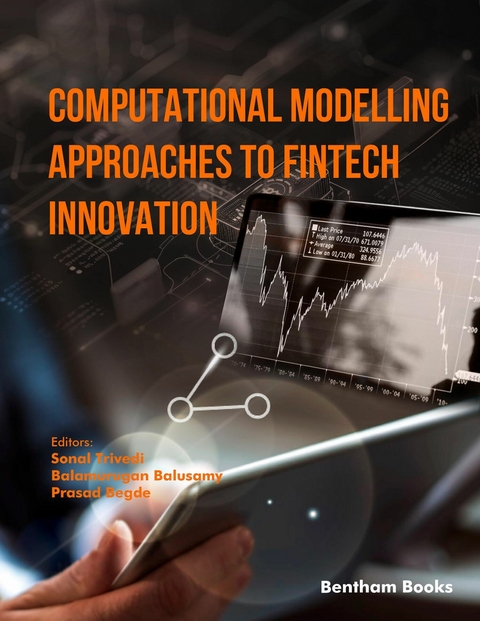
Computational Modelling Approaches to FinTech Innovation (eBook)
370 Seiten
Bentham Science Publishers (Verlag)
979-8-89881-081-8 (ISBN)
Computational Modelling Approaches to FinTech Innovation bridges the gap between technological advancement and financial systems by investigating the synergy between human intelligence and machine-driven models to drive innovation, resilience, and sustainability in finance. The book opens by grounding readers in the principles of Industry 5.0 and its implications for human-machine collaboration and green innovation. It then transitions into the evolution of management practices and enterprise digitalization, highlighting the journey from Industry 1.0 through to the current digital transformation. Later chapters explore the disruptive effects of Industry 5.0 on supply chains, production, and marketing strategies, before addressing the shifts in human resource management and the convergence of finance and technology. The final section offers insight into emerging technologies, including AI, IoT, Big Data, and Machine Learning, mapping their trajectory within modern industry frameworks. Key Features: Examine computational models driving FinTech transformation Explore Industry 5.0's role in sustainable innovation and human-machine integration Analyze digital enterprise evolution and its management implications Investigate the effects of advanced technologies on supply chains and marketing Assess the fusion of finance and technology within organizational structures Uncover future trends through real-world applications of AI, IoT, and Big Data.
Expanding the Horizon of Green Finance: A Computational Modelling Approach to FinTech and Sustainable Development
Aashna Sharma1, *, Tejasvini Alok Paralkar1, Amir Hafizullah Khan2
Abstract
While green finance and FinTech are essential in incentivizing sustainable development, their interrelations with trade, industrialization, capital formation, and environmental regulations have been relatively unexplored. This chapter explores these relationships to establish their overall effect on sustainable finance— particularly how FinTech works in resource management optimization through human capital. The study embeds different economic and regulatory factors in analyzing green finances and FinTech. For example, trade policy affects the flows of sustainable investment, industrialization patterns, the demand for green technologies, capital formation processes, funding availability for sustainable projects, and environmental rules, setting guideposts on green finance. That broad approach will allow for a nuanced understanding of how different elements influence sustainable financing. The present study focuses on the role of FinTech within the context of resource management. Innovations like blockchain, artificial intelligence, and big data analytics assure efficiency, transparency, and inclusiveness within the financial sector. The chapter presents the entire discussion on how the concerns interlink with FinTech and green finance projects. This study draws from various literature that has developed cumulative effects on the debates to fill research gaps toward sustainability outcomes. In particular, these findings pertain to emerging economies from long-term growth. The chapter thus provides insights and recommendations for policymakers, financial institutions, and stakeholders concerning the opportunities and challenges of using FinTech for sustainable development. The present research enhances existing knowledge on sustainable finance.
* Corresponding author Aashna Sharma: Symbiosis Centre for Management Studies, Symbiosis International Deemed University, Nagpur Campus, India; E-mail: aashna27sharma@gmail.com
INTRODUCTION
The relationship among FinTech, green finance, and environmental sustainability has been one of the fast-emerging topics in recent research and practice. While individual effects of FinTech and green finance on the environment have been well understood, further research is needed to elucidate how these fields interact with other variables relevant to influence trade, industrialization, capital formation, and environmental regulations. This chapter fills this gap by discussing how these additional variables could be fitted into FinTech and green finance research.
FinTech has made inroads into the heart of traditional financial systems and steered transparency and efficiencies that can significantly aid sustainable finance. Chen et al. [1] and Manta et al. [2] have investigated FinTech solutions, including blockchain-based technology, big data analytics, and artificial intelligence, that might help develop accountability, streamline financial flows, and better manage resources. The larger-scale effects of these developments remain rather unclear. This chapter aims to provide a comprehensive assessment of the complex consequences of sustainable finance in the presence of factors like trade, industrialization, the process of capital formation, and environmental restrictions. Thus, after synthesizing the extant literature, this versatile view would help explain how these elements interact to affect the efficacy and impact of green financing efforts. Our study is premised on the fact that sustainable development requires a holistic approach since, by nature, it is complex [3, 4]. Additional dimensions in FinTech and green finance research are required to find effective strategies that will drive progress [5]. This study will particularly seek to find these relations and synergies between these elements with insights that would lead to future research, formulation of public policy, and practical implications.
Therefore, this chapter addresses knowledge gaps and provides insightful views on how FinTech can drive sustainable development in varied economic contexts. Its further objective is to push the debate on sustainable development and to build financial systems that are more shock-resistant and more inclusive by drawing prominence to the relationships among green finance, FinTech, and other key variables [6, 7].
THEORETICAL UNDERPINNINGS FOR GREEN FINANCE AND SUSTAINABLE DEVELOPMENT
According to the literature review, several theoretical frameworks support the convergence of green finance and FinTech in explaining their respective roles and possible consequences for sustainable development. This chapter will assess three theoretical perspectives: institutional theory, financial innovation theory, and sustainable development theory.
Sustainable Development Theory
Sustainable development theory is a clear expression of the fact that there should be no trade-offs between social and environmental welfare for the benefit of economic growth. Instead, they emphasize the interconnectedness amongst economic, social, and ecological dimensions for long-term success. The World Commission on Environment and Development (WCED) [8] defined sustainable development as “development that meets the needs of the present without compromising the ability of future generations to meet their own needs”.
The prime objective of green finance as a sustainable development tool is to channel finances towards environmentally friendly projects and green innovations that help slow down global warming and maintain ecological balance. Green finance refers to the “provision of financial services supporting the flow of financial resources towards environmentally friendly projects like sustainable agriculture, energy efficiency, and renewable energy” [9].
Sustainable development theory justifies and underlines the intrinsic role of finance in the transition toward low-carbon economic development by emphasizing the integration of sustainability concepts into financial decision-making processes. Green finance, therefore, strives to bridge this gap to achieve climate objectives and sustainable development goals. The UN estimated that it would take $2.5 trillion annually from developing countries to achieve the SDGs by 2030, thus indicating a financial gap of trillions of dollars. Therefore, green finance has become very important for mobilizing investments in sustainable development in technology, underlying infrastructure, and innovation.
The theory of sustainable development emphasizes triple-bottom-line accounting, where the impact of a financial decision on society, the environment, and the whole economy is considered. A holistic approach ensures that financial operations have positive implications for each of the three dimensions of sustainability. In view of social and environmental concerns, long-term sustainability and resilience can only be attained by integrating them into the financial decision-making process.
Financial Innovation Theory
Financial innovation theory dwells on the study of how new financial instruments, technology, and institutions emerge, as well as their consequences and implications for the market. According to Tufano [10], financial innovations result from technological improvements, regulatory environment changes, and economic shocks. These can take the form of many innovations, including new services or products, organizational forms, and procedures.
Among financial innovations, FinTech is the most prominent, as it is likely to revolutionize traditional financial services with the help of blockchain, big data analytics, artificial intelligence, and other technologies. Firstly, these technological developments can enhance the efficiency, transparency, and effectiveness of financial systems, thereby boosting their capacity to support green finance projects [11]. For instance, blockchain technology could be implemented for accountability and transparency in checking the usage of funds on green projects. This understanding is fundamental in the case of green bonds, where investors must be assured that the funds they invest are being used for the intended environment-friendly purposes. Big data analytics helps collate and analyze enormous-scale environmental data, enabling risk management...
| Erscheint lt. Verlag | 22.10.2025 |
|---|---|
| Sprache | englisch |
| Themenwelt | Wirtschaft ► Betriebswirtschaft / Management ► Finanzierung |
| ISBN-13 | 979-8-89881-081-8 / 9798898810818 |
| Informationen gemäß Produktsicherheitsverordnung (GPSR) | |
| Haben Sie eine Frage zum Produkt? |
 EPUB (Ohne DRM)
Digital Rights Management: ohne DRM
Dieses eBook enthält kein DRM oder Kopierschutz. Eine Weitergabe an Dritte ist jedoch rechtlich nicht zulässig, weil Sie beim Kauf nur die Rechte an der persönlichen Nutzung erwerben.
Dateiformat: EPUB (Electronic Publication)
EPUB ist ein offener Standard für eBooks und eignet sich besonders zur Darstellung von Belletristik und Sachbüchern. Der Fließtext wird dynamisch an die Display- und Schriftgröße angepasst. Auch für mobile Lesegeräte ist EPUB daher gut geeignet.
Systemvoraussetzungen:
PC/Mac: Mit einem PC oder Mac können Sie dieses eBook lesen. Sie benötigen dafür die kostenlose Software Adobe Digital Editions.
eReader: Dieses eBook kann mit (fast) allen eBook-Readern gelesen werden. Mit dem amazon-Kindle ist es aber nicht kompatibel.
Smartphone/Tablet: Egal ob Apple oder Android, dieses eBook können Sie lesen. Sie benötigen dafür eine kostenlose App.
Geräteliste und zusätzliche Hinweise
Buying eBooks from abroad
For tax law reasons we can sell eBooks just within Germany and Switzerland. Regrettably we cannot fulfill eBook-orders from other countries.
aus dem Bereich