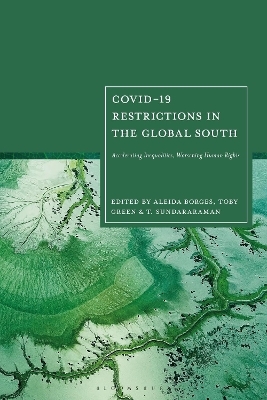
Covid-19 Restrictions in the Global South
Bloomsbury Academic (Verlag)
978-1-350-54236-5 (ISBN)
- Noch nicht erschienen (ca. August 2026)
- Versandkostenfrei
- Auch auf Rechnung
- Artikel merken
This groundbreaking, interdisciplinary collection is one of the first scholarly books in the world to address the impacts of Covid-19 restrictions on the Global South.
Bringing together health and social scientists from around the world--including many leading figures from Global-South countries such as Angola, Bolivia, Colombia, India, Kenya, and Nigeria--the book shows how, in low- and middle-income countries in particular, Covid responses often exacerbate problems and inequalities around education, gender, socioeconomics, and politics and political economics. They negatively and disproportionately affect routine medical treatments; vaccination programmes; access to maternity and neo-natal care; child learning and socialization; women's caring responsibilities; gender-based socioeconomic differences; and rates of domestic violence, all while accelerating existing trends towards political authoritarianism and damaging democratic processes.
In offering in-depth perspectives on all these problems, this book ultimately challenges practitioners to include Southern perspectives in future emergency response-planning, and it develops both global and multidisciplinary paradigms to guide them in their efforts.
Aleida Mendes Borges leads the Grassroots Women Leaders research stream at the Global Institute for Women’s Leadership (GIWL), Kings College London, UK. She is co-editor of Pandemic Response and the Cost of Lockdowns: Global Debates from Humanities and Social Sciences (2022), and she has authored several other reports and peer-reviewed publications in English and Portuguese. Toby Green is Professor of African history at King’s College London, UK. His book A Fistful of Shells: West Africa from the Rise of the Slave Trade to the Age of Revolution (2019) was awarded several international literary prizes and was shortlisted for both the the LA Times Book Prize and the Wolfson History Prize. He is also a co-author (with Thomas Fazi) of The Covid Consensus: The Global Assault on Democracy and the Poor – A Critique from the Left (2023). Thiagarajan Sundararaman is Professor and Dean of the School of Health Systems Studies at the Tata Institute of Social Sciences, India, as well as adjunct faculty at the School of Public Health in Jawaharlal Institute of Postgraduate Medical Education & Research, India. He is also a former director, and current member of the global steering council, of the Peoples Health Movement. He has over two decades of practitioner experience and has helped design and implement multiple state- and national-level health systems initiatives, including India’s National Rural Health Mission.
Part I. The Impacts of Covid Restrictions on Healthcare
1. Lockdowns as a Crisis of Both Public Health and Science Policy: Learnings from a Case Study
Sundaraman Thiagarajan (People’s Health Movement and Tata Institute of Social Sciences, India)
2. Unrestricted Analysis of the COVID Narrative in Africa: Emphasis on the Ghanaian Medical Context
Samuel Adu-Gyamfi (Kwame Nkrumah University of Science and Technology, Ghana)
3. The Impact of COVID-19 Lockdown on the Delivery of Healthcare Programmes in Nigeria
Wellington Oyibo (Centre for Transdisciplinary Research in Malaria and Neglected Tropical Diseases, Nigeria, and University of Lagos, Nigeria)
Part II. Economic Impacts and the Impacts on the Informal Market
4.: Exploring the Impact of the Pandemic on Low-Income Migrant Workers: Ethnographic Reflections from the Neighborhood of Kapashera, National Capital Region of Delhi, India
Deepanshu Mohan, Hima Trisha, and Shubhangi Derhgawen (O.P. Jindal Global University, India)
5. The Impacts of Covid Restrictions in Bolivia and the Importance of a Subnational Analysis
Alejandra Gonzales Rocabado (Conservation Strategy Fund, Bolivia)
6. Navigating Challenges: Analysing Long-Term Socioeconomic Impacts of Covid-19 Protocols in the Context of Argentina’s Polycrisis
Almendra Cresachi (National University of San Martín, Argentina)
Part III. Covid Restrictions and Aggravated Inequalities of Race and Gender
7. Afro-descendant Populations and the Covid-19 Crisis in Cartagena de Indias: Analyzing the Necro-politic Practices from an Intersectional Perspective
Airlín Pérez Carrascal (Political and human rights activist, Columbia)
8. Collateral Effects Of Covid-19 Lockdown On Vulnerable Populations In The Global South: An Overview From Humanitarian Professionals’ Perspective
Llanos Ortíz Montero (Kings College London, UK)
9. Lockdowns and Girls’ Schooling: Old Story, New Twist
Reva Yunus (University of York, UK)
Part IV. Education and the Public Sphere
10. Educational Leadership and Policy in Angolan Education during the COVID-19 pandemic: Challenges and Prospects
Nicolau Nkiawete Manuel (Agostinho Neto University, Angola)
11.Reshaping the Medical and Political Discourses on School Closures during the Pandemic: The Turkish Case
Tomris Cesuroglu (VU University, Netherlands); Aysuda Kölmelen (Bard College, Germany); and Gül Pamucku Gunaydin (Ankara Yildirim Beyazit University, Turkey)
12.Covid-19 as a ‘Politico-health’ crisis: Reflections on Africa’s Economies of (Information) Control
George Ogola (University of Nottingham, UK)
13. Missing in Action: Academia, Neoliberalism, and the Loss of Internationalist Critique during the Covid-19 Pandemic
Aleida Borges and Toby Green (Kings College London, UK)
| Erscheint lt. Verlag | 6.8.2026 |
|---|---|
| Verlagsort | London |
| Sprache | englisch |
| Maße | 156 x 234 mm |
| Themenwelt | Studium ► Querschnittsbereiche ► Prävention / Gesundheitsförderung |
| Sozialwissenschaften ► Pädagogik | |
| Wirtschaft ► Volkswirtschaftslehre ► Wirtschaftspolitik | |
| ISBN-10 | 1-350-54236-9 / 1350542369 |
| ISBN-13 | 978-1-350-54236-5 / 9781350542365 |
| Zustand | Neuware |
| Informationen gemäß Produktsicherheitsverordnung (GPSR) | |
| Haben Sie eine Frage zum Produkt? |
aus dem Bereich