


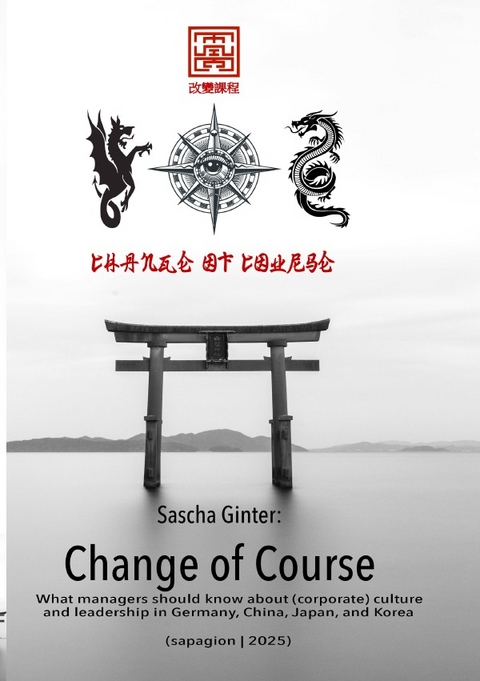
Change of Course
What managers should know about (corporate) culture and leadership in Germany, China, Japan, and Korea
Seiten
2025
epubli (Verlag)
978-3-565-09504-9 (ISBN)
epubli (Verlag)
978-3-565-09504-9 (ISBN)
This book aims to help readers develop a deeper understanding of the ideas and movements that have shaped the cultures of the Asian economic powers-China, Japan, and Korea in comparison to Germany.
The current U.S. economic and trade policy involves significant risks for the global economy by intensifying trade conflicts, increasing uncertainties, and complicating international cooperation. For Germany and the EU, it poses considerable challenges but also offers opportunities to respond with market diversification and by strengthening their own economic resilience. Promising partners for this endeavor can be found primarily in Asia. The influence of Confucianism, Daoism, and Buddhism in Asian countries has led to corporate and leadership cultures that differ markedly in many respects from our own 'Western' culture.In the book 'Change of Course', the author outlines his perspective on the most important differences in corporate and leadership cultures between Asian businesses from China, Japan, and Korea and the German business world. A summary of Sun Tzu's 'The Art of War,' broken down by chapters and supplemented with a condensed adaptation for management, further illuminates the philosophical and sociocultural underpinnings of Asian corporate leadership. In the author's view, five main dimensions feature divergences where Western and Asian perspectives differ most fundamentally: society, winning, perfection, nature, and guilt. To carry out successful projects together with companies from the Asian region, Western-oriented managers should be familiar with these concepts and observe whether and how their Asian colleagues evaluate certain situations differently, influenced by their own cultural background and values. Both value systems inherently bring advantages and strengths as well as weaknesses and risks. Successful projects emerge whenever people from different cultural backgrounds learn from one another and find the optimal middle ground through understanding and mutual respect.
The current U.S. economic and trade policy involves significant risks for the global economy by intensifying trade conflicts, increasing uncertainties, and complicating international cooperation. For Germany and the EU, it poses considerable challenges but also offers opportunities to respond with market diversification and by strengthening their own economic resilience. Promising partners for this endeavor can be found primarily in Asia. The influence of Confucianism, Daoism, and Buddhism in Asian countries has led to corporate and leadership cultures that differ markedly in many respects from our own 'Western' culture.In the book 'Change of Course', the author outlines his perspective on the most important differences in corporate and leadership cultures between Asian businesses from China, Japan, and Korea and the German business world. A summary of Sun Tzu's 'The Art of War,' broken down by chapters and supplemented with a condensed adaptation for management, further illuminates the philosophical and sociocultural underpinnings of Asian corporate leadership. In the author's view, five main dimensions feature divergences where Western and Asian perspectives differ most fundamentally: society, winning, perfection, nature, and guilt. To carry out successful projects together with companies from the Asian region, Western-oriented managers should be familiar with these concepts and observe whether and how their Asian colleagues evaluate certain situations differently, influenced by their own cultural background and values. Both value systems inherently bring advantages and strengths as well as weaknesses and risks. Successful projects emerge whenever people from different cultural backgrounds learn from one another and find the optimal middle ground through understanding and mutual respect.
Jahrgang 1966, geboren in Koblenz (Rheinland-Pfalz). Aufgewachsen in Deutschland und von 1972 bis 1978 in Arequipa (Peru). Abitur 1985 in Traben-Trarbach, danach Studium an der Universität Konstanz. Abschluss als Diplom Verwaltungswissenschaftler 1995. Nach dem Studium Arbeit als Unternehmensberater, Trainer und Coach (selbständig und angestellt) in mehr als 35 Ländern auf 5 Kontinenten für verschiedene Unternehmen und Branchen. Während dieser Zeit temporär wohnhaft in den USA, Thailand, Italien und Österreich. Heute angestellt bei der SEIPLAN GmbH als Chief Project Officer. Seit 2016 verheiratet mir Janine Ginter, in der Familie leben insgesamt sechs Kinder.
| Erscheinungsdatum | 20.11.2025 |
|---|---|
| Illustrationen | Sascha Ginter |
| Sprache | englisch |
| Maße | 148 x 210 mm |
| Gewicht | 277 g |
| Themenwelt | Sachbuch/Ratgeber ► Beruf / Finanzen / Recht / Wirtschaft |
| Wirtschaft ► Betriebswirtschaft / Management | |
| Schlagworte | China • Corporate Culture • Germany • Japan • Korea • Leadership • Management |
| ISBN-10 | 3-565-09504-0 / 3565095040 |
| ISBN-13 | 978-3-565-09504-9 / 9783565095049 |
| Zustand | Neuware |
| Informationen gemäß Produktsicherheitsverordnung (GPSR) | |
| Haben Sie eine Frage zum Produkt? |
Mehr entdecken
aus dem Bereich



aus dem Bereich
Ratgeber für Angehörige und Betroffene
Buch | Softcover (2024)
C.H.Beck (Verlag)
CHF 16,65
Praxistipps für die Steigerung Ihrer Produktivität
Buch | Softcover (2024)
C.H.Beck (Verlag)
CHF 16,65
alle Funktionen verständlich erklärt
Buch | Softcover (2025)
Stiftung Warentest (Verlag)
CHF 27,85


