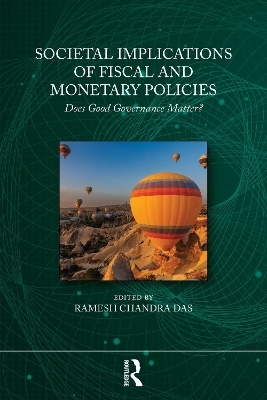
Societal Implications of Fiscal and Monetary Policies
Routledge (Verlag)
978-1-041-02605-1 (ISBN)
- Noch nicht erschienen (ca. April 2026)
- Versandkostenfrei
- Auch auf Rechnung
- Artikel merken
Public spending is an important policy tool of the fiscal policy. This book empirically examines whether government expenditure - both capital and revenue - and governance indicators maintain any dynamic relationships with social sector developments.
The book addresses critical themes in contemporary macroeconomics, including the ongoing debate between monetarist and Keynesian schools regarding inflation drivers, the role of government expenditure and money supply in promoting economic growth, social sustainability, and the emerging importance of environmental sustainability in policy formulation. It explores how good governance practices, particularly corruption control, influence the effectiveness of fiscal and monetary policies, while examining the delicate balance between economic expansion and environmental conservation through green financing and sustainable development initiatives.
The book will be useful to students and researchers of economics, political science, sociology, administrative sciences, international relations, and the policy makers in the fiscal and monetary sectors of a country.
Ramesh Chandra Das, PhD, is currently Professor at the Department of Economics of Vidyasagar University in the state of West Bengal, India, with more than twenty five years of teaching and research experience. His main areas of research lie in Theoretical and Applied Macroeconomics, Financial Economics, Environmental Economics and Political Economics. He has contributed several research papers to national and international journals of repute along with more than a dozen edited volumes in the related areas of the subject. Besides, he has written textbooks on Microeconomics, Macroeconomics and Managerial Economics with the internationally reputed publishers for the different fields of readers and academicians and has been acting as the editor-in-chief in a couple of refereed journals.
Lists of figures. List of tables. List of contributors. Foreword. Preface. List of abbreviations. Introduction Section I: Policy Implications to Education, Health and Overall Development 1. An Empirical Analysis of Fiscal Policy, Governance, and Educational Outcomes in Low and Middle-Income Countries 2. Nexus between Governance, Corruption and Human Development: Evidence from Low-income Countries 3. The Role of Government Expenditure, Economic Growth and Investment in Explaining Human Development Index: A Panel Data Analysis 4. Nexus between Economic Development and Quality of Governance: A cross-country study with reference to post-globalization time 5. Examining the Idea of Good Governance and Human Rights in South Asian Context 6. Corruption and Development in Bangladesh: An Analysis 7. Role of Digitalization in the Effectiveness of Monetary Policy: Evidence from Developing Economies 8. Fiscal Priorities in SAARC and ASEAN Countries: Exploring the Trade-offs between Defence and Development 9. Monetary Policy Tools and Their Effectiveness in Renewable Energy Project Development 10. The Relations between Monetary Policy and Economic Growth: A Study on Political Economy of Japan 11. Does public spending upon science and technology affect state income and environmental pollution? A state level analysis in India Section II: Policy Implications to Socio-economic Sustainability 12. The Nexus Between Social Expenditures and Human Development in OECD Countries: Fiscal Strategies for Sustainable Social Policies 13. Do Public Sector Corruption and Other Macroeconomic Indicators Increase Regional Imbalances in Economic Growth in Asian Countries? An Inquiry 14. Gender-Sensitive Budgeting and Social Sector Development: Insights from Türkiye’s Budget Justifications 15. Factors Influencing Good Governance and Intention to Adopt Digital Governance Services: An Empirical Study on the e-Government Participation among Users in West Bengal 16. Good Governance as a Key for the Social Sustainability in the Industry 5.0 Era 17. Good Governance and Social Sector Developments in India (2014-2024): Challenges and Future Directions 18. Terrorism, regulatory quality and economic complexity in selected African countries 19. Good Governance and Digital Financial Inclusion: Evidences from West Bengal, India 20. Nexus between Gender Inclusion and Climate Finance: Bridging Gaps for Sustainable Development 21. Governance of Organizational Sustainability Management. Index
| Erscheint lt. Verlag | 14.4.2026 |
|---|---|
| Zusatzinfo | 57 Tables, black and white; 9 Line drawings, black and white; 2 Halftones, black and white; 11 Illustrations, black and white |
| Verlagsort | London |
| Sprache | englisch |
| Maße | 156 x 234 mm |
| Themenwelt | Sozialwissenschaften ► Politik / Verwaltung |
| Sozialwissenschaften ► Soziologie ► Spezielle Soziologien | |
| Wirtschaft ► Volkswirtschaftslehre ► Finanzwissenschaft | |
| ISBN-10 | 1-041-02605-6 / 1041026056 |
| ISBN-13 | 978-1-041-02605-1 / 9781041026051 |
| Zustand | Neuware |
| Informationen gemäß Produktsicherheitsverordnung (GPSR) | |
| Haben Sie eine Frage zum Produkt? |
aus dem Bereich