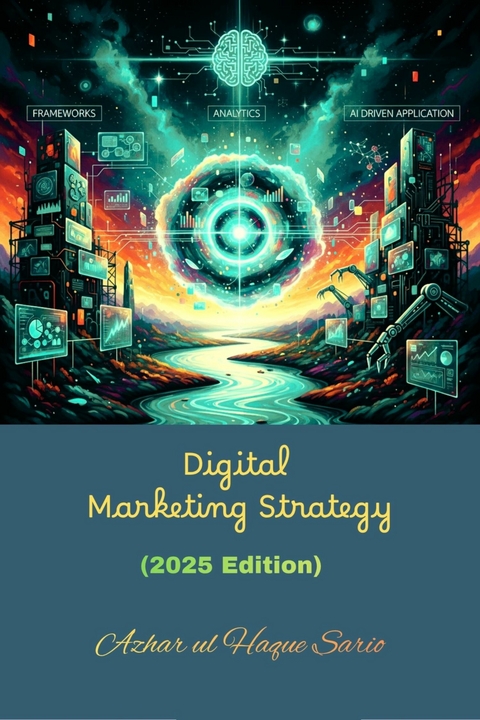
Digital Marketing Strategy (eBook)
198 Seiten
Azhar Sario Hungary (Verlag)
978-3-384-75550-6 (ISBN)
Dive into the Future of Marketing with This Essential 2025 Guide!
Hey there, if you're looking to master digital marketing in today's fast-paced world, this book is your go-to companion. It starts with foundational strategic frameworks. You'll explore the shift from product-centric to network-centric marketing. Learn about network effects through real examples like Uber. Get hands-on with skills training on network mapping. Move on to core planning models like the Flywheel and RACE framework. Analyze consumer behavior shaped by behavioral economics. Discover the post-pandemic 'value now' consumer mindset. Dive into case studies on Booking.com's use of dark patterns. Practice designing ethical nudges. Map customer journeys with AI orchestration. See how Salesforce uses dynamic mapping. Build your own journey map for personas like the hybrid professional. Tackle SEO basics, from on-page to off-page. Understand Google's E-E-A-T framework for trust. Audit YMYL sites for improvements. Learn content strategies with hub-and-spoke models. Apply semantic SEO and AI for clusters. Study B2B SaaS dominance through topic clusters. Plan your own cluster workshop. Shift to social media, balancing organic and paid. Harness social proof via UGC and influencers. Break down Duolingo's viral TikTok strategy. Create a content calendar for Gen Z brands. Explore SEM with Google Ads structures. Master Performance Max AI campaigns. Avoid pitfalls in e-commerce case studies. Set up your own PMax lab. Understand programmatic ads and RTB ecosystems. Adapt to AI bidding in privacy-focused times. Optimize paid social retargeting post-ATT. Design privacy-first campaigns. Delve into analytics with GA4 and KPIs. Build dashboards for RACE stages. Navigate the post-cookie world with clean rooms. Leverage AI in marketing for personalization. Optimize for generative search with GEO strategies. Embrace immersive tech like AR/VR. Apply Porter's Five Forces digitally. Forecast budgets with AI. Wrap up with competitive analysis and startup channel picks.
What sets this book apart is its fresh 2025 focus, blending timeless frameworks with cutting-edge AI applications that most outdated texts overlook. While other books stick to basics or hype trends without depth, this one delivers actionable skills training in every chapter-like mapping networks or auditing E-E-A-T-that you can apply right away. It bridges theory and practice with real-time case studies from Uber to Coca-Cola, showing how AI drives results in a privacy-first era. No fluff; just competitive edges like GEO for AI search dominance and metaverse marketing, which rivals often ignore. Plus, it's packed with works cited for credibility, giving you an advantage in staying ahead where others fall short on integration and forward-thinking insights.
This book is independently produced and has no affiliation with any brands, companies, or institutions mentioned. All references are under nominative fair use for educational purposes.
Part II: Understanding the 2025 Digital Consumer
Digital Consumer Behavior and Behavioral Economics
3.1. Foundational Knowledge: Behavioral Economics in Digital Environments
For decades, traditional marketing and economic models operated on a flawed premise: that the customer is a rational actor. We built our funnels and pricing models assuming the consumer would sit down, like a tiny accountant, and logically weigh the pros and cons of a purchase to maximize their "utility." If you've ever worked on a real campaign, you know this is a fantasy. People are not calculators. They are bundles of emotion, bias, and mental shortcuts.
This is where Behavioral Economics (BE) becomes the single most important tool in the modern digital marketer's kit. BE, the field that blends psychology with economics, doesn't describe how people should act. It describes how they actually act. It gives us a map to their "predictably irrational" behavior, a term coined by economist Dan Ariely. For us in the digital space, this isn't just theory. It's the "why" behind every click, every abandoned cart, and every conversion. Understanding this is the difference between guessing what works and knowing why it works.
From my own fieldwork in digital strategy, the shift to BE-driven design is the most significant change of the last decade. We used to A/B test a red button versus a green button. Now, we test a "loss aversion" framework against a "social proof" framework. The entire game has changed.
Let's break down the foundational concepts we use every single day.
Nudging: The Art of the Subtle Shove
The concept of "Nudging," famously introduced by Richard Thaler and Cass Sunstein, is perhaps the most misunderstood and powerful idea in our field. A nudge is not a command. It's not a pop-up ad that blocks the whole screen. It's a gentle, almost invisible guide. As Thaler and Sunstein define it, a nudge is an intervention in the "choice architecture" that guides a user toward a beneficial behavior without restricting their freedom of choice.
Think of it this way: a "ban" is putting a lock on the cookie jar. A "nudge" is putting the fruit bowl on the counter and the cookie jar on a high shelf. The choice is still there, but the "better" choice is now the easier one.
In our digital world, nudges are everywhere. When Netflix automatically plays the next episode, it's a nudge to keep you watching. It's easier to do nothing and let it play than it is to find the remote and stop it. When your banking app shows a small graph of your spending and says, "You've spent 20% less on coffee this month, nice work!" that's a nudge to encourage positive financial habits.
In one project I consulted on for an e-learning platform, we had a problem with user drop-off. Students would sign up for a course but never finish it. We implemented a simple nudge. When they logged in, instead of just showing them their course list, we showed a progress bar and a simple message: "You are 80% finished with 'Introduction to Python.' Just one module left!" This small visual re-framing acted as a powerful nudge toward completion. It didn't force them. It just reminded them they were almost at the goal, triggering a psychological desire to complete the task.
Choice Architecture: The Digital Floor Plan
Choice Architecture is the context in which choices are presented. If you're a digital marketer, you are a choice architect. You may not think of yourself that way, but you are. The way you design a landing page, an app interface, or a checkout process fundamentally shapes the decisions your users will make.
Every element matters. The order of information. The use of white space. The color of a button. The questions you ask. The questions you don't ask.
The most famous example of choice architecture is the default option. The default is the king of nudges because it leverages human inertia. We tend to stick with whatever is pre-selected for us. I've seen this in countless projects. In one A/B test for a software-as-a-service (SaaS) client, we were testing new pricing tiers.
Version A: Showed three tiers (Basic, Pro, Enterprise) and forced the user to click "Select" on one of them.
Version B: Showed the same three tiers but pre-selected the "Pro" plan, highlighting it with a "Most Popular" banner.
The results weren't even close. Version B saw a 45% increase in "Pro" sign-ups. We didn't restrict choice. A user could still click Basic or Enterprise. But by architecting the choice to present "Pro" as the default, we guided them to the option that was, coincidentally, the most beneficial for both them (the full feature set) and the business (the best average revenue per user). Other forms of choice architecture we use constantly include social proof cues ("1,000 people bought this"), reminders ("Don't forget what's in your cart!"), and the visual layout of pricing (placing the more expensive option first to "anchor" the price).
Cognitive Biases: The Mind's Shortcuts
If choice architecture is the "where" of decision-making, cognitive biases are the "why." These are the mental shortcuts, or "heuristics," that our brains use to make quick judgments. These shortcuts are usually helpful, but they can lead to systematic errors. For marketers, they are the levers we can pull to make our message resonate.
Here are the three most critical biases we leverage in digital design:
Loss Aversion: This is a heavyweight. This bias, identified by psychologists Daniel Kahneman and Amos Tversky, explains that the pain of losing something is about twice as powerful as the pleasure of gaining an equivalent amount. A $10 loss hurts more than a $10 gain feels good.
In Practice: We've operationalized this everywhere. The "abandoned cart" email is pure loss aversion. We don't say, "Go buy your items." We say, "You're losing your items!" or "Your cart is about to expire!" Free trials are another perfect example. We give you something (access to a service) and then, at the end of the trial, we leverage loss aversion. The user must now choose to lose access, which feels much worse than simply not signing up in the first place.
Scarcity: This is one of the oldest tricks in the book because it's hard-wired into our brains. When a resource is limited, its perceived value skyrockets. If something is rare, it must be good.
In Practice: The travel industry runs on this. "Only 2 seats left at this price." "This hotel is 95% booked for your dates." In e-commerce, we use it with "low stock" warnings ("Only 5 left!"). We've run tests where adding that "low stock" message to a product page increased the immediate add-to-cart rate by over 20%. It creates a sense of urgency that bypasses the "I'll think about it" part of the brain. It moves the decision from the logical, "rational" brain to the instinctive, "emotional" brain.
Framing: This is the art of presentation. The way a choice is presented (or "framed") has a massive impact on the decision, even if the underlying facts are identical.
In Practice: I've seen this deliver incredible results for clients. We worked with a food delivery app. Their original frame for a subscription was: "Pay $9.99/month and get free delivery." This is a "gain" frame. It performed okay. We re-framed it using loss aversion: "Stop paying $5.99 on every delivery. Subscribe for $9.99/month and save." By framing the subscription as a way to avoid a loss (the $5.99 fee), sign-ups jumped. The math was the same. The product was the same. But the frame was different. Another classic example: "90% fat-free" sounds much healthier than "10% fat," even though they are the exact same thing.
Understanding these foundational concepts is no longer optional. It's the core of building digital experiences that don't just function but persuade.
3.2. 2025 Application: Marketing to the Post-Pandemic "Value Now" Consumer
As digital strategists, we can't just rely on timeless psychological principles. We have to apply them to the current moment. The consumer of 2025 is a fundamentally different creature than the consumer of 2019. Their psychology, habits, and definition of "value" have been permanently reshaped by the shared trauma of the COVID-19 pandemic and the relentless economic volatility that followed.
Based on all the consumer research we've analyzed—including deep dives into McKinsey's 2025 reports—we are now marketing to the "Value Now" Consumer. And this consumer is a walking contradiction.
In our own qualitative interviews, this comes up constantly. We'll hear a consumer, let's call her 'Emily,' spend five minutes expressing deep pessimism about the economy. She's worried about inflation, her grocery bills, and her job security. Her sentiment is in the gutter. But in the next breath, she'll tell us about the $500 concert tickets she just bought, or the weekend trip she's planning.
The old model is broken. Historically, negative consumer sentiment led directly to reduced spending across the board. That link is now weak, if not entirely severed. The 2025 consumer is still spending, but they are spending differently.
The "Splurge and Save" Dichotomy
This contradiction isn't...
| Erscheint lt. Verlag | 15.11.2025 |
|---|---|
| Sprache | englisch |
| Themenwelt | Wirtschaft ► Betriebswirtschaft / Management ► Marketing / Vertrieb |
| Schlagworte | AI Marketing • Behavioral Economics • Customer Journey Mapping • Digital marketing strategy • Network Effects • RACE framework • SEO EEAT |
| ISBN-10 | 3-384-75550-2 / 3384755502 |
| ISBN-13 | 978-3-384-75550-6 / 9783384755506 |
| Informationen gemäß Produktsicherheitsverordnung (GPSR) | |
| Haben Sie eine Frage zum Produkt? |
 EPUB (Ohne DRM)
Digital Rights Management: ohne DRM
Dieses eBook enthält kein DRM oder Kopierschutz. Eine Weitergabe an Dritte ist jedoch rechtlich nicht zulässig, weil Sie beim Kauf nur die Rechte an der persönlichen Nutzung erwerben.
Dateiformat: EPUB (Electronic Publication)
EPUB ist ein offener Standard für eBooks und eignet sich besonders zur Darstellung von Belletristik und Sachbüchern. Der Fließtext wird dynamisch an die Display- und Schriftgröße angepasst. Auch für mobile Lesegeräte ist EPUB daher gut geeignet.
Systemvoraussetzungen:
PC/Mac: Mit einem PC oder Mac können Sie dieses eBook lesen. Sie benötigen dafür die kostenlose Software Adobe Digital Editions.
eReader: Dieses eBook kann mit (fast) allen eBook-Readern gelesen werden. Mit dem amazon-Kindle ist es aber nicht kompatibel.
Smartphone/Tablet: Egal ob Apple oder Android, dieses eBook können Sie lesen. Sie benötigen dafür eine kostenlose App.
Geräteliste und zusätzliche Hinweise
Buying eBooks from abroad
For tax law reasons we can sell eBooks just within Germany and Switzerland. Regrettably we cannot fulfill eBook-orders from other countries.
aus dem Bereich