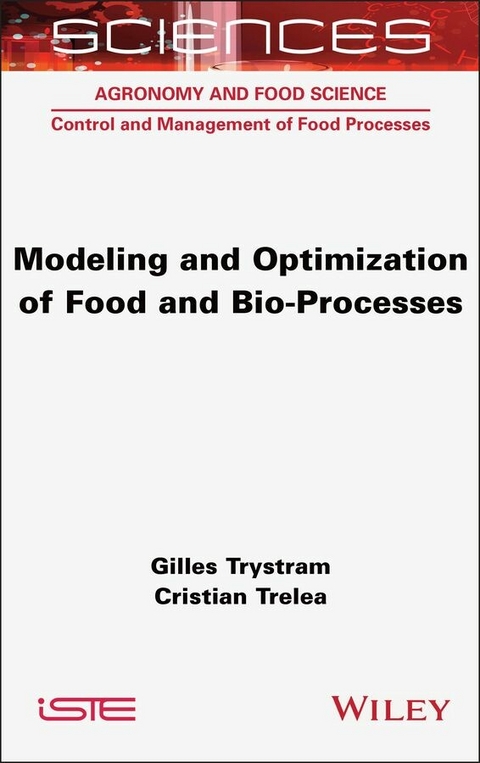
Modeling and Optimization of Food and Bio-Processes (eBook)
419 Seiten
Wiley-Iste (Verlag)
978-1-394-42360-6 (ISBN)
Models have become an indispensable tool for scientists and engineers alike. For the scientist, a model makes it possible to quantitatively test hypotheses, understand phenomena, and, if necessary, revise them until a satisfactory agreement with experiments is reached. For the engineer, a technical object is nowadays designed, tested and optimized in simulation long before its physical birth. In all cases, modeling is an important gas pedal of research and engineering, and a tool for competitiveness in the modern world.
Modeling and Optimization of Food and Bio-Processes is aimed at anyone with a grounding in process, chemical or microbiological engineering, as well as students of these disciplines. Drawing on the authors' extensive teaching and research experience, this book is designed to teach engineers and scientists the main concepts and the right reflexes to adopt when embarking on the noble art of modeling.
Gilles Trystram is Professor Emeritus at AgroParisTech and Managing Director of Genopole, France. His research areas include food and biotechnology processes, through their opimization, modeling and associated optimal control.
Cristian Trelea is Professor at AgroParisTech, Université Paris-Saclay, France. His research areas include the dynamic modeling of physical, chemical and biological systems, for understanding phenomena, changing of scale and optimization and process control.
Models have become an indispensable tool for scientists and engineers alike. For the scientist, a model makes it possible to quantitatively test hypotheses, understand phenomena, and, if necessary, revise them until a satisfactory agreement with experiments is reached. For the engineer, a technical object is nowadays designed, tested and optimized in simulation long before its physical birth. In all cases, modeling is an important gas pedal of research and engineering, and a tool for competitiveness in the modern world. Modeling and Optimization of Food and Bio-Processes is aimed at anyone with a grounding in process, chemical or microbiological engineering, as well as students of these disciplines. Drawing on the authors extensive teaching and research experience, this book is designed to teach engineers and scientists the main concepts and the right reflexes to adopt when embarking on the noble art of modeling.
General Introduction
I.1. Why read this book?
This book focuses not only on master’s degree and engineering students but also on engineers, PhD students and researchers who are interested in scientific modeling.
This book is intended for educational purposes. Presenting the latest achievements in scientific modeling is definitely beyond our scope; conferences and specialized journals are the best sources of information on cutting-edge scientific advances. In contrast, our aim is to present essential techniques that should be part of the background knowledge of any modeling scientist. “Essential” here means “a must for everyone” but not necessarily “simple”, as the reader will note while going through the chapters.
Is it possible to learn modeling by directly reading scientific articles? Most likely, yes, but someone who has already tried to do it has undoubtedly realized it is quite a challenging task. Indeed, it has become common practice for scientific articles to present how the activities were conducted but rarely why.
Everything is presented as if the authors had one day experienced divine inspiration, telling them what to do and how to do it and which miraculously proved to be relevant. Not a word about inconclusive preliminary tests, failed experiments, unsuccessful models, doubts, trials and errors, questioning and never-ending restarts that are all part of a researcher’s life.
However, someone willing to follow this path would like to know first of all how to approach it, where to start, what choices to make, when and on what basis, how to check the consistency of results, how to improve things if needed, etc. None (or very few) of these choices can be found in the current scientific literature. If by chance someone tried to present the arduous process leading to a result, the article reviewers would unavoidably react, asking the author to stick to the facts and stop digressing and telling life stories.
You have by now undoubtedly guessed: the precise aim of this work is to tell the life story of models, from the birth of ideas to their use in process design and optimization; to answer your most commonly asked questions at various stages, and there are many; and to use examples as illustrations of the types of problems that may emerge and how to solve them. Briefly, it is everything you need to know and what nobody tells you.
I.2. What is a model?
Modeling is great, but what is a model? This word has many meanings, the one of interest here being “a mathematical, quantitative representation of certain aspects of a dynamic system”. Being intended as a general definition, it is by necessity somewhat vague, and raises several comments:
- Why focus on a mathematical and quantitative representation? Many other types of models exist. When learning to speak, a child learns a language model based on implicit rules, which are readily explained by grammarians and used by artificial intelligence (AI), for better or for worse. When learning to ride a bicycle, our brain builds a model of the bicycle behavior encoded in synapses, which has no connection with mathematical equations. We have deliberately restricted the scope of this book to physical, chemical and biological models written on the basis of the laws of nature, as science currently formulates them. These models are also known as mechanistic, knowledge-based, white box or first principles. While these models are our deliberate choice, other types of models can be used, such as those based on learning large volumes of data by AI techniques. Many concepts explored in this book are applicable to any model developed, irrespective of its nature.
- Why only certain aspects? This is because nature is infinitely complex and, to obtain models that can be easily handled, the hypotheses we formulate must sometimes be drastically simplified. Here, “easy to handle” means something that can be written down on paper, encoded in a standard computer program and whose simulation requires a sufficiently short time to be practically useful. Choosing the level of detail of a model is the core issue that the modeling practitioner should address, and unfortunately, there is no universal technique to make this choice; it is a wise mixture of intuition and experience. The strength of a model resides in the fact that it represents a simplification of reality: it is easier to understand and handle than the physical object it represents. However, this is also its weakness, as phenomena that are not included in the model may become significant at any moment and falsify our representation.
- Why a dynamic system? The term “system” is used here for any natural or artificial object of study that is mentally separated from the outside world and is the focus of interest. In reality, since an object is never isolated, we describe its interactions with the rest of the world in explicit quantities, which are unsurprisingly known as model inputs and outputs. As this work focuses on agri-food and biotechnology processes, examples will belong to this field, but the methodology is quite generic. The dynamic aspect is also an a priori choice, as it is rarely explored in the process engineering literature. However, those methods that can handle a difficult task can also handle an easy task, and the methods presented here are fully applicable to models that do not consider evolution in time.
I.3. Why make models in process engineering?
Irrespective of whether you consider yourself a modeling practitioner, you have already created many models. Yes, there is no doubt about it. Whether you make the simplest linear regression or write the simplest relationship between physical, chemical or biological quantities, you write a model. To make it clear, you started writing models from the beginning of your studies.
The model is therefore similar to prose: any person who has started or conducted scientific studies writes it without being aware. What is considered “modeling” and what is not a cultural issue depends on the field, for example:
- In physics, everyone uses or builds models all of the time, without the slightest question. Doing physics involves making models, and it is so natural that physicists are not even aware of it.
- At the other extreme, in biology, building a linear relationship between several measured quantities may be perceived as a real modeling challenge. In this way, building this relation according to good practice, with the choice of measurements, checking hypotheses, analysis of residues, confidence intervals and correlation matrix between the estimated parameters, is ultimately not trivial; consequently, condescending smiling should be avoided if the subject matter is not understood.
- In process engineering, the current situation is somehow intermediate. Writing a “simple” relationship between dimensionless numbers is generally not perceived as modeling, whereas describing an object by a system of differential equations (or of partial differential equations) tends to be considered part of this category.
Therefore, the question is not whether we should make models, as everyone makes them. Rather, why should we make them?
Figure I.1. Several examples of possible uses of models in process engineering
Figure I.1 illustrates several examples of common uses of models in process engineering:
- First, a model can facilitate the understanding of the most significant mechanisms at play. This involves writing a model on the basis of hypotheses related to these mechanisms and then comparing its predictions to the tough reality of measurements. If there is a reasonable degree of agreement between them, for example, within the limits of experimental repeatability, then the model is declared provisionally valid until proven otherwise. Indeed, if the model works well, this is not an absolute proof that its hypotheses are correct, as different hypotheses might have led to very similar predictions. On the other hand, if the predictions are not in agreement, this proves that a mistake was indeed made somewhere: either on the numerical values of the parameters, by ignoring certain phenomena that prove to be important, or else on the very nature of the phenomena at play. In principle, a model is either “falsified” (invalidated) or temporarily accepted, if no major failure has been detected. Nevertheless, the more a model is used in various situations and with good results, the greater our confidence in the underlying hypotheses and the stronger our trust in its predictions. This may result in the model “reification”, which, having been tested in many situations, becomes some sort of standard or even a dogma, often far from the context and theoretical bases where it was initially proposed.
- Once a model is reasonably validated, it can be used for rapid, low-cost and low-risk testing of a wide range of scenarios (simulation). Needless to say, the model must be sufficiently “light” in this case; if the time it takes to produce predictions is longer than that of an appropriate experiment and/or if it is more expensive to operate, its interest is greatly reduced. However, it can be used to test scenarios that cannot be put into practice, such as independently changing parameters that are normally linked or inaccessible or safely testing dangerous configurations. Compared with an exploded reactor, a failed simulation is...
| Erscheint lt. Verlag | 13.11.2025 |
|---|---|
| Reihe/Serie | ISTE Invoiced |
| Sprache | englisch |
| Themenwelt | Naturwissenschaften ► Biologie |
| Wirtschaft ► Betriebswirtschaft / Management | |
| Weitere Fachgebiete ► Land- / Forstwirtschaft / Fischerei | |
| Schlagworte | bio-processing • chemical engineering • Food Processing • Microbiological Engineering • Modeling • Optimization |
| ISBN-10 | 1-394-42360-8 / 1394423608 |
| ISBN-13 | 978-1-394-42360-6 / 9781394423606 |
| Informationen gemäß Produktsicherheitsverordnung (GPSR) | |
| Haben Sie eine Frage zum Produkt? |
 EPUB (Adobe DRM)
Kopierschutz: Adobe-DRM
Adobe-DRM ist ein Kopierschutz, der das eBook vor Mißbrauch schützen soll. Dabei wird das eBook bereits beim Download auf Ihre persönliche Adobe-ID autorisiert. Lesen können Sie das eBook dann nur auf den Geräten, welche ebenfalls auf Ihre Adobe-ID registriert sind.
Details zum Adobe-DRM
Dateiformat: EPUB (Electronic Publication)
EPUB ist ein offener Standard für eBooks und eignet sich besonders zur Darstellung von Belletristik und Sachbüchern. Der Fließtext wird dynamisch an die Display- und Schriftgröße angepasst. Auch für mobile Lesegeräte ist EPUB daher gut geeignet.
Systemvoraussetzungen:
PC/Mac: Mit einem PC oder Mac können Sie dieses eBook lesen. Sie benötigen eine
eReader: Dieses eBook kann mit (fast) allen eBook-Readern gelesen werden. Mit dem amazon-Kindle ist es aber nicht kompatibel.
Smartphone/Tablet: Egal ob Apple oder Android, dieses eBook können Sie lesen. Sie benötigen eine
Geräteliste und zusätzliche Hinweise
Buying eBooks from abroad
For tax law reasons we can sell eBooks just within Germany and Switzerland. Regrettably we cannot fulfill eBook-orders from other countries.
aus dem Bereich