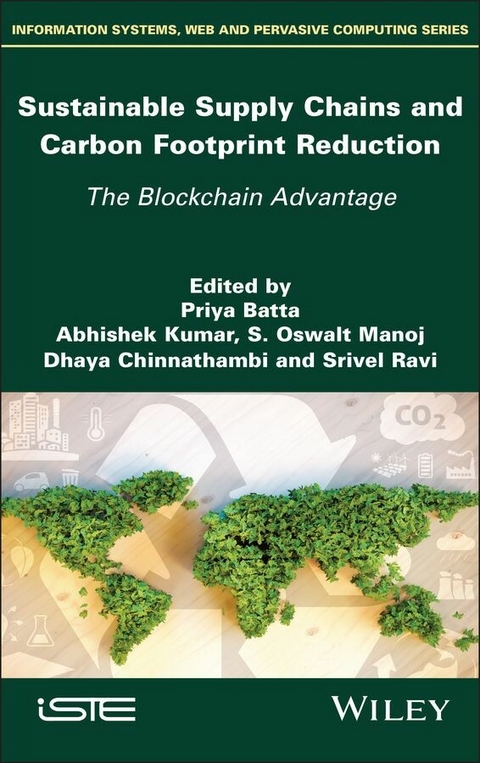
Sustainable Supply Chains and Carbon Footprint Reduction (eBook)
526 Seiten
Wiley-Iste (Verlag)
978-1-394-42340-8 (ISBN)
Sustainable Supply Chains and Carbon Footprint Reduction explores how blockchain technology enables greener, more accountable supply chains by improving traceability, reducing inefficiencies and offering real-time visibility into resource use and carbon emissions.
This book examines how blockchain creates secure, tamper-proof records of supply chain activities, helping industries track products from origin to consumption while ensuring compliance with environmental standards. Through real-world case studies and practical strategies, it highlights blockchain's role in driving sustainable practices across sectors such as agriculture, manufacturing, logistics and energy.
Designed for business leaders, sustainability professionals and policymakers, this book provides actionable insights for leveraging blockchain to meet climate goals and support circular economy initiatives and demonstrates how digital innovation and sustainability can work together to create transparent, resilient and environmentally responsible supply chains.
Priya Batta is Associate Professor at Amity School of Engineering and Technology, Amity University Punjab, Mohali, India. Her expertise includes AI, blockchain and IoT.
Abhishek Kumar is Senior IEEE Member and Professor at Chandigarh University, India. His research interests include AI, renewable energy and image processing.
S. Oswalt Manoj is Professor at Alliance University, India. His research interests include AI, big data and cloud computing.
Dhaya Chinnathambi is Professor and Head at Adhiparasakthi Engineering College, India. Her research interests include machine learning, data science and software architecture.
Srivel Ravi is Assistant Professor at Adhiparasakthi Engineering College, India. His research interests include AI-powered drones, healthcare applications and embedded systems.
Sustainable Supply Chains and Carbon Footprint Reduction explores how blockchain technology enables greener, more accountable supply chains by improving traceability, reducing inefficiencies and offering real-time visibility into resource use and carbon emissions. This book examines how blockchain creates secure, tamper-proof records of supply chain activities, helping industries track products from origin to consumption while ensuring compliance with environmental standards. Through real-world case studies and practical strategies, it highlights blockchain's role in driving sustainable practices across sectors such as agriculture, manufacturing, logistics and energy. Designed for business leaders, sustainability professionals and policymakers, this book provides actionable insights for leveraging blockchain to meet climate goals and support circular economy initiatives and demonstrates how digital innovation and sustainability can work together to create transparent, resilient and environmentally responsible supply chains.
1
Blockchain for Sustainable Agriculture: Enhancing Supply Chain Transparency and Reducing Carbon Footprint
Agriculture plays a crucial role in global food production and economic stability. However, traditional supply chains in agriculture often suffer from inefficiencies, including limited transparency, high operational costs and susceptibility to fraud. Findings indicate that blockchain, along with the IoT and smart contracts, will reduce fraud, improve traceability and could give farmers better access to markets, thereby transforming agri-food supply chains. By enabling smarter crop index insurance delivery using blockchain technology, insurance residents aim to tackle issues plaguing the ordinary crop index insurance delivery mechanism. Smart contracts automate the processing of claims without the need for human intervention, thereby reducing security threats. Agi and Jha (2022) and Omar et al. (2023a) propose a decentralized peer-to-peer model that uses real-time weather data, along with blockchain oracles, to approve claims and instantly pay out. Etherisc shows how automated compensation works during catastrophes. Shrimali and Patel (2022) also note that blockchain technology can reduce administrative costs, improve traceability and diminish fraud cases. In summary, blockchain makes agricultural insurance easier, open and cheaper than before. Chacko et al. (2023) explores the potential of integrating blockchain and IoT (BIoT) in agriculture to improve efficiency, security and transparency. They design a system of plant growth based on BIoT connected to the blockchain using sensors to improve traceability and low costing.
1.1. Introduction
Agriculture is one of the pillars of world sustainability, critical to food security, livelihoods and economic development – particularly for developing nations. While it is termed as being key, traditional agricultural supply chains are plagued by traditional inefficiencies in the form of disintegrated logistics, distrust among actors, restricted data interoperability, and susceptibility to corruption and fraud. These inefficiencies result in enormous post-harvest losses, delayed payments, diminishing profitability for farmers, and consequently a compromised food distribution system. Blockchain technology presents a potentially revolutionary framework for agricultural activity and transaction management. With decentralization, transparency, immutability and trustless consensus being its defining characteristics, blockchain technology makes it possible to have secure and tamper-evident record-keeping across the value chain. By keeping information in a shared ledger, blockchain technology reduces the likelihood of tampering with data and guarantees that information is accessible to all actors – ranging from producers to end-consumers – authenticated, time-stamped and therefore reliable. In addition, the convergence of blockchain technology, Internet of Things (IoT) and artificial intelligence (AI) makes intelligent automation and real-time decision-making along the agricultural value chain possible. IoT sensors embedded in farms, warehouses and transport infrastructure can sense real-time data regarding environment conditions, crop health and product movement. When fed into blockchain networks, this data becomes transparent and traceable, improving food quality assurance and logistics. At the same time, AI algorithms can analyze this data to optimize agricultural decisions, predict yields and detect anomalies such as pest infestation or spoilage risk. Particularly, AI-driven smart contracts – self-executing code on blockchain technology – can automate essential processes such as payments, insurance claims, enforcement of contracts and delivery of services (e.g. crop spraying through drones), which consequently removes intermediaries and increases efficiency. Ultimately, these technologies enable the creation of more resilient, inclusive and data-driven agricultural systems. However, the transition to blockchain-based smart agriculture is replete with a plethora of challenges. Major challenges such as the high energy requirement, network scalability, weak digital infrastructure of rural areas, unclear regulatory environments and weak technical competency among agricultural producers need to be addressed. To achieve its full potential, special effort must be made in areas such as policy-making, education of farmers, growth of infrastructure and standardization of open data. This chapter gives an overview of how blockchain, when combined with AI and the IoT, can transform agricultural supply chains. It discusses the technical potential, areas of application, advantages, disadvantages and prospects of this technology in the context of smart agriculture to support secure, transparent and efficient food systems.
1.2. Literature review
In their work, Yu and Mu (2024) investigate attribute-based encryption (ABE) as a post-quantum cross-blockchain data exchange approach (PQCBCDEA) for smart agriculture. It solves the security and scalability issues of conventional single-blockchain models by implementing a multilayer blockchain system that is integrated with the Interplanetary File System (IPFS) to store data effectively. The suggested ABE-PQCBCDEA structure guarantees enhanced encryption efficiency (42.6%), lower communication costs (48.5%) and fine-grained access control. The study is a useful addition to the fields of blockchain security and agricultural data management since it emphasizes the importance of safe and decentralized data exchange in smart agriculture. Raza et al. (2023) present Agri-4-All, a blockchain-powered smart agriculture supply chain infrastructure that complies with Industry 4.0 guidelines. Agricultural operations are made more transparent, secure and efficient by the framework’s integration of IoT devices, smart contracts and decentralized ledgers. The study illustrates how blockchain automation may simplify farming, warehousing and logistics by mapping supply chain operations using business process modeling (BPM) and RAMI 4.0. One important contribution is the hybrid smart contract paradigm, which reduces computing and gas costs, increasing the viability of blockchain implementation for stakeholders in agriculture. This research addresses the difficulties of sustainability and traceability in contemporary agribusiness, opening the door for reliable and automated food supply chains. It highlights the potential to reduce supply chain inefficiencies, such as the lack of real-time monitoring, third-party dependency and data manipulation. Rahman et al. (2024) discuss the practice of cultivating paddy, which represents a major economic activity worldwide, with rice production playing a crucial role in shaping global economic patterns. However, paddy farms often suffer from insect infestations, which significantly affect growth rates and ecological balance. A potential solution emerges from managing these insects through precise and timely identification. This research establishes an automated control system for paddy cultivation using a real-time IoT-based system that integrates blockchain technology and deep learning (DL) algorithms. The DL-based system primarily focuses on time-sensitive pest identification, using additional paddy insect data for enhanced detection accuracy. The process involves three key stages: preprocessing, feature extraction and identification. The IoT-based system includes multiple components such as a camera module and micro-processor, working alongside necessary automated equipment and apparatus. Blockchain technology is integrated to ensure secure data transmission among IoT components and the cloud server, reinforcing system reliability and security. An experimental data assessment has been systematically documented and analyzed, demonstrating the effectiveness of the proposed framework. The system achieved a peak pest detection accuracy of 98.91% using the VGG19 model combined with ensemble classifiers. Additionally, it exhibited a specificity of 99.14% and a precision rate of 98.21%. When integrated with cloud computing, the IoT system achieved an average response time of 1.71 seconds post-pest identification. These results validate the system’s real-time operational efficiency in monitoring and automating paddy farm processes, highlighting its potential for scalable and cost-effective deployment in large-scale agricultural settings. Sharma et al. (2024) highlight the growing adoption of blockchain in agricultural supply chains due to its ability to enhance transparency, traceability and efficiency. Traditional systems often face issues such as data fragmentation, lack of trust and poor product tracking. Blockchain addresses these challenges by offering a decentralized, tamper-proof ledger for secure data management. The study explores adoption trends across countries such as the Netherlands, the USA, Saudi Arabia and India, identifying policy support, technological readiness and industry collaboration as key enablers. However, challenges such as regulatory uncertainty, high costs and limited awareness continue to hinder adoption. The findings emphasize that integrating blockchain with the IoT and smart contracts can significantly reduce fraud, improve food traceability and expand market access for farmers, thereby transforming agri-food supply chains. The adoption of blockchain-enabled crop index insurance addresses key issues in traditional systems such as fraud, delayed settlements and limited access for smallholder farmers. Smart contracts automate claim processing, reducing human intervention and enhancing...
| Erscheint lt. Verlag | 12.11.2025 |
|---|---|
| Reihe/Serie | ISTE Invoiced |
| Sprache | englisch |
| Themenwelt | Wirtschaft ► Betriebswirtschaft / Management ► Logistik / Produktion |
| Schlagworte | Blockchain • circular economy • climate goals • digital innovation • Environmental Standards • Supply Chain Management • sustainability |
| ISBN-10 | 1-394-42340-3 / 1394423403 |
| ISBN-13 | 978-1-394-42340-8 / 9781394423408 |
| Informationen gemäß Produktsicherheitsverordnung (GPSR) | |
| Haben Sie eine Frage zum Produkt? |
 EPUB (Adobe DRM)
Kopierschutz: Adobe-DRM
Adobe-DRM ist ein Kopierschutz, der das eBook vor Mißbrauch schützen soll. Dabei wird das eBook bereits beim Download auf Ihre persönliche Adobe-ID autorisiert. Lesen können Sie das eBook dann nur auf den Geräten, welche ebenfalls auf Ihre Adobe-ID registriert sind.
Details zum Adobe-DRM
Dateiformat: EPUB (Electronic Publication)
EPUB ist ein offener Standard für eBooks und eignet sich besonders zur Darstellung von Belletristik und Sachbüchern. Der Fließtext wird dynamisch an die Display- und Schriftgröße angepasst. Auch für mobile Lesegeräte ist EPUB daher gut geeignet.
Systemvoraussetzungen:
PC/Mac: Mit einem PC oder Mac können Sie dieses eBook lesen. Sie benötigen eine
eReader: Dieses eBook kann mit (fast) allen eBook-Readern gelesen werden. Mit dem amazon-Kindle ist es aber nicht kompatibel.
Smartphone/Tablet: Egal ob Apple oder Android, dieses eBook können Sie lesen. Sie benötigen eine
Geräteliste und zusätzliche Hinweise
Buying eBooks from abroad
For tax law reasons we can sell eBooks just within Germany and Switzerland. Regrettably we cannot fulfill eBook-orders from other countries.
aus dem Bereich