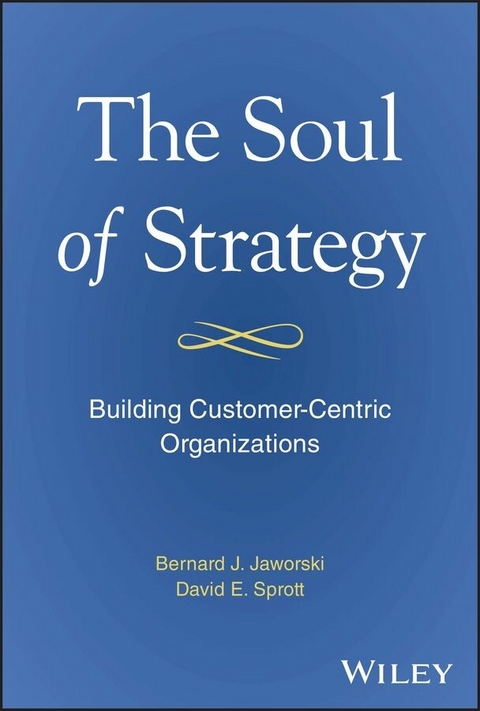
The Soul of Strategy (eBook)
367 Seiten
Wiley (Verlag)
978-1-394-27994-4 (ISBN)
A powerful and original new take on business strategy-with the customer at the center of it-designed to generate enduring competitive advantage
When setting strategy, organizations typically spend too much time thinking about the competition and resources within the firm and not enough time on the customer-the soul of any organization. Such an approach is reflected in the fact that most popular theories of business strategy have focused on resource- and capability-based perspectives of the firm. Real-world businesses embracing and applying these intuitively attractive theories have struggled to compete, however, exactly because those theories fail to adequately account for the most important actor in all commercial transactions: the customer.
In The Soul of Strategy, two veteran strategists and academics deliver a straightforward new approach to business strategy-one that builds and expands on the classic work of Peter Drucker-recognizing the inescapable reality, faced by every organization, that a firm's primary job is to create and keep customers.
The book offers a comprehensive customer-centric strategy framework, a set of fresh perspectives and tools, and step-by-step guides to implementing the leadership styles, governance structures, and technology that companies require to outcompete their rivals in attracting and retaining customers. The book brings to life these key principles by using case studies and examples of organizations in a variety of industries. You'll find:
- A clear description of the concept of customer centricity and its value to the organization.
- A new consumer behavior framework that will enable you to ask the right questions to elicit unique, actionable customer insights
- A 'Customer Choice Cascade' that details how to select, prioritize, and deliver value for both customers and the firm.
- A balanced perspective on how to both find sources of innovation and systematically abandon activities, products, structures and systems that no longer add value to customers.
- The key role that customer insight data play in setting customer-centered strategy.
- Expansions on Drucker's proven strategic insights and ideas that go beyond well-worn frameworks like Porter's Five Forces.
Perfect for managers, executives, board members, and other business leaders, The Soul of Strategy is also a can't-miss resource for strategy consultants and advisors and anyone else interested in effective new ways of thinking about difficult and long-standing strategic problems.
BERNARD J. JAWORSKI, PHD, is the Drucker Chair in Management and the Liberal Arts in the Peter F. Drucker and Masatoshi Ito Graduate School of Management, as well as an ISBM and AMA Marketing Fellow. He has authored seven books on leadership, corporate strategy, and service management.
DAVID E. SPROTT, PHD, is the Henry Y. Hwang Dean and a Professor of Marketing in the Peter F. Drucker and Masatoshi Ito Graduate School of Management. He's authored dozens of articles exploring various factors exploring why consumers behave as they do.
2
The Evolution of Strategic Thinking*
“Results depend not on anybody within the business nor on anything within the control of the business. They depend on somebody outside…”1
—Peter Drucker
Introduction
How can organizations achieve and sustain a competitive edge in an ever‐changing world? This question has been central to the study of strategic management. Over the decades, scholars and practitioners have developed frameworks to help organizations navigate their environments, build capabilities, and outperform competitors. The evolution of strategy thinking reflects a dynamic progression from early foundational ideas to contemporary frameworks that emphasize agility, resource alignment, and, increasingly, customer focus.
This chapter provides a historical and thematic overview of the major schools of thought in strategy, highlighting their unique contributions and limitations. From Alfred Chandler's pioneering work on aligning organizational structure with strategy to the emergence of customer centricity as a core strategic principle, this exploration underscores the critical interplay among internal resources, external environments, and customer needs.2 This backdrop explains why a new paradigm centered on the customer is now essential.
The Foundations of Modern Strategy
Strategic thinking as we know it began in the mid‐20th century with groundbreaking contributions from Alfred Chandler, Roland Christensen, and Kenneth Andrews. These scholars laid the groundwork for understanding how organizations align their internal capabilities and structures with external opportunities. In Strategy and Structure,3 Chandler argued that “structure follows strategy.” His analyses of American corporations like General Motors and DuPont revealed that organizational success depends on aligning internal structures with strategic objectives. Chandler's work also introduced the importance of economies of scale and managerial expertise as key drivers of competitive advantage.
Chandler's work went beyond structural alignment, identifying key sources of competitive advantage such as economies of scale and scope. These insights laid the groundwork for later theories on cost leadership strategies. Additionally, he highlighted the critical role of managerial expertise and operational efficiency, showing how effective resource management and leadership are essential for sustaining strategic initiatives. By integrating these ideas, Chandler revolutionized the way businesses approached strategy, offering a systematic framework for achieving competitive advantage through strategic and organizational alignment.
Concurrent with Chandler's influence on management, Roland Christensen and Kenneth Andrews at Harvard Business School revolutionized the teaching and practice of strategy through their Business Policy course, which became a cornerstone of MBA education. Their seminal works, including Business Policy: Text and Cases4 and The Concept of Corporate Strategy5 , introduced tools like SWOT analysis.
Andrews's concept of distinctive competencies—unique internal capabilities—paved the way for theories focusing on resource‐based competitive advantage. Andrews championed defining an organization's mission and leveraging its distinctive competencies—unique capabilities such as specialized knowledge or proprietary technologies. These competencies were early articulations of what would later be known as sources of competitive advantage.
Meanwhile, Christensen revolutionized strategy teaching by pioneering the case method, a now‐iconic approach in business education that encouraged analytical thinking and practical problem‐solving. Together, Andrews and Christensen emphasized the critical role of managerial judgment in identifying and leveraging a firm's strengths, arguing that strategic advantage arises not only from structural alignment but also from effective leadership and resource deployment.
Their work expanded on Chandler's insights into strategic alignment by focusing on the interplay between internal resources and external factors. This emphasis on aligning strengths, weaknesses, opportunities, and threats laid the groundwork for subsequent theories on strategic positioning and leveraging organization‐specific resources. Through their efforts, Andrews and Christensen established a lasting framework for strategic planning and education that continues to shape how organizations approach competitive advantage today.
Competitive Advantage into Focus
Central to strategy is the concept of competitive advantage: the ability of a company to consistently outperform its rivals. Scholars after Chandler, Andrews, and Christensen focused on two key questions:
- What are the sources of competitive advantage?
- How can these sources be cultivated and sustained over time?
Much of the academic underpinning of future theories on competitive strategy is the concept of sources of competitive advantage. This concept is at the heart of competitive strategy, because it provides the foundation for why and how an organization can outperform its competitors. Without clearly identifying, cultivating, and leveraging these sources, the broader strategic question—how to achieve and sustain a competitive advantage—cannot be effectively answered.
The concept of sources of competitive advantage evolved directly from Chandler's foundational ideas and the Business Policy teachings of Andrews and Christensen through a progression of thinking about strategy's relationship to organizational capabilities, environmental opportunities, and competitive dynamics. Chandler's work provided a foundational perspective on achieving and sustaining competitive advantage by shifting the focus to the systematic alignment of resources with strategic intent. Andrews and Christensen's approach underscored the idea that competitive advantage stems from matching internal capabilities with external demands.
The foundational ideas of Chandler and Andrews evolved naturally into more specific explanations for how firms outperform competitors. Chandler's focus on economies of scale and scope laid the groundwork for cost‐based competitive advantages, later formalized by Michael Porter's concept of cost leadership. Andrews' emphasis on “distinctive competence” similarly advanced strategic thinking toward differentiation, wherein firms achieve advantage by delivering unique customer value. Both scholars also stressed aligning internal capabilities with external industry conditions, influencing frameworks like Porter's Five Forces. Andrews' insights into distinctive competencies prefigured the resource‐based view emphasizing valuable, rare, and inimitable resources. Additionally, their shared belief in sustainable competitive advantage through long‐term capability development set the stage for later theories on dynamic capabilities and enduring strategic adaptability.
The Theory of Competitive Advantage
Sources of competitive advantage emerged as a dominant concept in strategic management during the 1970s and 1980s, driven by the work of influential thinkers such as Michael Porter, Jay Barney, Richard Rumelt, and Pankaj Ghemawat. These scholars formalized the understanding that competitive advantage arises from a combination of distinct internal and external factors, offering valuable insights into the strategic choices that drive organizational success.
One prominent theory underpinning competitive advantage is industry positioning, which Porter articulated through his Five Forces framework.6 This approach emphasizes the significance of external factors, including industry structure, buyer power, and competition, in shaping a firm's opportunities for success. By analyzing these forces, organizations can identify optimal market positions that enhance their competitiveness and create opportunities for differentiation.
In contrast to the external focus of industry positioning, another critical perspective centers on internal resources. Scholars such as Edith Penrose,7 Birger Wernerfelt,8 and Jay Barney9 argued that competitive advantage is sustained by possessing unique, valuable, rare, and hard‐to‐imitate resources, often referred to as “VRIN resources.” From this perspective, such internal assets drive an organization's enduring success by distinguishing it from its competitors in meaningful ways.
A third significant framework highlights the importance of dynamic adaptation. David Teece10 and Henry Mintzberg11 advanced the notion that organizations must continuously reconfigure their capabilities to address rapidly changing environments. This perspective underscores the need for agility and the ongoing renewal of organizational resources to maintain a competitive edge in an ever‐evolving marketplace.
Adding to the discourse on competitive advantage, Gary Hamel and C.K. Prahalad emphasized the role of strategic innovation.12 Their work on core competencies demonstrated how innovation within a company's strategy could foster new sources of competitive advantage. By identifying and cultivating core competencies, organizations can differentiate themselves in the marketplace and create unique value for customers. That said, in subsequent work, Porter...
| Erscheint lt. Verlag | 11.11.2025 |
|---|---|
| Sprache | englisch |
| Themenwelt | Wirtschaft ► Betriebswirtschaft / Management ► Unternehmensführung / Management |
| Schlagworte | Analytics strategy • business governance strategy • business leadership strategy • Business Strategy • business strategy book • Business Strategy Guide • Corporate Strategy • Data strategy • drucker business strategy • drucker strategy • Marketing strategy |
| ISBN-10 | 1-394-27994-9 / 1394279949 |
| ISBN-13 | 978-1-394-27994-4 / 9781394279944 |
| Informationen gemäß Produktsicherheitsverordnung (GPSR) | |
| Haben Sie eine Frage zum Produkt? |
 EPUB (Adobe DRM)
Kopierschutz: Adobe-DRM
Adobe-DRM ist ein Kopierschutz, der das eBook vor Mißbrauch schützen soll. Dabei wird das eBook bereits beim Download auf Ihre persönliche Adobe-ID autorisiert. Lesen können Sie das eBook dann nur auf den Geräten, welche ebenfalls auf Ihre Adobe-ID registriert sind.
Details zum Adobe-DRM
Dateiformat: EPUB (Electronic Publication)
EPUB ist ein offener Standard für eBooks und eignet sich besonders zur Darstellung von Belletristik und Sachbüchern. Der Fließtext wird dynamisch an die Display- und Schriftgröße angepasst. Auch für mobile Lesegeräte ist EPUB daher gut geeignet.
Systemvoraussetzungen:
PC/Mac: Mit einem PC oder Mac können Sie dieses eBook lesen. Sie benötigen eine
eReader: Dieses eBook kann mit (fast) allen eBook-Readern gelesen werden. Mit dem amazon-Kindle ist es aber nicht kompatibel.
Smartphone/Tablet: Egal ob Apple oder Android, dieses eBook können Sie lesen. Sie benötigen eine
Geräteliste und zusätzliche Hinweise
Buying eBooks from abroad
For tax law reasons we can sell eBooks just within Germany and Switzerland. Regrettably we cannot fulfill eBook-orders from other countries.
aus dem Bereich