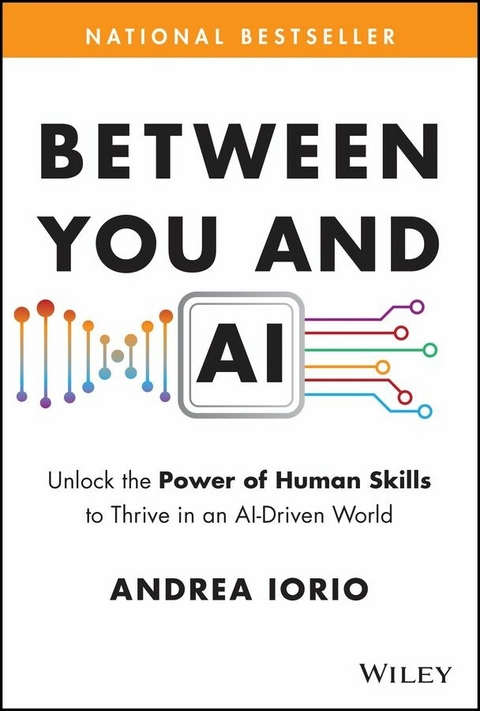
Between You and AI (eBook)
313 Seiten
Wiley (Verlag)
978-1-394-35799-4 (ISBN)
An eye-opening strategy guide for business leaders navigating the introduction of artificial intelligence
In Between You and AI: Unlock the Power of Human Skills to Thrive in an AI-Driven World, digital transformation speaker and economist Andrea Iorio delivers a clear and actionable roadmap to not just maintain relevance, but to thrive as the technology we all work with everyday changes rapidly. The author offers a three-part framework addressing the cognitive, behavioral, and emotional dimensions of tech transformation, walking readers through the steps to developing the human skills needed to thrive in the modern marketplace.
Between You and AI challenges you to embrace artificial intelligence as a partner and unlock the uniquely human potential that defines the future of work. You'll also find:
- Real-world strategies, examples, and insights that you can use immediately in your own company
- Tools to help leverage AI as a strategy for growth, rather than as 'competition' for human labor
- Ways to lead others with trust and emotional intelligence, creating value where AI cannot
This book answers the question, 'How do we make humans indispensable in a world of machines?' It's a blueprint to building hybrid teams-human and AI-that effectively innovate, unlock resilience, and achieve long-term success. It's perfect for managers, executives, and other business leaders in virtually any industry.
ANDREA IORIO is a digital transformation, innovation, leadership, and soft skills keynote speaker. He has held multiple leadership positions in technology companies, including the Head of Tinder in Latin America and the Chief Digital Officer at L'Oréal Brazil. He's an MBA professor at Fundação Dom Cabral.
An eye-opening strategy guide for business leaders navigating the introduction of artificial intelligence In Between You and AI: Unlock the Power of Human Skills to Thrive in an AI-Driven World, digital transformation speaker and economist Andrea Iorio delivers a clear and actionable roadmap to not just maintain relevance, but to thrive as the technology we all work with everyday changes rapidly. The author offers a three-part framework addressing the cognitive, behavioral, and emotional dimensions of tech transformation, walking readers through the steps to developing the human skills needed to thrive in the modern marketplace. Between You and AI challenges you to embrace artificial intelligence as a partner and unlock the uniquely human potential that defines the future of work. You'll also find: Real-world strategies, examples, and insights that you can use immediately in your own company Tools to help leverage AI as a strategy for growth, rather than as competition for human labor Ways to lead others with trust and emotional intelligence, creating value where AI cannot This book answers the question, How do we make humans indispensable in a world of machines? It's a blueprint to building hybrid teams human and AI that effectively innovate, unlock resilience, and achieve long-term success. It's perfect for managers, executives, and other business leaders in virtually any industry.
Introduction
IN THE 1800s, during the Golden Age of gold mining and railroad expansion in the United States, there lived a man that, according to folklore, was considered the strongest alive. His name was John Henry—a steel driver who shattered massive rock with unmatched power, carving tunnels through mountains with his sledgehammer. Day after day, with sheer strength and unwavering resolve, John Henry struck each blow with the force of a lifetime of toil and pride. No other human could outdo him.
But the major threat to his dominance did not come from fellow workers in flesh and bone, but from ones in steel. Technological progress was relentless indeed. One fateful day, a salesperson arrived at John Henry’s construction site, unveiling a mechanical marvel—a steam-powered drilling machine that he claimed would outwork any human laborer.
To John Henry, this was more than just a sales pitch; it was a direct challenge to his very identity. Unwilling to accept that any machine could surpass human strength and skill, he proposed a contest: he challenged the salesperson to determine who—him or the machine—could drill the deepest hole in a single day.
Confident in the power of his invention, the salesperson agreed. At dawn, the contest began. The machine roared to life, its piston hammering away with relentless precision, while beside it, John Henry swung his sledgehammer with determination, but at nowhere near the same speed. Although he was already lagging behind, his fellow workers cheered, their voices blending with the rhythmic clang of metal against stone.
Hour after hour, the machine surged ahead, its endurance seemingly limitless, drilling a 9-foot hole into the rock—far ahead of John Henry. But just when the outcome seemed inevitable, the unexpected happened: due to a mechanical dysfunction, the machine broke down under the strain.
John Henry, undeterred, pressed on. His blows grew heavier, his determination fiercer. By the end of the day, he eventually not only caught up to the stuck machine but surpassed it, winning the contest by digging an impressive 14-foot hole. He had outperformed the steam-powered drill, proving that human strength and resilience could triumph over mechanical innovation.
Yet victory came at a cost. As the dust settled and cheers filled the air, an exhausted John Henry collapsed at the foot of the mountain, his hammer still clutched in his hand. His heart, pushed beyond its limits, gave out just moments after his triumph.
Though he had won the battle, he had paid the ultimate price with his life.
Although the legend of John Henry exists in many versions, they all share the same bittersweet lesson: the story of a man who refused to be replaced by a machine, believing that human strength and spirit could never be outdone by technology. It is a tale of defiance and of humanity’s innate resistance when faced with threats to its dominance.
But the true purpose of this tale is to make us wonder: What if John Henry had survived?
Surely, months later, the salesperson would have returned with an improved machine—stronger, faster, designed to overcome the mechanical shortcomings that caused it to break. Sort of a drilling machine 2.0.
John Henry, true to his spirit, would have challenged it once more—perhaps even won again. But for how long could that cycle continue? With each return, the machine would come back better—improved not by itself, but by the hands and minds of its inventors, who would learn from each failure, tweak its design, and increase its power. Eventually, the inevitable day would come when even John Henry’s legendary strength would not be enough. At that point, he would have to face a choice: keep fighting an unwinnable battle or adapt to a new reality—one where technology had outperformed him at the very physical skill that defined him.
Today, as Artificial Intelligence (AI) accelerates at an ever-increasing pace and permeates every aspect of our life and work with its power, we are confronted with a question that is more pressing than ever: How can humans thrive in an era where AI is automating not just manual labor, but thinking itself? Unlike John Henry’s mechanical rival, AI is a tool that thinks, learns, and evolves at an accelerating pace, mimicking and outperforming humans in a much broader range of skills than at any other point in time—and this time not only coming for our muscles, but for our brains. Like John Henry, we must decide: Do we resist, or do we evolve?
This dilemma is not unique to AI. It is a recurring theme in history. Time and again, humans have had to redefine their value when confronted with new technology that is capable of performing our tasks better than we can. The Industrial Revolution, factory automation, and now AI—each has challenged the existing hierarchy of skills. But to truly understand how we got to this point, we must look further back—to the very origins of human survival and the skills that originally determined success.
From Physical to Cognitive Skills
Deep in the remote southwestern corner of Ethiopia, nestled within the Omo Valley, lives the Suri tribe—an indigenous community known for their striking body decorations, including intricate scarification and iconic lip plates, as well as their deeply traditional way of life. The Suri are seminomadic cattle herders who primarily cultivate sorghum, and their access to modern technology is nearly nonexistent. Ironically, the most advanced tools at their disposal are weapons smuggled from nearby South Sudan, used to defend their livestock from rival tribes seeking to steal their cattle.
Another weapon in their hands—though far more rudimentary—is the Bire, a wooden stick that plays a crucial role in their traditional Donga ceremony. This event serves as a rite of passage, marking a Suri boy’s transition from adolescence to manhood, proving his strength and readiness to care for a family. The initiation unfolds through an intense, often brutal fight, where opponents strike each other with powerful blows from the Bire. Picture these young boys as gladiators in an arena of people—the entire tribe encircles them, watching intently to see who will emerge as the proudest and strongest warrior. The winner of the Donga ceremony earns not only status but also the right to choose his desired partner. By winning the fight, he secures greater reproductive opportunities and solidifies his place within the tribe, ensuring his success in Suri society.
The correlation between physical attributes and better life outcomes has been a recurring pattern throughout human history. Between 130,000 and 80,000 years ago, the world saw the emergence of modern Homo sapiens, who originated in Africa and organized into small, tightly knit tribes of hunters and gatherers. They led highly mobile, nomadic lives, constantly moving to track food sources and adapt to shifting environmental conditions. Their survival depended on the ability to hunt game using spears and other primitive weapons crafted from stone—a cutting-edge technology for their time and a crucial lifeline for existence. Alongside hunting, they foraged for fruits, nuts, and edible plants, sustaining themselves on whatever the land provided.
In those days, the rules of survival were brutally simple. Strength and endurance reigned supreme. The most formidable warriors could chase prey for miles, wielding weapons with the precision and force needed to bring down animals far larger than themselves. A tribe’s dominance—its ability to protect its people and secure sustenance—often depended on its strongest and most resilient members. Physical prowess wasn’t just an asset; it was a lifeline. Those who were faster, stronger, and more robust earned their place at the forefront of tribal life, ensuring their survival in an unforgiving world.
Of course, cognitive skills and adaptability also played a role, but they were far less of a differentiator than physical abilities. In a world with limited access to external information and an oral, rather than written, tradition, people’s cognitive abilities were largely uniform. Without exposure to new ideas, diverse knowledge, or complex problem-solving beyond their immediate environment, intelligence was constrained by the shared experiences of the tribe.
In a world where cognitive skills were undifferentiated, the real competitive advantage lay in physical prowess. Greater endurance meant a higher success rate in hunting, while superior strength made carving weapons from stone more efficient. In this harsh reality, those who excelled physically had the greatest chances of survival and success.
This skills paradigm—what we might call physical leadership—began to shift over time. From around 11,000 BCE, with the emergence of the first agricultural settlements, throughout the Industrial Revolution, and up until today, new technologies gradually leveled the physical playing field. Innovations such the plow, steam engines, and electricity provided broader access to physical power, often surpassing human capabilities and making raw physical strength less of a scarce advantage.
As these technologies advanced, they gave rise to a new skills paradigm—one we can call cognitive leadership. After all, if a single steam engine could lift, press, and transport with a force no human could match, the fundamental question shifted. If machines could now perform the tasks that once defined the strongest Homo...
| Erscheint lt. Verlag | 10.11.2025 |
|---|---|
| Sprache | englisch |
| Themenwelt | Wirtschaft ► Betriebswirtschaft / Management ► Unternehmensführung / Management |
| Schlagworte | AI business case studies • AI business strategy • AI for Business • AI for business growth • AI Leadership • ai strategy • AI Tools • AI transformation • Artificial Intelligence • Artificial Intelligence Tools • Digital transformation • leading with ai |
| ISBN-10 | 1-394-35799-0 / 1394357990 |
| ISBN-13 | 978-1-394-35799-4 / 9781394357994 |
| Informationen gemäß Produktsicherheitsverordnung (GPSR) | |
| Haben Sie eine Frage zum Produkt? |
 EPUB (Adobe DRM)
Kopierschutz: Adobe-DRM
Adobe-DRM ist ein Kopierschutz, der das eBook vor Mißbrauch schützen soll. Dabei wird das eBook bereits beim Download auf Ihre persönliche Adobe-ID autorisiert. Lesen können Sie das eBook dann nur auf den Geräten, welche ebenfalls auf Ihre Adobe-ID registriert sind.
Details zum Adobe-DRM
Dateiformat: EPUB (Electronic Publication)
EPUB ist ein offener Standard für eBooks und eignet sich besonders zur Darstellung von Belletristik und Sachbüchern. Der Fließtext wird dynamisch an die Display- und Schriftgröße angepasst. Auch für mobile Lesegeräte ist EPUB daher gut geeignet.
Systemvoraussetzungen:
PC/Mac: Mit einem PC oder Mac können Sie dieses eBook lesen. Sie benötigen eine
eReader: Dieses eBook kann mit (fast) allen eBook-Readern gelesen werden. Mit dem amazon-Kindle ist es aber nicht kompatibel.
Smartphone/Tablet: Egal ob Apple oder Android, dieses eBook können Sie lesen. Sie benötigen eine
Geräteliste und zusätzliche Hinweise
Buying eBooks from abroad
For tax law reasons we can sell eBooks just within Germany and Switzerland. Regrettably we cannot fulfill eBook-orders from other countries.
aus dem Bereich