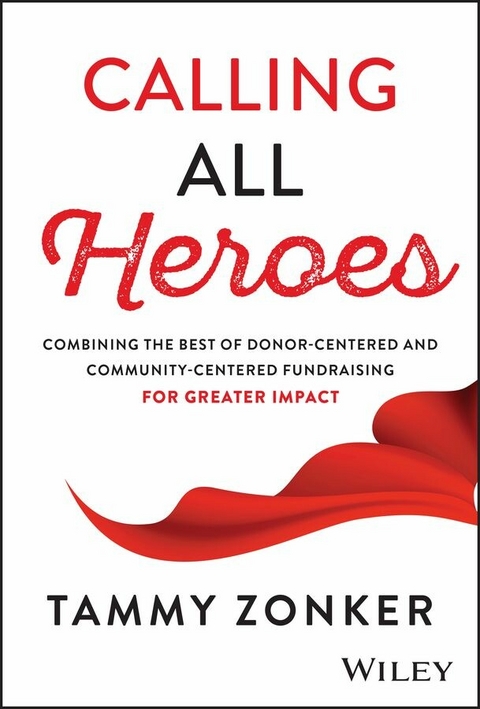
Calling All Heroes (eBook)
355 Seiten
Wiley (Verlag)
978-1-394-33860-3 (ISBN)
Transform your nonprofit's approach to fundraising with the power of human-centered strategies
In Calling All Heroes: Combining the Best of Donor-Centered and Community-Centered Fundraising for Greater Impact, author Tammy Zonker delivers a compelling discussion about the crossroads at which the nonprofit sector finds itself. Here, traditional fundraising approaches are no longer sufficient to tackle the complex challenges of nonprofit organizations and the communities they serve. This book helps fundraisers, nonprofit leaders, and advocates find common ground by uniting around shared values and focusing on human-centered practices that empower communities and build genuine connections.
The value of Calling All Heroes lies in its unique mix of donor-centered and community-centered models. It offers practical guidance to enhance nonprofit impact through genuine relationship-building. By embracing these strategies, readers can work towards a future where every mission is fully funded, and communities thrive.
Inside the book:
- Discover innovative fundraising strategies that unite donor and community objectives
- Learn how to build and sustain genuine connections in the nonprofit sector
- Empower your team with the tools to achieve ambitious fundraising goals
Calling All Heroes is an essential read for fundraisers, nonprofit and community leaders, volunteers, and advocates who are eager to make a real difference. By leveraging a human-centered approach, this book equips readers with the inspiration and strategies needed to transform their communities for the better.
TAMMY ZONKER is a fundraising strategist, AFP Master Trainer, and international speaker who has coached, trained, and led nonprofit teams to collectively raise over $1 billion, including a single gift of $27.1 million. She was the Chief Philanthropy Officer at The Children's Center in Detroit for nine years and currently serves as the President at the Modern Institute for Charitable Giving. She also contributes to advancing the fundraising profession through her involvement with the Fundraising.AI Global Advisory Council and Forbes Nonprofit Advisory Council.
Transform your nonprofit's approach to fundraising with the power of human-centered strategies In Calling All Heroes: Combining the Best of Donor-Centered and Community-Centered Fundraising for Greater Impact, author Tammy Zonker delivers a compelling discussion about the crossroads at which the nonprofit sector finds itself. Here, traditional fundraising approaches are no longer sufficient to tackle the complex challenges of nonprofit organizations and the communities they serve. This book helps fundraisers, nonprofit leaders, and advocates find common ground by uniting around shared values and focusing on human-centered practices that empower communities and build genuine connections. The value of Calling All Heroes lies in its unique mix of donor-centered and community-centered models. It offers practical guidance to enhance nonprofit impact through genuine relationship-building. By embracing these strategies, readers can work towards a future where every mission is fully funded, and communities thrive. Inside the book: Discover innovative fundraising strategies that unite donor and community objectives Learn how to build and sustain genuine connections in the nonprofit sector Empower your team with the tools to achieve ambitious fundraising goals Calling All Heroes is an essential read for fundraisers, nonprofit and community leaders, volunteers, and advocates who are eager to make a real difference. By leveraging a human-centered approach, this book equips readers with the inspiration and strategies needed to transform their communities for the better.
Introduction
Throughout this book we'll discuss the intersection of donor‐centered fundraising (focused largely on people who hold the majority of wealth) and community‐centered fundraising (focused on race, equity, and social justice). We'll navigate sensitive topics such as power dynamics, diversity, equity, and inclusion.
I recognize that I hold unearned privileges as a white, cisgendered woman. These privileges are not something I have earned or chosen; they are bestowed upon me by structures that favor individuals with my racial and gender identity. I understand that these privileges are not solely mine to enjoy but also part of a broader system perpetuating inequality. I commit to using my privilege to amplify the voices of marginalized people and work toward dismantling oppression systems. This includes listening to and believing the experiences of others, educating myself on issues of racial and gender justice, and advocating for policies and practices that promote equity and inclusion. I've been blessed by mentors and friends who have shared their experiences and insights as people of other races, faiths, and gender identities. They've generously schooled me on issues of social justice inequities and given me a safe space to ask questions. I am, and always will be, a grateful and humbled student.
Acknowledging my privilege is only the first step. I am committed to ongoing self‐reflection and action to ensure that my privilege does not silence or overshadow the experiences of others but rather be a catalyst for positive change alongside you and others. With that understanding and your grace, let's get started!
Let me take you back to a pivotal moment in my nonprofit career journey during the throes of the US Great Recession in 2008. I was living in Indiana, working for a West Coast training company, crisscrossing the country, leading seminars and conferences, and teaching fundraising strategies. But it felt like we were stuck in a rut. The model we were using, deeply rooted in traditional fundraising strategies and best practices, was rigid, left little room for innovation, and wasn't producing the expected results in an increasingly difficult economy. My clients were struggling and looking to me for new ideas and solutions to their fundraising challenges.
That's when I realized what I needed—a fundraising sandbox, a space where experimentation and bold ideas could be tested, take root, and flourish. Detroit, with its resilience in the midst of adversity, stood out as the perfect crucible for transformation. So, I packed some things and set up a modest home‐away‐from‐home in Motown in October 2008. I had just become an empty nester, so what was to stop me?
Detroit was hard hit by the Great Recession—a city grappling with the full force of the economic downturn where challenges seemingly loomed at every corner. Unemployment was 30%. Two of the three largest employers were in bankruptcy. The population had dropped from nearly three million to less than one million. One in five homes was in foreclosure. The City of Detroit was $18 billion in debt, with creditors circling. The only thing bigger than Detroit's challenges was the heart and determination of its people.
But, where some might have seen obstacles, I saw opportunities—a chance to create something truly transformative. I knew if I could successfully raise money in Detroit, I could raise money almost anywhere. Detroit became my fundraising laboratory, where I dared to experiment, learn, and push the boundaries of conventional fundraising wisdom.
After creating and testing, failing, iterating, and refining key strategies, I applied what I was learning from my Detroit fundraising experience and spearheaded the team effort that secured monumental gifts, like the $27.1 million from General Motors Foundation to United Way for Southeastern Michigan. I witnessed firsthand the transformative power of an inspiring CEO and Board vision, coupled with innovative programs and tailored fundraising strategies, when they engage passionate, community‐focused individual and institutional partners.
Transforming the Children's Center
The Children's Center, a beacon of hope in Detroit, faced daunting hurdles. Their fundraising efforts were faltering, leaving critical programs underfunded. However, within these challenges lay opportunities for growth and impact.
By embracing bold, data‐driven, tested, and proven strategies, we charted a new course. While the executive team and board were at first apprehensive about a plan loaded with innovative ideas and big, hairy, audacious goals, we rallied leadership and board members around a shared vision, revamped donor communications, and overhauled outdated systems. We also created a high‐performing development team to help drive our mission forward and achieve our ambitious fundraising goals. We diversified funding streams beyond an events strategy. The result? A staggering tripling of philanthropy within the first three years and doubling it again six years later.
But it wasn't just about the numbers. It was about the people—the children and families who relied on organizations like The Children's Center to walk alongside them, often in their darkest moments. Their stories of determination and courage fueled my passion for creating change.
I'm sharing my journey with you because I firmly believe in John F. Kennedy's ideal that “a high tide lifts all boats.” I believe there's an urgent need for fundraisers and nonprofit leaders everywhere to work together toward a transformed and sustainable future. I knew that if I could learn how to raise money successfully in Detroit during a catastrophic economic recession, then I could teach others how to raise money in the most difficult of circumstances.
My life's mission is to equip and empower fundraisers and nonprofit leaders like you to reach new heights of fundraising success. I believe in the power of collaboration and collective growth. It's my obsession.
United for the Greater Good
But here's my concern. Our world feels deeply divided, like everyone is taking sides on every little thing. The nonprofit sector has always been about bringing people together, about finding common ground, and working hand‐in‐hand to make a real difference.
Aren't we the helpers, peacemakers, the conveners, and the champions for goodness, comfort and healing, equity, inclusion, and possibilities? The ones who believe in a brighter tomorrow? Aren't we stronger when we work together? So why are we letting this debate over donor‐centered versus community‐centered fundraising divide us? What's this division costing us as a sector and those we serve? Our strength lies in our ability to unite, put aside our differences, find common ground, and focus on the greater good.
At the end of the day, I believe most of us want the same thing—to create positive change and build a better world for everyone. And we can't do that if we're too busy debating among ourselves. Every minute spent focusing on what separates us is a minute we could have spent working together to solve the problems our communities are facing. Do we have the will to find enough common ground and shared values to work together? I believe human‐centered fundraising can help unite us in nearly every circumstance, with one exception:
As author and LGBTQ+ Activist, James Baldwin said, “We can disagree and still love each other, unless your disagreement is rooted in my oppression and denial of my humanity and right to exist.”
What You Can Expect from This Book
The nonprofit sector is at a crossroads. We're letting debates over fundraising approaches divide us. I wrote this book to serve as a guide to implementing a human‐centered approach to fundraising that combines the best of donor‐centered and community‐centered models. To help us all raise even more money and accelerate short and long‐term goals while ensuring everyone has a seat at the table. With the proven strategies and tools that I share in this book, I'm fully committed to being a guide and partner in achieving our ambitious fundraising goals so we can create a brighter future for our communities and our sector.
This Human‐Centered approach to fundraising stands on the broad shoulders of Donor‐Centered Fundraising and Community‐Centered Fundraising. For that, I'm deeply grateful for Penelope Burk and Vu Le, who birthed these movements and all those who have embraced, implemented, failed, learned, and iterated these diverse approaches.
My fondest dream is that Human‐Centered Fundraising reflects the strengths of both approaches, mitigates the shadow side, and is embraced by you—fundraising professionals and nonprofit leaders everywhere. That you embody, learn, fail, iterate, and evolve this approach. I'll just say we won't perfect it. Because perfection means we stop getting better.
It Will Take You, Me—Everyone
I know we won't see eye‐to‐eye on everything—that's just life. But can't we find a way to come together despite our differences? Can we remember the values that brought us to this work in the first place—compassion, empathy, a commitment to justice, equitable access to education, healthcare, the arts, and more?
There's so much...
| Erscheint lt. Verlag | 10.11.2025 |
|---|---|
| Sprache | englisch |
| Themenwelt | Wirtschaft ► Betriebswirtschaft / Management |
| Schlagworte | Community Building • Community Empowerment • donor-centered approach • fundraising innovation • fundraising strategies • human-centered • Leadership • Nonprofit • Nonprofit Management • nonprofit success • philanthropy • social change • united vision |
| ISBN-10 | 1-394-33860-0 / 1394338600 |
| ISBN-13 | 978-1-394-33860-3 / 9781394338603 |
| Informationen gemäß Produktsicherheitsverordnung (GPSR) | |
| Haben Sie eine Frage zum Produkt? |
 EPUB (Adobe DRM)
Kopierschutz: Adobe-DRM
Adobe-DRM ist ein Kopierschutz, der das eBook vor Mißbrauch schützen soll. Dabei wird das eBook bereits beim Download auf Ihre persönliche Adobe-ID autorisiert. Lesen können Sie das eBook dann nur auf den Geräten, welche ebenfalls auf Ihre Adobe-ID registriert sind.
Details zum Adobe-DRM
Dateiformat: EPUB (Electronic Publication)
EPUB ist ein offener Standard für eBooks und eignet sich besonders zur Darstellung von Belletristik und Sachbüchern. Der Fließtext wird dynamisch an die Display- und Schriftgröße angepasst. Auch für mobile Lesegeräte ist EPUB daher gut geeignet.
Systemvoraussetzungen:
PC/Mac: Mit einem PC oder Mac können Sie dieses eBook lesen. Sie benötigen eine
eReader: Dieses eBook kann mit (fast) allen eBook-Readern gelesen werden. Mit dem amazon-Kindle ist es aber nicht kompatibel.
Smartphone/Tablet: Egal ob Apple oder Android, dieses eBook können Sie lesen. Sie benötigen eine
Geräteliste und zusätzliche Hinweise
Buying eBooks from abroad
For tax law reasons we can sell eBooks just within Germany and Switzerland. Regrettably we cannot fulfill eBook-orders from other countries.
aus dem Bereich