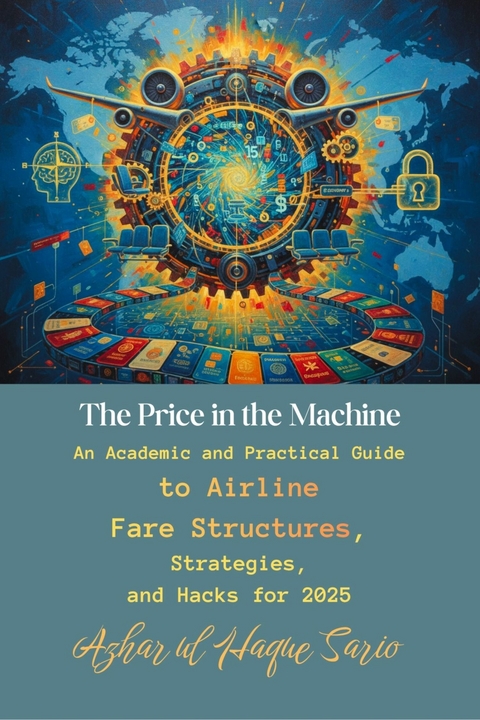
The Price in the Machine (eBook)
198 Seiten
Azhar Sario Hungary (Verlag)
978-3-384-75185-0 (ISBN)
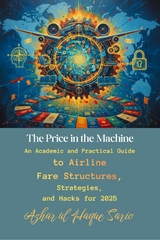
Discover the real secrets behind every airline ticket price in 2025-no myths, no outdated tricks, just hard data from 15 countries.
Hey, traveler! Imagine sitting down with a super-smart friend who's spent years digging into airline pricing systems across the globe. That's exactly what The Price in the Machine feels like. This book breaks down how airlines actually set fares today. It starts with the birth of revenue management in the US after 1978 deregulation. Then it jumps country by country: China's state-controlled floors, UK's LCC unbundling, Germany's NDC revolution, Japan's bullet-train battles, Australia's duopoly games, Brazil's wild taxes and installments, UAE's sixth-freedom hubs, Malaysia's super-app trap, South Africa's LCC takeover, Spain's green-fuel premium, Vietnam's platform loyalty war, Canada's border-hop hack, India's OTA black boxes, and Colombia's merger mysteries. Short sentences. Real numbers. Fresh 2025 data. Every chapter ends with actionable hacks that still work right now.
No other book does this. Most travel guides recycle the same tired tips-use incognito, try VPNs, book on Tuesday. They're wrong and outdated. This one proves why those tricks fail in 2025. It shows the new battlefield: AI context pricing, NDC-exclusive fares, super-app cross-subsidies, mandated SAF costs, duopoly mirroring, platform vs airline loyalty. You get brand-new models-like the Mandated Green Premium formula, the Duopoly Price-Matching Game, Total Journey Time calculators-plus verifiable strategies backed by annual reports, court cases, academic papers, and government studies from this year. While others guess, this book measures. While others repeat myths, this book kills them with evidence. You'll finish knowing exactly where to search, when to book, which channel hides the real price, and how to beat the machine every time.
© 2025 Azhar ul Haque Sario. This book is an independently produced academic and practical work. The author has no affiliation with any airline, regulatory board, GDS, OTA, or industry organization mentioned. All airline names, trademarks, and data are used under nominative fair use for critique, education, and analysis only. No endorsement is claimed or implied.
Part II: Practical Applications and Regional Strategies
Germany – Practical Implications of the New Distribution Capability (NDC)
The German air travel market, and by extension the global landscape, is not just adopting the New Distribution Capability (NDC); it is being forcibly remade by it. Germany serves as the primary case study for this revolution for one reason: the Lufthansa Group.
What began over a decade ago as a technical standard from IATA (International Air Transport Association) has, by 2025, been fully weaponized into a powerful commercial strategy. NDC is no longer a theoretical upgrade. It is a lever of power.
Lufthansa's strategy has been decisive, aggressive, and effective. It has deliberately fractured the very foundation of how flights are sold, moving from a unified, transparent marketplace to a fragmented, dynamic one. This chapter analyzes the practical, real-world consequences of this shift, from the financial penalties forcing agents to change, to the "invisible" fares that price-hunting consumers can no longer see.
4.1 The Lufthansa Group's GDS Surcharge: Forcing a Channel Shift
The Lufthansa Group’s strategy began not with an invitation, but with a penalty. This was the first and most crucial step in forcing the market's hand.
To understand the surcharge, we first have to appreciate the problem it was designed to solve. For decades, airlines relied on a handful of Global Distribution Systems (GDSs)—giants like Amadeus, Sabre, and Travelport. These systems were built on a technology protocol from the 1970s and 80s called EDIFACT (Electronic Data Interchange for Administration, Commerce and Transport).
EDIFACT is, by 2025 standards, a technological dinosaur. It is rigid, text-based, and "dumb." It was built to file static fares, schedules, and (eventually) seat maps. It was never designed to sell a modern, unbundled, "a la carte" airline product. An airline using EDIFACT cannot easily sell you a bundle of "Seat 12A + Priority Boarding + WiFi Access" in a single, dynamic offer. It can only sell you a fare, and then agents must use clunky, manual workarounds to add ancillaries.
This technical limitation was also a financial one. Airlines were paying the GDSs billions globally for every booking, yet they had no control over their own product. They couldn't differentiate themselves from competitors. On a GDS screen, a Lufthansa flight looked just like an Air France flight: a line of text with a price.
Lufthansa’s solution was brutal in its simplicity. If the old channel is the problem, make the old channel expensive.
In 2015, they introduced the "Distribution Cost Charge" (DCC), a surcharge on any booking made through a GDS. This was a declaration of war. By 2025, this surcharge has evolved into a precision instrument. As your text notes, the penalty for booking via Travelport’s legacy EDIFACT system is a staggering $24.50. For Amadeus, it's $19.
This is not a small fee. On a $150 short-haul ticket, a $24.50 surcharge is a 16% penalty. It makes the GDS channel commercially non-viable for travel agents booking low-cost fares.
But the strategy is even more nuanced. Lufthansa has created a tiered system of access, a "good-better-best" model for distribution costs:
Worst Channel (Highest Cost): Legacy GDS (EDIFACT): This is the "penalty box." Any travel agent using this old technology pays the full surcharge, $19 to $24.50. This is a punitive measure, designed to accelerate extinction.
Better Channel (Medium Cost): GDS-NDC: This is the compromise. As GDSs like Amadeus and Sabre have slowly integrated NDC content, Lufthansa offers them a reduced surcharge. Industry data from early 2025 shows this "NDC-enabled GDS" fee is often around $8. This is still a penalty, but it's a clear incentive for the GDSs to invest in the new technology.
Best Channel (Zero Cost): Direct NDC: This is Lufthansa's preferred channel. Any travel agent or corporate tool that bypasses the GDSs and connects directly to Lufthansa's NDC API (Application Programming Interface) pays no surcharge at all.
This financial "weaponization" is forcing a massive channel shift. For a travel management company (TMC) or an online travel agency (OTA), the math is simple. If they don't adopt an NDC-enabled connection, they cannot compete on price. They are, by default, $24.50 more expensive than a competitor who has, or the airline's own website.
Lufthansa has successfully turned a technological upgrade into a powerful economic ultimatum: Adapt, or become uncompetitive.
4.2 Exclusive Content: Moving "Light Fares" and Specific Routes to NDC-Only Channels
The surcharge was the stick. Exclusive content is the carrot—and also a bigger stick.
By 2025, the Lufthansa Group's strategy has entered its second and more aggressive phase. It is no longer just penalizing the old channel; it is starving it of content. This has created a fractured marketplace and is the single most important "hack" for travelers to understand.
The announcement in August 2025, as you noted, was a watershed moment: Lufthansa's cheapest, unbundled "Light" fares would be removed from GDS EDIFACT channels entirely. The same was done for specific fare classes on key routes, like those from Singapore to the DACHB region (Germany, Austria, Switzerland, Belgium).
The practical implication is profound.
Imagine a leisure traveler or a small business owner going to a traditional OTA (Online Travel Agency) to find the cheapest flight from Berlin to Munich. That OTA, if it has not invested in a full NDC integration, is now searching a "deficient market." It queries the GDS, and the GDS responds with the available fares. But the cheapest fare, the "Economy Light" option, is not there. It has been made invisible to that channel.
The traveler sees a list of fares starting at, for example, $120. They believe this is the best price. They are wrong.
That same traveler could then open a new tab, go directly to Lufthansa.com (which is an NDC channel), and find the "Economy Light" fare for $95.
This is the new reality of "price-hunting" in 2025. The traveler thinks they are conducting a comprehensive search, but they are only seeing the more expensive, bundled fares that Lufthansa allows the GDS to see. This fragmentation shatters the core promise of travel aggregators—the promise that you can see all your options in one place.
This content removal goes far beyond just the base fare. It includes:
Ancillaries: The ability to pre-purchase WiFi, buy lounge access, or select a specific seat is often available only through NDC channels.
"Green Fares": Lufthansa's sustainable aviation fuel (SAF) offset fares are a key product, and they are distributed primarily via NDC.
"Continuous Pricing": This is a critical concept. In the old EDIFACT world, airlines could only file about 26 static fare "buckets" (e.g., Q-class, V-class, T-class). With NDC, they can offer "continuous pricing"—hundreds of micro-price points between those old buckets. This means the NDC channel might have a fare of $122, $124, and $126, while the GDS only has the $135 fare.
For the consumer, the strategy is non-negotiable: you can no longer trust a single aggregator. The only way to ensure you are seeing the cheapest price is to "double-check" the airline's direct website against any third-party site. Lufthansa has successfully trained a generation of travelers to check its own website first, or risk overpaying.
4.3 The Corporate Travel Impact: How NDC Affects Business Travelers and Fare Transparency
For leisure travelers, this fragmentation is an annoyance. For corporate travel, it is an earthquake.
The entire infrastructure of corporate travel management is built on a single principle: transparency. A corporation's Travel Management Company (TMC) and its online booking tool (OBT) exist to enforce travel policy and secure the "lowest logical fare." This requires an "apples-to-apples" comparison.
NDC, by its very design, shatters this. It replaces the "apples-to-apples" world with an "apples-to-oranges" marketplace. As you rightly pointed out, this is a profound double-edged sword for corporate travel buyers in 2025.
The "Promise" (The Sharp Edge of the Sword):
Airlines, including Lufthansa, sell NDC to corporations as a clear benefit. It allows for "richer content" and "tailored offers."
Richer Content: Instead of a text-based line, the OBT can now display photos of the seat, details on WiFi quality, and videos of the lounge. This improves the traveler experience.
Tailored Offers: This is the real hook. Lufthansa can now bypass the GDS and send a customized bundle directly to a corporation's booking tool. For example, if they have a contract with Siemens, a Siemens employee might see an exclusive "Siemens Corporate Bundle" that includes: "Flight + Free WiFi + Lounge Access + Extra-Legroom Seat," all for a single, dynamic price.
This promise is compelling. It offers personalization and value beyond just the base fare, which many business travelers prefer.
The "Peril" (The Blunt Edge of the...
| Erscheint lt. Verlag | 11.11.2025 |
|---|---|
| Sprache | englisch |
| Themenwelt | Wirtschaft |
| Schlagworte | airline pricing 2025 • Dynamic Pricing • flight hacks • NDC fares • Revenue Management • skiplagging risks • sustainable aviation fuel cost |
| ISBN-10 | 3-384-75185-X / 338475185X |
| ISBN-13 | 978-3-384-75185-0 / 9783384751850 |
| Informationen gemäß Produktsicherheitsverordnung (GPSR) | |
| Haben Sie eine Frage zum Produkt? |
 EPUB (Ohne DRM)
Digital Rights Management: ohne DRM
Dieses eBook enthält kein DRM oder Kopierschutz. Eine Weitergabe an Dritte ist jedoch rechtlich nicht zulässig, weil Sie beim Kauf nur die Rechte an der persönlichen Nutzung erwerben.
Dateiformat: EPUB (Electronic Publication)
EPUB ist ein offener Standard für eBooks und eignet sich besonders zur Darstellung von Belletristik und Sachbüchern. Der Fließtext wird dynamisch an die Display- und Schriftgröße angepasst. Auch für mobile Lesegeräte ist EPUB daher gut geeignet.
Systemvoraussetzungen:
PC/Mac: Mit einem PC oder Mac können Sie dieses eBook lesen. Sie benötigen dafür die kostenlose Software Adobe Digital Editions.
eReader: Dieses eBook kann mit (fast) allen eBook-Readern gelesen werden. Mit dem amazon-Kindle ist es aber nicht kompatibel.
Smartphone/Tablet: Egal ob Apple oder Android, dieses eBook können Sie lesen. Sie benötigen dafür eine kostenlose App.
Geräteliste und zusätzliche Hinweise
Buying eBooks from abroad
For tax law reasons we can sell eBooks just within Germany and Switzerland. Regrettably we cannot fulfill eBook-orders from other countries.
aus dem Bereich