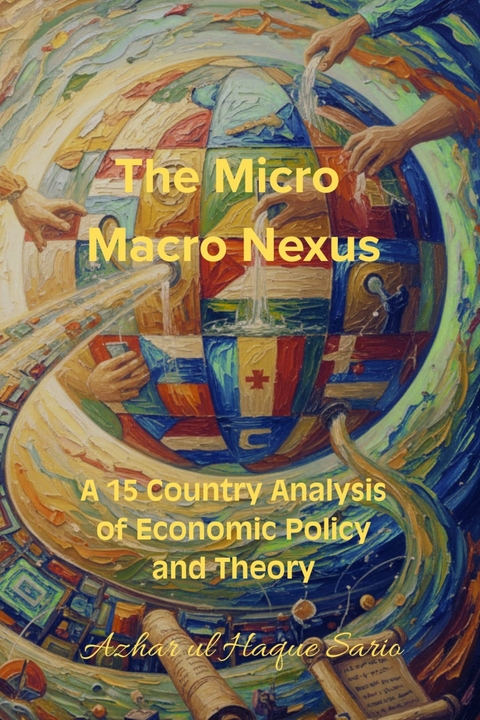
The Micro Macro Nexus (eBook)
184 Seiten
Azhar Sario Hungary (Verlag)
978-3-384-75172-0 (ISBN)
Discover the hidden link that really drives economies.
Hey there! Imagine a book that doesn't just lecture you about GDP numbers or supply curves, but actually shows how tiny rules, incentives, and data points at the ground level end up steering entire nations. That's exactly what The Micro Macro Nexus: A 15 Country Analysis of Economic Policy and Theory does. It dives into fifteen real-world stories-from Germany's rule-obsessed Ordoliberalism to South Korea's chaebol juggernaut, Chile's Chicago-Boys experiment, India's chaotic GST rollout, and the U.S. Inflation Reduction Act's sneaky green subsidies. Each chapter zooms in on one country, one big policy idea, and proves that macro outcomes (growth, crises, inequality) almost always start with micro details: a tax credit here, a zoning law there, a bank refusing to let a zombie firm die, or a nudge changing how people save. Short sentences. Clear examples. No fluff. You'll meet Ordoliberals who feared monopolies more than inflation, Korean bureaucrats who hand-picked conglomerates, Chilean privatizers who created billionaires overnight, and Chinese planners tracking every citizen's behavior in real time. From Japan's lost decades explained by 'zombie' companies to Canada's housing mess caused by local bylaws, the book keeps asking one question: why do some macro policies soar while others crash? The answer is always in the micro plumbing.
What makes this book different from the dusty textbooks or trendy 'big idea' bestsellers? Simple: it refuses to choose sides between micro and macro. Most economics books either drown you in abstract models or serve reheated ideology. This one bridges the gap with fresh 2024-2025 data, granular firm-level evidence, and honest admissions when policies backfired. You won't find recycled Friedman quotes or endless Keynes vs. Hayek debates. Instead, you get competitive advantage through real comparative analysis: Germany's liability obsession versus Korea's top-down industrial bets; New Zealand's radical labor deregulation versus Brazil's stubborn earmarked credit; France building brand-new green macro models versus the UK quietly nudging millions into better choices. It spots patterns others miss-like how modern policy everywhere now uses micro tools (tax credits, blacklists, zoning tweaks, big data) to chase macro dreams. If you're tired of books that promise to explain the world but leave you more confused, this one actually delivers clarity, surprises, and actionable insights you can use whether you're a student, investor, policymaker, or just curious.
© 2025 Independent author. This book is an independently produced work with no affiliation to any government board, university, or cited institution. All country case studies and analyses are presented under nominative fair use for criticism, comment, and scholarship. Sources are publicly available and fully cited.
Part I: Theoretical Foundations: Ideological Blueprints of the Micro-Macro Relationship
Germany: Ordoliberalism’s Social Market Economy: The Micro-Foundations of Macroeconomic Rules
1.1 The Freiburg School's Intellectual Origins: Differentiating Ordoliberalism from Classical Liberalism
The story of German Ordoliberalism is, at its heart, a story of profound crisis. It is not an abstract economic theory conceived in a sterile academic vacuum. Instead, it was forged in the inferno of the 1920s and 1930s, a period when Germany witnessed the complete and utter disintegration of its economic, social, and political order. To understand the "Freiburg School"—the small, brave group of academics who fathered this idea—one must first understand what they were reacting against. They had a front-row seat to the failure of not one, but two, dominant ideologies: the perceived anarchy of laissez-faire capitalism and the totalitarian nightmare of National Socialism.
The founders, intellectuals like the economist Walter Eucken and the lawyer Franz Böhm, were living in Freiburg, a university town in the 1930s and 1940s. They were witnessing the death of the Weimar Republic, a state torn apart by political extremism, social chaos, and the infamous hyperinflation that vaporized the savings and, more importantly, the trust of the middle class. They saw how this economic instability created a vacuum that was eagerly filled by the Nazis. But their critique went deeper. They asked why the system had failed so spectacularly.
Their answer was a radical break from the classical liberalism of Adam Smith, which was often (and perhaps simplistically) interpreted as "leave it alone" (laissez-faire). The Freiburg School argued that this "hands-off" approach was naïve and, ultimately, self-destructive. They believed that a market left to its own devices does not remain free. It inevitably degenerates as powerful actors—cartels, monopolies, and powerful interest groups—use their economic might to capture the state. They rig the rules, block new competitors, and destroy the very competition that classical liberalism celebrated. Eucken wrote of the "interdependence of orders," meaning that economic freedom and political freedom were inseparable. You could not have a free society with a "feudalized" economy dominated by a few corporate barons.
This is the central, foundational insight of Ordoliberalism. It is a "liberalism" that is deeply skeptical of concentrated power, whether that power is held by the state or by private corporations. In their view, the failure of 19th-century laissez-faire was precisely that the state was too weak. It was a passive observer, not a referee. It allowed these "power groups" to form and, in the end, was captured by them. The result, as they saw in both the German Empire and the Weimar Republic, was not a free market but a corrupted, "boundless" system driven by "greed" and "relativism," which ultimately collapsed into "dictatorship."
So, what was their solution? It was not socialism, which they saw as simply replacing private tyrants with a single, all-powerful state tyrant. Their solution was an "organizing state" (Ordnungspolitik or "policy of order"). This is the "Ordo" in Ordoliberalism. The state's primary, proactive, and permanent job is not to direct the economy (like a central planner) but to create and ruthlessly enforce the "economic constitution"—the framework of rules for the market.
This framework is not just a suggestion; it is a strong legal and ethical order. Think of it like a sport. A "laissez-faire" approach would be like dumping 22 players on a field with a ball and no rules, expecting a beautiful game to "naturally" emerge. The result would be chaos, violence, and the victory of the biggest bully. The Ordoliberal approach, by contrast, sees the state as the governing body of the sport. The state writes the rulebook (contract law, property rights), trains and empowers referees (an independent judiciary and a powerful anti-cartel office), and ensures the playing field is level (preventing monopolies).
For example, a core part of Franz Böhm's work was on competition law. He argued that the state must have a powerful and independent competition authority—what would later become Germany's Federal Cartel Office (Bundeskartellamt). This body's job would be to actively break up monopolies and cartels that tried to subvert competition. This was a radical idea at the time. It meant the state was not just an umpire making calls but an active guardian of the process of competition itself. The state sets the arena, enforces the rules, and then—and only then—lets the players compete freely within those rules. This robust, permanent, and "organizing" role is what makes Ordoliberalism a completely different intellectual creature from the Anglo-American tradition of neoliberalism, which often focused more on limiting the state's size rather than defining its quality and strength.
1.2 The Primacy of Price Stability: Macroeconomic Dogma or Microeconomic Necessity?
To anyone observing German economic policy over the last 70 years, the national "obsession with price stability" is its most defining and, to many outsiders, most baffling characteristic. From the structure of the famously independent Bundesbank to Germany's hardline stance during the European sovereign debt crisis, this focus on stable money seems to be a non-negotiable, almost religious dogma. The common explanation, repeated in countless textbooks and articles, is simple: hyperinflation. The trauma of 1923, when wheelbarrows of worthless marks were needed to buy a loaf of bread, is said to have "burned itself into the collective memory," creating a permanent, fear-based demand for a strong currency.
This explanation is not wrong, but it is dangerously incomplete. It's the "lived experience" part of the story, but it's not the intellectual framework. The true Ordoliberal case for price stability, as developed by Walter Eucken and his colleagues, is far deeper, more theoretical, and rooted in microeconomics, not just macro-history. For the Freiburg School, price stability is not merely a desirable goal; it is the absolute, indispensable foundation for a free market to function at all.
Why? It comes down to one of the core constitutional principles of the Ordoliberal framework: the "principle of liability" (Haftungsprinzip). This is an ethical and legal concept before it is an economic one. It states, very simply, that those who make decisions and stand to profit from them must also be fully responsible for the risks and potential losses. Responsibility and control must be unified. If you are shielded from the consequences of your bad decisions, you will make more bad decisions. The market mechanism of profit and loss breaks down, and the system becomes corrupt and inefficient.
What does this have to do with inflation? Eucken argued that inflation is the most powerful and insidious force for destroying the principle of liability. When the value of money is unstable, it becomes impossible to make rational, long-term calculations. Prices are the central nervous system of an economy; they transmit vital information about scarcity and demand. Inflation is like static on the line, distorting every signal. It blurs the line between a smart investment and a lucky gamble. It arbitrarily punishes savers (who see their nest eggs evaporate) and rewards debtors (who can pay back their loans with worthless money).
In an inflationary environment, the link between effort and reward is severed. Liability is socialized. A business that fails is not necessarily poorly run; it may have just been on the wrong side of the monetary distortion. A business that succeeds may not be innovative; it may have just been smart enough to borrow and hoard physical assets. Inflation, in this view, is a form of state-sponsored "boundless relativism." It destroys the "ethical order" of the market by making individual responsibility meaningless. This, Eucken argued, is why the 1920s hyperinflation wasn't just an economic problem; it was a moral catastrophe that directly paved the way for totalitarianism by destroying the middle class and their faith in a rules-based system.
This micro-foundational belief is precisely why the German position during the Eurozone crisis (starting around 2010) was so "dogmatic" and incomprehensible to many in the US and UK. When countries like Greece faced insolvency, the Anglo-American-influenced response was Keynesian and pragmatic: provide massive bailouts, have the European Central Bank (ECB) buy the debt, and do "whatever it takes" to stop the macroeconomic panic.
Germany’s response, guided by this deep Ordoliberal instinct, was one of profound horror. Why? Because the proposed rescue mechanisms, like "Eurobonds" (where all countries would jointly guarantee each other's debt), were a direct violation of the sacred principle of liability. It would mean that German taxpayers (who had no control over Greek fiscal policy) would be made liable for Greek debts. This, to the Ordoliberal mind, is the beginning of the end. It separates liability from control, encourages moral hazard (why would any government practice fiscal discipline if it knows it will be bailed out?), and distorts the price of risk. Germany's "dogmatic" insistence on "rules" (like the Maastricht Treaty's deficit limits) and "structural reforms" (making economies more competitive) in exchange for aid was not just a political power play; it was a direct expression of this core microeconomic and ethical belief that...
| Erscheint lt. Verlag | 11.11.2025 |
|---|---|
| Sprache | englisch |
| Themenwelt | Wirtschaft |
| Schlagworte | Behavioral macroeconomics • Comparative Economic Policy • Developmental state • Inflation Reduction Act • Informal Economy • Macro Prudential Policy • Micro Macro Nexus |
| ISBN-10 | 3-384-75172-8 / 3384751728 |
| ISBN-13 | 978-3-384-75172-0 / 9783384751720 |
| Informationen gemäß Produktsicherheitsverordnung (GPSR) | |
| Haben Sie eine Frage zum Produkt? |
 EPUB (Ohne DRM)
Digital Rights Management: ohne DRM
Dieses eBook enthält kein DRM oder Kopierschutz. Eine Weitergabe an Dritte ist jedoch rechtlich nicht zulässig, weil Sie beim Kauf nur die Rechte an der persönlichen Nutzung erwerben.
Dateiformat: EPUB (Electronic Publication)
EPUB ist ein offener Standard für eBooks und eignet sich besonders zur Darstellung von Belletristik und Sachbüchern. Der Fließtext wird dynamisch an die Display- und Schriftgröße angepasst. Auch für mobile Lesegeräte ist EPUB daher gut geeignet.
Systemvoraussetzungen:
PC/Mac: Mit einem PC oder Mac können Sie dieses eBook lesen. Sie benötigen dafür die kostenlose Software Adobe Digital Editions.
eReader: Dieses eBook kann mit (fast) allen eBook-Readern gelesen werden. Mit dem amazon-Kindle ist es aber nicht kompatibel.
Smartphone/Tablet: Egal ob Apple oder Android, dieses eBook können Sie lesen. Sie benötigen dafür eine kostenlose App.
Geräteliste und zusätzliche Hinweise
Buying eBooks from abroad
For tax law reasons we can sell eBooks just within Germany and Switzerland. Regrettably we cannot fulfill eBook-orders from other countries.
aus dem Bereich