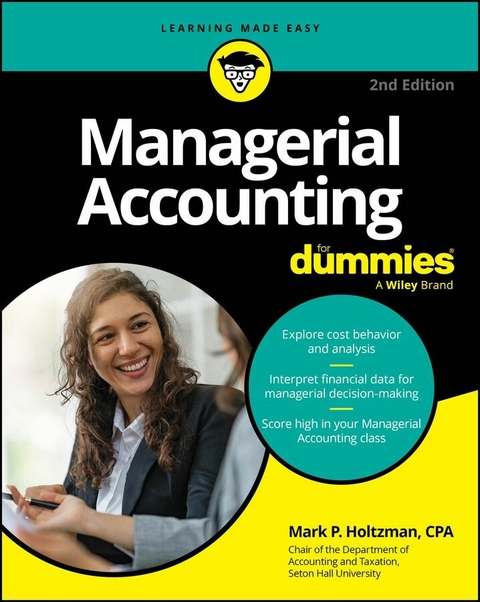
Managerial Accounting For Dummies (eBook)
443 Seiten
For Dummies (Verlag)
978-1-394-36750-4 (ISBN)
An easy-to-understand guide to making informed and effective business decisions
With clear explanations and real-life examples, Managerial Accounting For Dummies gives you the basic concepts, terminology, and methods you need to fully grasp this important area of business, anywhere. You'll know how to identify, measure, analyze, interpret, and communicate the data that drives decision making in every industry. Understand and manage costs, plan, budget, and use these accounting skills for business evaluation and control.
This approachable guide covers all the content in a typical managerial accounting course, making it perfect for students preparing for accounting careers. Professionals looking for a refresher will also benefit from this straightforward resource.
Inside:
- Get clear descriptions of managerial accounting techniques and processes
- Learn how to collect, report, and analyze financial data to drive effective business decisions
- Discover how managerial accounting can improve sustainability and reduce risk
Managerial Accounting For Dummies, 2nd Edition provides comprehensive information on global strategic management, basic data analysis techniques, and beyond-you'll understand all parts of the managerial accounting process and why it matters with this accessible resource.
Mark P. Holtzman, CPA, PhD, is an Associate Professor and Chair of the Department of Accounting and Taxation at Seton Hall University. He is also Associate Principal for Technical Resources with the national accounting firm WithumSmith+ Brown PC.
An easy-to-understand guide to making informed and effective business decisions With clear explanations and real-life examples, Managerial Accounting For Dummies gives you the basic concepts, terminology, and methods you need to fully grasp this important area of business, anywhere. You'll know how to identify, measure, analyze, interpret, and communicate the data that drives decision making in every industry. Understand and manage costs, plan, budget, and use these accounting skills for business evaluation and control. This approachable guide covers all the content in a typical managerial accounting course, making it perfect for students preparing for accounting careers. Professionals looking for a refresher will also benefit from this straightforward resource. Inside: Get clear descriptions of managerial accounting techniques and processes Learn how to collect, report, and analyze financial data to drive effective business decisions Discover how managerial accounting can improve sustainability and reduce risk Managerial Accounting For Dummies, 2nd Edition provides comprehensive information on global strategic management, basic data analysis techniques, and beyond you'll understand all parts of the managerial accounting process and why it matters with this accessible resource.
Introduction
If accounting is the language of business, then managerial accounting is the language inside a business. Accountants establish specific definitions for terms such as revenue, expense, net income, assets, and liabilities. Everyone uses these same definitions when they announce and discuss these attributes, so that when a company reports sales revenue, for example, investors and other businesspeople understand how that figure was calculated. This way, companies, investors, managers, and everyone else in the business community speak the same language, a language for which accountants wrote the dictionary.
Managerial accounting allows a company’s managers to understand how their business operates and gives them information needed to make decisions. It helps them plan their business’s activities and control its operations. Suppose that a marketing executive needs to set a price for a new product. To set that price, the executive needs to understand how much the product costs; that’s where managerial accounting comes in. Furthermore, the price needs to be set at such a level that at the end of the year, when the company sells all the products it’s supposed to sell at whatever prices it sets, it earns the profit and cash flow that it has projected for itself. That, too, is where managerial accounting comes in.
When I teach managerial accounting, I always take care to point out who the users of managerial accounting information usually are. They’re the managers, marketing professionals, financial analysts, and information systems professionals working within a company. All have a role in not only developing managerial accounting information but also, more importantly, using it to make better decisions.
About This Book
Running a business without understanding managerial accounting would be difficult. Therefore, I wrote this book for businesspeople — both present and future — who want to better understand how to use managerial accounting to make decisions and how managerial accountants develop information.
That said, I have a confession to make: Much to the dismay of my wife and the embarrassment of my children, I love to do accounting, especially managerial accounting. And better yet, I love to teach it. I believe that contribution margin is the greatest thing since sliced bread (see Chapter 9) and that planning and controlling operations (Part 4) provides a useful template for planning one’s life. And I often think about and admire the legends of managerial accounting that I introduce in Chapter 23.
For all the bad rap that accounting gets for being boring (and for all that financial accountants, of all people, trash their poor managerial brethren for being the most boring of all accountants), I felt a special calling to commit to writing — and share with you — what I believe makes managerial accounting engaging and (yes) exciting, right here in this book.
Therefore, when you start reading this book and soon find that you can’t put it down, don’t blame me and my lame little puns. Instead, appreciate that after you start discovering accounting, it can be quite difficult to stop.
What You’re Not to Read
I tried to write this book so that it spellbinds you, the reader, such that you feel you can’t put it down until you read the whole thing. I won’t be upset, though, if you can’t resist the temptation to peek at the last few pages to see how it ends.
That said, if you’re the busy type, feel free to focus on the most important stuff that you need to know and skip some of these less important elements:
- Technical Stuff icons: Anything marked with the Technical Stuff icon is especially interesting to managerial accounting geeks like me. However, if you’re in a rush, you can skip these paragraphs.
- Sidebars: These fascinating, gray-shaded boxes include factoids and information that I thought you may enjoy, though you can pick up managerial accounting just fine without reading them.
Foolish Assumptions
To write this book, I had to make certain assumptions about you. I assume that you’re one of the following people:
- A college student taking a managerial accounting course who needs some help understanding the topics you’re covering in class
- A businessperson or entrepreneur who wants to know more about how to collect accounting information to make decisions
- A recent college graduate interested in pursuing a career in managerial accounting, perhaps as a certified management accountant
- A professional accountant or bookkeeper looking for a straightforward refresher in the basics of managerial accounting
How This Book Is Organized
Each of the six parts of this book tackles a different aspect of managerial accounting. The following sections explain how I organized the information so that you can find what you need quickly and easily.
Part 1: Introducing Managerial Accounting
Part 1 gives you just a taste of what managerial accounting is and why it’s important. This part also reviews some important aspects of accounting that every businessperson needs to know. I hit profitability, efficiency, productivity, and continuous improvement especially hard.
Part 2: Managing Costs and Profitability
At its crux, managerial accounting is all about costs — whether they’re direct, indirect, overhead, or whatever — and how those costs behave. What drives costs up, down, or sideways? Part 2 explores the world of costs.
Part 3: Using Managerial Accounting Techniques to Make Decisions
When you understand how costs work, you’re ready to make decisions, and that’s what Part 3 deals with. After a brief spiel about my favorite topic — contribution margin — I explain how to use cost information to make decisions. I cover such areas as whether to buy equipment, which products to make, and how to price.
Part 4: Planning and Controlling Operations
An important part of managing an organization is planning for the future, and managerial accountants play a critical role in this process by preparing budgets, the topic of Part 4. These budgets integrate information from every part of an organization to develop a plan to meet managers’ goals. To make things even more interesting, managerial accountants are responsible for controlling operations — carefully monitoring a company’s performance, and comparing that performance to their budgets. That way, managers can quickly identify and address problems before the problems become crises.
Part 5: Managerial Accounting and Strategy
Managerial accountants also play important roles in risk management, strategic planning, and corporate social responsibility. Sometimes running a company or organization can be something like navigating through a minefield. Managerial accountants help to identify what could go wrong in an organization, and develop systems to control these risks. They also provide information to help companies to stay on track in meeting strategic goals. And they even help managers to implement initiatives to meet environmental, social and governance objectives. Part 5 will dive deeply into these topics.
Part 6: The Part of Tens
The chapters in this part provide you with a quick reference to the most important formulas in the book. I also share some career options for managerial accountants and profile inspirational role models.
Icons Used in This Book
Throughout the margins of this book, certain symbols emphasize important points, examples, and warnings. Watch for these icons:
This icon highlights facts that are especially important to keep in mind. Tucking these facts away helps you keep key concepts at your fingertips.
This icon pops up alongside examples that show you how to apply an idea to real-life accounting problems.
Like building Titanic II, not every idea is a good idea. This icon alerts you to situations that require caution. Look out!
This icon marks simple hints that can help you solve problems on tests and in real-life managerial accounting situations.
I couldn’t resist sharing these interesting tidbits with you. However, if you’re in a hurry, don’t panic; just skip them.
Where to Go from Here
All the chapters in this book are modular, so you can study and understand them without reading other chapters. Just examine the table of contents and pick out a topic you want to know more about. I provide cross-references to topics in other chapters where appropriate, so if you’ve skipped a foundational concept crucial to what you’re reading about, you know where to find what you need.
If you’re looking to discover managerial accounting from scratch, or to unlearn some part of managerial accounting that you fear you learned wrong, start with Part 1 to take in the basics. When writing this book, I took special care to explain all the fundamentals that some managerial accounting texts skip. Students with little or no background in accounting should make a point to read Chapter 2.
Managerial accounting itself is built on a few basic principles. In my experience, most students who have trouble learning managerial...
| Erscheint lt. Verlag | 6.11.2025 |
|---|---|
| Sprache | englisch |
| Themenwelt | Sachbuch/Ratgeber ► Beruf / Finanzen / Recht / Wirtschaft ► Wirtschaft |
| Wirtschaft ► Betriebswirtschaft / Management | |
| Schlagworte | accounting data analysis • accounting equation • Accounting Principles • Business Accounting • Cost Accounting • Financial Accounting • Managerial Accounting • managerial accounting book • managerial accounting guide • managerial accounting study guide • managerial accounting textbook |
| ISBN-10 | 1-394-36750-3 / 1394367503 |
| ISBN-13 | 978-1-394-36750-4 / 9781394367504 |
| Informationen gemäß Produktsicherheitsverordnung (GPSR) | |
| Haben Sie eine Frage zum Produkt? |
 EPUB (Adobe DRM)
Kopierschutz: Adobe-DRM
Adobe-DRM ist ein Kopierschutz, der das eBook vor Mißbrauch schützen soll. Dabei wird das eBook bereits beim Download auf Ihre persönliche Adobe-ID autorisiert. Lesen können Sie das eBook dann nur auf den Geräten, welche ebenfalls auf Ihre Adobe-ID registriert sind.
Details zum Adobe-DRM
Dateiformat: EPUB (Electronic Publication)
EPUB ist ein offener Standard für eBooks und eignet sich besonders zur Darstellung von Belletristik und Sachbüchern. Der Fließtext wird dynamisch an die Display- und Schriftgröße angepasst. Auch für mobile Lesegeräte ist EPUB daher gut geeignet.
Systemvoraussetzungen:
PC/Mac: Mit einem PC oder Mac können Sie dieses eBook lesen. Sie benötigen eine
eReader: Dieses eBook kann mit (fast) allen eBook-Readern gelesen werden. Mit dem amazon-Kindle ist es aber nicht kompatibel.
Smartphone/Tablet: Egal ob Apple oder Android, dieses eBook können Sie lesen. Sie benötigen eine
Geräteliste und zusätzliche Hinweise
Buying eBooks from abroad
For tax law reasons we can sell eBooks just within Germany and Switzerland. Regrettably we cannot fulfill eBook-orders from other countries.
aus dem Bereich