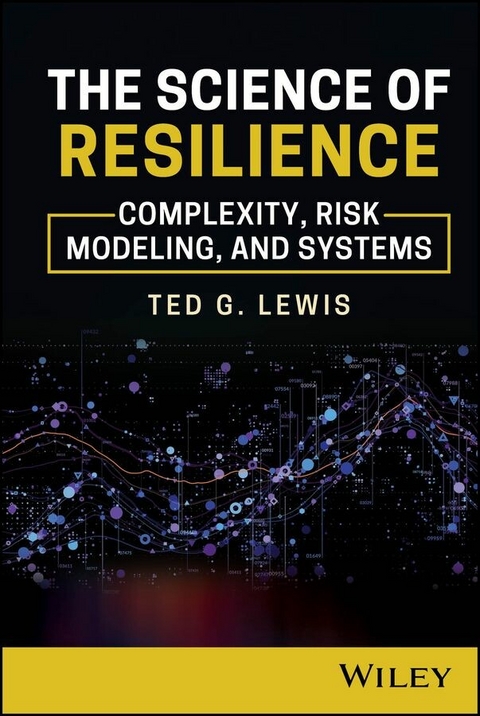
The Science of Resilience (eBook)
350 Seiten
Wiley (Verlag)
978-1-394-35493-1 (ISBN)
Strategies for improving resilience, incorporating complexity theory, risk analysis, and systems thinking with a rigorous mathematical treatment
The Science of Resilience delves into the fascinating field of resilience science, exploring how various systems, ranging from physical infrastructure to social networks, can withstand and recover from disruptions. This interdisciplinary subject combines principles from complexity theory, risk analysis, and systems thinking to understand and mitigate the impacts of events like natural disasters, cyber-attacks, and economic crises. By using mathematical models and real-world examples, the book provides practical tools and strategies for designing resilient systems that can adapt and thrive in the face of uncertainty.
Written by a highly qualified author with significant experience in the field, this book:
- Covers synchronization, bottleneck analysis, epidemic modeling, social network disinformation and how to counter it, and restructuring a system to increase resilience
- Explains phase change and shows how to apply it to general complex systems
- Integrates rigorous mathematical models with real-world applications through mini case studies and hypothetical examples covering physical, economic, and social systems
- Provides tools and strategies to design resilient systems, analyze potential risks, and plain for resilience
Addressing an important gap in risk and resilience literature, this book offers valuable insights for engineering and systems design professionals, complexity science and risk analysis researchers, and graduate students in related fields, as well as anyone interested in the science of resilience.
Ted G. Lewis is an author and computer scientist with expertise in applied complexity theory, homeland security, infrastructure systems, and early-stage startup strategies. He was inducted into the Oregon State University Engineering Hall of Fame in 2021. He has served in government, industry, and academia over an extensive career. He has also served as the Editor-in-Chief of several periodicals including IEEE Computer Magazine and is a member of the IEEE Computer Society Board of Governors.
Strategies for improving resilience, incorporating complexity theory, risk analysis, and systems thinking with a rigorous mathematical treatment The Science of Resilience delves into the fascinating field of resilience science, exploring how various systems, ranging from physical infrastructure to social networks, can withstand and recover from disruptions. This interdisciplinary subject combines principles from complexity theory, risk analysis, and systems thinking to understand and mitigate the impacts of events like natural disasters, cyber-attacks, and economic crises. By using mathematical models and real-world examples, the book provides practical tools and strategies for designing resilient systems that can adapt and thrive in the face of uncertainty. Written by a highly qualified author with significant experience in the field, this book: Covers synchronization, bottleneck analysis, epidemic modeling, social network disinformation and how to counter it, and restructuring a system to increase resilience Explains phase change and shows how to apply it to general complex systems Integrates rigorous mathematical models with real-world applications through mini case studies and hypothetical examples covering physical, economic, and social systems Provides tools and strategies to design resilient systems, analyze potential risks, and plain for resilience Addressing an important gap in risk and resilience literature, this book offers valuable insights for engineering and systems design professionals, complexity science and risk analysis researchers, and graduate students in related fields, as well as anyone interested in the science of resilience.
1
Sandpiles, Long Tails, and Complex Catastrophes
Terrorist attacks, floods, nuclear power meltdowns, economic collapses, political disruptions, and natural events like earthquakes come and go in waves – they are bursty – arriving sporadically with uneven consequences that are “long‐tailed” rather than purely random. We ask why?
The modern world differs from the past mainly due to vast network connections that replace independent parts acting independently. This applies to all kinds of systems – both physical and socio‐economic. Today, most systems are highly dependent on one another. The actions of one system affect other systems increasing the probability of a catastrophic cascade event conditioned on a tripping event. That is, the probability of an incident is no longer independent and represented by the normal distribution – it is highly dependent on other events. This abolishes the normal distribution as an explanation for catastrophes replacing it with a long‐tailed power law distribution.
For example, a tsunami far across the Pacific created by an earthquake under the ocean northeast of the Japanese islands swept over the northeast coast of Japan, overwhelming the retaining wall protecting the nuclear reactor at Fukushima daiichi [reactor number one in Fukushima Prefecture]. A chain reaction that began in the Pacific Ocean propagated disaster through miles of Blue Ocean, seashore, retaining wall, and very thick cement walls into the heart of one of Japan’s nuclear power plants. This was the immediate consequence of the Great East Japan Earthquake (also known as the 2011 Tohoku earthquake). The consequences spread to both physical and economic systems across the globe. The connectivity led to an avalanche of consequences.
The 21st century is an age of lopsided long‐tailed probability distributions rather than the classical normal distribution. Like an episodic tsunami striking the beach, modern‐day events come and go in bursts – most are clustered together in time and space, with bursts separated in time, space, and consequence according to a power law. This model of reality is a form of punctuated reality, characterized by wave‐like behavior of modern complex systems.
Scale is another property of the punctuated 21st century – both big and small events are subject to the same long‐tailed fingerprint. Aerial and close‐up wave‐counting experiments produce long‐tailed distributions, but at different scales. We say that wave‐intervals scale because whether I measure the intervals from near or far, both measurements produce a long‐tailed distribution. This curious fact is profound because it says something about the similarity of earth‐shaking events versus insignificant events – earth‐shaking events are a lot like everyday small events – only bigger. It is a matter of scale.
Long‐tailed distributions like the ones described in this book are called scalable, or self‐similar, because they are fractals. In simple terms, a fractal looks the same at all scales. Take a magnifying glass to a long‐tailed distribution like the ones shown in this book, and you get another long‐tailed distribution! They all look identical regardless of how near or far away they are observed. Ocean waves and many worldly events such as changes in stock market indexes look similar at different scales – that is, they exhibit self‐similarity. The underlying patterns are the same regardless of how far or close we observe them.1
Many more events in modern life obey fractal or self‐similar distributions than ever before in history. [This is a big claim that will take the rest of this book to justify]. Big waves (tsunamis) are just like small waves (Asilomar Beach), in terms of frequency of time intervals. The time scale (or size scale) may change, but the underlying phenomenon is the same. Big events mimic small events, and vice versa. For example, big events like the Arab Spring in Tunisia and Egypt in 2011 mimic self‐similar small events like Occupy Wall Street, and the American Tea Party movement. Even small flashmob events that pass with little notice are fractals – disturbances operating at a relatively small scale. Similarly, political protests occur at all scales, but when aggregated into a frequency distribution, they obey a long‐tailed distribution just like the ocean waves.
Fractal nature of nature: Observations made at different scales often belie the same underlying structural dynamics – punctuated, self‐similar, and long‐tailed.2
Some say history repeats itself, but I say history replicates self‐similar fractals. Large‐scale hurricanes, terrorist attacks, nuclear power meltdowns, financial collapses, and earthquakes are simply scaled‐up small hurricanes, attacks, nuclear power hazards, financial disruptions, and earth tremors. Incidents like these happen all the time, but most of them go unnoticed (fall on the left end of the long‐tailed distribution), while a small number of extreme events blow up in our face (and fall on the right end of the long‐tailed distribution). Instead of repeating itself, history repeats a self‐similar pattern at different scales. Mark Twain got it right when he said, “History doesn't repeat itself, but it often rhymes.”
We put the power law to work modeling complex systems subject to faults due to connectivity of systems. The power law is a result of connectivity – structure that renders the likelihood of an incident conditional on prior incidents. Like dominos falling because an adjacent domino fell, the next incident is predicated on earlier incidents and conditions.
This chapter presents basic concepts of risk and resilience in complex systems under stress:
- Resilience is defined in terms of a system under stress and its reaction. The components of resilience are (and not limited to) design, resistance, absorption, adaptation, and recovery. The profile of an incident is represented as a v‐shaped incident profile curve.
- We define systems as black boxes with inputs and outputs subject to stresses that lead to failures with consequences. Accordingly, we model stress and consequences as probabilistic or stochastic functions that follow a power law with slope q, also known as the fractal dimension, leading to a fundamental mathematical theory of resilience.
- System behaviors that demonstrate long‐tailed power laws (q < 1) are considered complex. They hold the potential for complex catastrophe, as gauged by the slope, q, of their exceedance probability distribution.
- Exceedance is the probability an incident will equal or exceed a certain consequence. It can be computed two ways: (1) binned or (2) ranked. We explore both to show the advantages of each and compare their accuracy.
- These concepts are developed from their origins in the work of Per Bak and his simulations of avalanches in a hypothetical sandpile. These became known as the BTW experiment and form the basis of the science of resilience.
- We extend Bak’s theory to include exceedance probability, risk, and MPL – maximum probable loss as measures of risk and resilience.
- We find that risk and resilience depend solely on the fractal dimension, q, obtained by data analysis of recorded faults in real systems.
The Many Faces of Resilience
Intuitively, a resilient system is one that tolerates faults, rapidly recovers, and continues to operate, perhaps with less performance, while under stress [1]. Figure 1.1 illustrates the general idea applied to the BTW experiment. Stress is always present at some level and leads to an incident with consequences.
In contrast, Taleb [2] defines a resilient system as an antifragile system possessing an increase in capability to thrive as a result of stressors, shocks, volatility, noise, mistakes, faults, attacks, or failures. Taleb’s definition suggests that resilience is an increase of function above “normal operating capacity” in order to compensate for stresses. Antifragility implies additional cost and capability in anticipation of stress, while resilience is a property of systems in general, regardless of their capacity for handling stress.
Resilience and resilient system design touches on at least six dimensions of systems subject to stress:
- Resilience by design – structure, redundancy, etc.
- Resistance to stress – structure, anti‐fragility, etc.
- Absorbance of stress – redundancy, backup, etc.
- Adaptation – lowering vulnerability/consequences by re‐design
- Recovery – time to recover, backup, restart, etc.
While we will not cover all of these aspects of systems capable of recovering from a damaging incident, we will focus on many of the attributes above, such as structure, redundancy, buying down vulnerability, and time to recover. The model proposed here assumes an unexpected incident of probabilistic magnitude will occur with a probability determined by past history, for example, a frequentist approach to disaster.
Figure 1.1 Idealized profile of an incident and its...
| Erscheint lt. Verlag | 5.11.2025 |
|---|---|
| Sprache | englisch |
| Themenwelt | Technik ► Bauwesen |
| Wirtschaft ► Betriebswirtschaft / Management | |
| Schlagworte | Carrying Capacity • Co-Evolution • Critical point • exceedance • Fault Tree • Lotka--Volterra equations • maximum probable loss • probability risk assessment • Resilience • resilience failure • Self-Organization • Surge capacity • Tipping Point |
| ISBN-10 | 1-394-35493-2 / 1394354932 |
| ISBN-13 | 978-1-394-35493-1 / 9781394354931 |
| Informationen gemäß Produktsicherheitsverordnung (GPSR) | |
| Haben Sie eine Frage zum Produkt? |
 EPUB (Adobe DRM)
Kopierschutz: Adobe-DRM
Adobe-DRM ist ein Kopierschutz, der das eBook vor Mißbrauch schützen soll. Dabei wird das eBook bereits beim Download auf Ihre persönliche Adobe-ID autorisiert. Lesen können Sie das eBook dann nur auf den Geräten, welche ebenfalls auf Ihre Adobe-ID registriert sind.
Details zum Adobe-DRM
Dateiformat: EPUB (Electronic Publication)
EPUB ist ein offener Standard für eBooks und eignet sich besonders zur Darstellung von Belletristik und Sachbüchern. Der Fließtext wird dynamisch an die Display- und Schriftgröße angepasst. Auch für mobile Lesegeräte ist EPUB daher gut geeignet.
Systemvoraussetzungen:
PC/Mac: Mit einem PC oder Mac können Sie dieses eBook lesen. Sie benötigen eine
eReader: Dieses eBook kann mit (fast) allen eBook-Readern gelesen werden. Mit dem amazon-Kindle ist es aber nicht kompatibel.
Smartphone/Tablet: Egal ob Apple oder Android, dieses eBook können Sie lesen. Sie benötigen eine
Geräteliste und zusätzliche Hinweise
Buying eBooks from abroad
For tax law reasons we can sell eBooks just within Germany and Switzerland. Regrettably we cannot fulfill eBook-orders from other countries.
aus dem Bereich