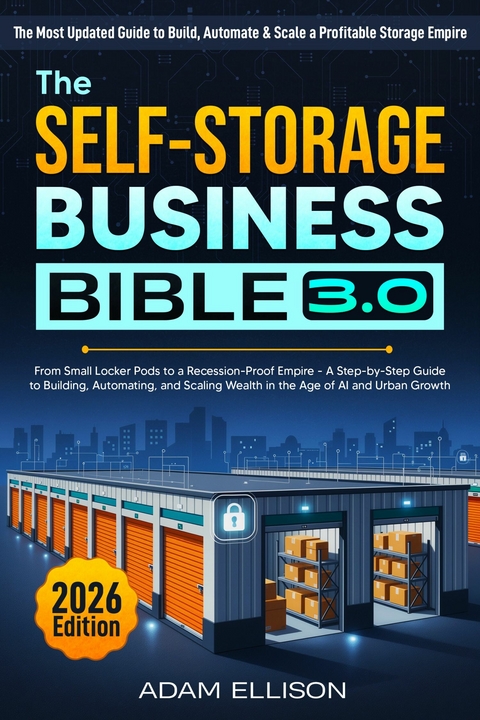
The Self-Storage Business Bible 3.0 (eBook)
182 Seiten
Publishdrive (Verlag)
978-0-00-109533-5 (ISBN)
INTRODUCTION
Why Self-Storage Is America’s Most Underrated Business
Across the landscape of American enterprise, few sectors remain as quietly powerful as self-storage. Often dismissed as unglamorous, it has proven to be one of the most consistent and profitable business models in modern real estate — combining the stability of property ownership with the adaptability of a scalable service.
For decades, the industry has lived in the shadow of flashier fields like tech startups, luxury developments, and Wall Street investments. Yet behind this modest façade lies a business that performs steadily through economic booms and recessions alike. Its resilience comes from a structure that is both simple and efficient: real estate that generates recurring income with minimal upkeep.
At its foundation, self-storage is a property-based business. Investors acquire or lease land, develop functional facilities, and rent individual spaces to customers. Unlike residential or office properties, however, the operational demands are minimal. There are no tenants to manage, few maintenance emergencies, and limited staff requirements. Once a facility is up and running, expenses stay low while the cash flow remains steady.
What makes the model even more appealing is its service component. Self-storage isn’t just about owning space; it’s about providing convenience, flexibility, and security. Customers range from families storing personal belongings to small businesses keeping excess inventory or seasonal equipment. This broad customer base ensures a reliable income stream, unaffected by downturns in any single market segment.
Resilience is at the core of the industry’s success. Demand for storage rarely declines — it simply shifts. During economic growth, individuals accumulate more possessions, relocate for new jobs, or start businesses that require storage. During recessions, people downsize, move, or consolidate, creating new storage needs. This counter-cyclical pattern keeps occupancy levels stable and makes the business nearly recession-proof.
Scalability adds another layer of attraction. Starting small is not only possible but often strategic. Many entrepreneurs begin with one facility or even a set of modular locker pods, expanding as profits compound. The modular design of storage units allows for easy construction in phases, ensuring that growth aligns with demand and available capital. Each new unit or facility becomes an additional income-producing asset without dramatically increasing overhead.
Profitability in self-storage consistently outperforms many traditional real-estate categories. Strong rental yields, low staffing needs, and predictable operating expenses translate into impressive margins. Because facilities are valued primarily by their net income rather than comparable sales, owners can directly influence property value through efficient management and marketing. Well-run storage businesses become cash-flow engines that steadily build equity over time.
Despite all this, the industry remains underrated. Its low visibility plays a major role: storage centers often sit on the outskirts of towns, away from main commercial corridors, with little public recognition. The business lacks the glamour of high-rise construction or the allure of tech innovation. Yet this quiet image is precisely what makes it attractive — it thrives on reliability, not speculation.
For entrepreneurs who value stability and measurable growth, self-storage represents one of the clearest paths to financial independence. It blends the tangible security of real estate with the recurring revenue of a service enterprise. It performs in expansion and contraction, and it scales naturally without the risks tied to volatile markets.
The true opportunity lies in recognizing what most overlook: a business model that rewards operational discipline, leverages technology for efficiency, and generates wealth over time. Self-storage is not just a side investment — it’s a long-term platform for building a durable, recession-resistant empire.
From Chaos to Cash Flow — The Rise of the Self-Storage Revolution
The rise of the self-storage industry is a story of reinvention — how a fragmented, overlooked market evolved into one of the most reliable and profitable sectors in modern real estate. It’s a journey defined by vision, innovation, and the steady refinement of a simple idea: turning empty space into recurring income.
In its early years, the industry was dominated by independent, family-run facilities scattered across the country. Most of them were basic — corrugated metal units, minimal lighting, and padlocked doors on gravel lots. Security was inconsistent, amenities were sparse, and customer experience was rarely a priority. Operations were informal, bookkeeping was manual, and marketing often consisted of little more than roadside signs. Self-storage existed, but it lacked identity, standardization, and professionalism.
Beneath that rough exterior, however, was an extraordinary business model waiting to be developed. Americans were accumulating more possessions, relocating more frequently, and living in smaller spaces. The demand for storage was growing, but the industry hadn’t yet adapted to meet it at scale. Entrepreneurs began to recognize the potential — a low-maintenance, high-margin service that could thrive in almost any economy.
The first major shift came through consolidation. Larger operators and real estate groups started acquiring small facilities, merging them into recognizable brands with centralized management. This move introduced consistency, improved customer service, and leveraged economies of scale. National and regional networks replaced scattered independents, laying the groundwork for an organized, data-driven industry.
The next transformation came through technology. Operators began implementing digital management systems, online reservations, and automated access control. Surveillance cameras replaced security guards, and dynamic pricing software replaced guesswork. These innovations streamlined operations, cut costs, and gave customers the convenience they had come to expect from other service sectors. What once looked like a simple real estate play began to operate like a modern tech-enabled business.
The third transformation arrived through financial sophistication. Institutional investors entered the space, bringing advanced financing tools and valuation models. REITs emerged, giving self-storage the same legitimacy as multifamily or commercial real estate. Operators embraced strategic debt, equity partnerships, and yield optimization models. Pricing became dynamic, capital structures became efficient, and the industry began to attract serious capital — not as a niche investment, but as a mainstream asset class.
Today, the self-storage industry represents one of the most refined and dependable business models in the United States. Facilities generate consistent cash flow, enjoy high occupancy rates, and require minimal operational oversight. The model appeals to both private investors seeking passive income and institutional players building large-scale portfolios.
And yet, the transformation continues. A new wave of innovation is reshaping the landscape again — driven by urbanization, automation, and shifting consumer behavior. The rise of dense cities and minimalist lifestyles has fueled demand for compact micro-storage units and locker pods. Automation is creating fully contactless facilities operated remotely with smart locks and cloud systems. Subscription-based models now offer flexible, on-demand storage, blending convenience with recurring revenue. Sustainability trends are introducing eco-efficient buildings powered by solar energy and designed with smaller footprints for urban markets.
The modern self-storage business stands at the intersection of real estate, technology, and consumer service. Its evolution from disorganized beginnings to streamlined profitability illustrates the enduring strength of innovation and adaptation. What began as a simple collection of metal boxes has become a sophisticated ecosystem built on automation, efficiency, and recurring income — proof that even the simplest ideas can redefine entire industries when executed with vision.
Your Roadmap to a Recession-Proof Empire
Building a recession-proof empire demands strategy, foresight, and adaptability. It requires understanding how to operate within an economy that constantly shifts — where inflation rises, consumer habits evolve, and technology reshapes industries overnight. In this environment, self-storage stands out as one of the few business models capable of thriving through both expansion and contraction. Its dual nature — part real estate, part service enterprise — gives entrepreneurs the ability to build lasting wealth while minimizing volatility.
The path to that stability is not linear. Success in self-storage comes from building layer by layer — informed planning, precise execution, and continuous optimization. Each decision compounds over time, turning small beginnings into scalable, resilient operations that can withstand any economic climate. With discipline and the right structure, the reward is financial independence, recurring income, and a business immune to the market’s usual extremes.
The first milestone on this roadmap is mastering the fundamentals. Every successful operator understands how rentable space, occupancy rates, and net operating income work together to drive profitability. Knowing how to read your facility’s performance metrics is as important as understanding property...
| Erscheint lt. Verlag | 2.11.2025 |
|---|---|
| Sprache | englisch |
| Themenwelt | Wirtschaft ► Betriebswirtschaft / Management |
| ISBN-10 | 0-00-109533-1 / 0001095331 |
| ISBN-13 | 978-0-00-109533-5 / 9780001095335 |
| Informationen gemäß Produktsicherheitsverordnung (GPSR) | |
| Haben Sie eine Frage zum Produkt? |
 EPUB (Adobe DRM)
Größe: 3,3 MB
Kopierschutz: Adobe-DRM
Adobe-DRM ist ein Kopierschutz, der das eBook vor Mißbrauch schützen soll. Dabei wird das eBook bereits beim Download auf Ihre persönliche Adobe-ID autorisiert. Lesen können Sie das eBook dann nur auf den Geräten, welche ebenfalls auf Ihre Adobe-ID registriert sind.
Details zum Adobe-DRM
Dateiformat: EPUB (Electronic Publication)
EPUB ist ein offener Standard für eBooks und eignet sich besonders zur Darstellung von Belletristik und Sachbüchern. Der Fließtext wird dynamisch an die Display- und Schriftgröße angepasst. Auch für mobile Lesegeräte ist EPUB daher gut geeignet.
Systemvoraussetzungen:
PC/Mac: Mit einem PC oder Mac können Sie dieses eBook lesen. Sie benötigen eine
eReader: Dieses eBook kann mit (fast) allen eBook-Readern gelesen werden. Mit dem amazon-Kindle ist es aber nicht kompatibel.
Smartphone/Tablet: Egal ob Apple oder Android, dieses eBook können Sie lesen. Sie benötigen eine
Geräteliste und zusätzliche Hinweise
Buying eBooks from abroad
For tax law reasons we can sell eBooks just within Germany and Switzerland. Regrettably we cannot fulfill eBook-orders from other countries.
aus dem Bereich