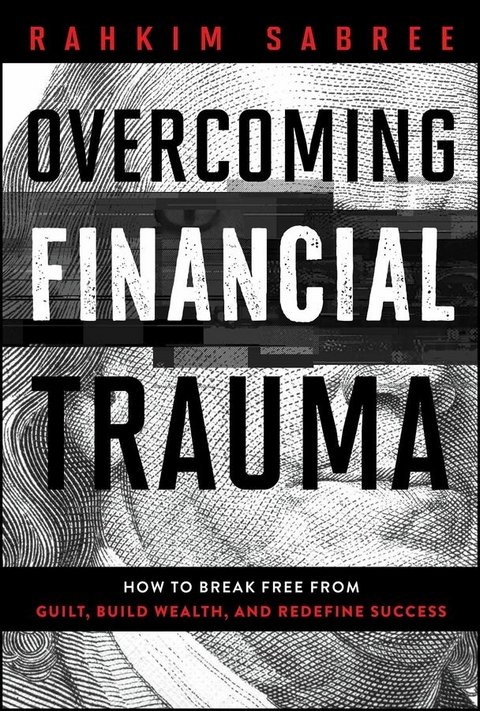
Overcoming Financial Trauma (eBook)
247 Seiten
Wiley (Verlag)
978-1-394-34125-2 (ISBN)
An invaluable, hands-on guide to understanding your financial past while building a secure financial future
In Overcoming Financial Trauma: How to Break Free from Guilt, Build Wealth, and Redefine Success, award-winning financial therapist Rahkim Sabree delivers a deeply honest and supportive discussion of how to get to the root of your financial trauma. The author helps you identify triggers for nervous system dysregulation that result in financial anxiety and financial stress, demonstrating the importance of financial psychology and behavioral finance, as well as financial therapy as an effective solution.
This book introduces Rahkim's 3 E framework for overcoming financial trauma as a healing reframe for everyone who has been primed to view their financial failures through a lens of personal shortcomings. You'll learn how to navigate the guilt, shame, and fear that naturally arise from this old mindset. You'll also find:
- Introductions to effective financial education, along with an acknowledgement of systemic barriers to financial success and social commentary
- Exercises utilizing mindfulness and personal audits
- Culturally relevant personal anecdotes and real-life stories of overcoming formidable obstacles
A powerful new resource for human resource professionals, first-generation high-income earners, and anyone else doing their best to make their financial way in a market that's increasingly challenging to navigate, Overcoming Financial Trauma is filled with actionable strategies and a liberating new way of understanding your financial choices and situation.
RAHKIM SABREE is an award-winning financial therapist and an Accredited Financial Counselor®. He's a Forbes columnist, keynote speaker, and author who specializes in financial trauma, broaching such topics as wealth, mental health, and race. His work has been seen or featured in TED talks, The New York Times, Investopedia, Black Enterprise, The Grio, CNBC Make It, Business Insider, and more.
An invaluable, hands-on guide to understanding your financial past while building a secure financial future In Overcoming Financial Trauma: How to Break Free from Guilt, Build Wealth, and Redefine Success, award-winning financial therapist Rahkim Sabree delivers a deeply honest and supportive discussion of how to get to the root of your financial trauma. The author helps you identify triggers for nervous system dysregulation that result in financial anxiety and financial stress, demonstrating the importance of financial psychology and behavioral finance, as well as financial therapy as an effective solution. This book introduces Rahkim's 3 E framework for overcoming financial trauma as a healing reframe for everyone who has been primed to view their financial failures through a lens of personal shortcomings. You'll learn how to navigate the guilt, shame, and fear that naturally arise from this old mindset. You'll also find: Introductions to effective financial education, along with an acknowledgement of systemic barriers to financial success and social commentary Exercises utilizing mindfulness and personal audits Culturally relevant personal anecdotes and real-life stories of overcoming formidable obstacles A powerful new resource for human resource professionals, first-generation high-income earners, and anyone else doing their best to make their financial way in a market that's increasingly challenging to navigate, Overcoming Financial Trauma is filled with actionable strategies and a liberating new way of understanding your financial choices and situation.
Chapter 2
Vicarious Trauma and Financial Fear Through Observation
Client Story: Megan and Joel
Megan and Joel were a young couple living in New York City who came to me for financial therapy. They weren't on the same page financially and, despite being a high‐income household, struggled with debt living paycheck to paycheck. When we initiated our session, Joel, the breadwinner, shared with me that he already knew what I was going to say about their situation: that they should know better, and that they did, both coming from a background in banking. Before letting him continue, I stopped him and assured him that he in fact did not know what I was going to say and that I was there to support him and his wife, not guilt or shame them into submission. As I watched his shoulders relax a bit, we started discussing the numbers and the subsequent issues behind them. When I asked him how he felt about all he had shared, he replied, “like an idiot.”
Joel did most of the talking initially, sharing his goals, his values, and his financial behaviors with me. He valued being a provider and earning a majority of the household income. He valued spending time with friends and had poorly established financial boundaries when it came to social spending. I noticed when discussing going out to eat with friends specifically, there was a difference in opinion on splitting the bill evenly versus paying only for what they ordered. Megan felt it was rude not to split it evenly, and Joel's body language indicated he disagreed.
Megan was a creative entrepreneur, and a portion of Joel's income went to supporting her business. As they racked up credit card debt, balancing an expensive rent and lifestyle expenses, Joel's plate was full, and he didn't want to stay in this cycle of living paycheck to paycheck. I turned to his wife and asked her how she felt hearing all of this and if any of what he shared was new information.
She seemed a bit surprised that things were weighing on him the way they were but didn't seem to want to compromise on any of their spending habits and instead justified why they needed to maintain them. After a bit of hearing what she valued, her background in financial services, and the fluctuations in her entrepreneurial income, I got her to agree that their current lifestyle was not sustainable. I asked them about their plans for the future and whether they were planning for retirement.
This was where things began to unravel.
Joel shared that he knew it was important to plan for retirement, wanted to, but could not afford it due to the financial burdens he carried. Megan, on the other hand, did not believe in saving long‐term due in part to her reaction to financial trauma she absorbed vicariously from her parents, which contributed to her chronic overspending and living in the moment approach to the household finances.
Megan didn't come from a struggling upbringing. Her family had moderate success in real estate. Delaying gratification, her parents built up a significant nest egg before deciding to indulge in the building of a family home. Unfortunately mid‐build, her father had suffered a debilitating illness leaving him unable to work. With the family savings tied up in the unfinished home, the family was forced to liquidate assets at a loss. To make matters worse, she watched her mother spiral, turning to alcohol to cope with losing it all. Megan internalized the emotional scars of these experiences that would shape her approach to money in adulthood. Why save and delay gratification for the future when you could lose it all in an instant? Why not enjoy the money now?
This variable introduces a unique challenge in her marriage because Joel, concerned about his future, experiencing shame and guilt around the debt, and wanting to support his partner, was burning the candle at both ends.
Vicarious Financial Trauma
Vicarious financial trauma is the observation and internalization of someone else's financial pain, fear, or loss without direct experience.
The Adverse Childhood Experiences (ACEs) study revealed strong correlations between early trauma and long‐term health and behavioral outcomes (Felitti et al., 1998). While financial trauma is not named explicitly in the original ACEs questionnaire, it does fit into categories like emotional neglect, household dysfunction, and parental mental health issues.
Witnessing financial struggle—especially as a child—can impact long‐term money habits in a variety of ways. For some, it can create painful associations that encourage vigilance around money and/or disdain for people without it. Think about how you feel walking down a busy street and someone asks you for money. You see their clothes are a bit dated, and they may or may not have a smell of body odor—or worse. You might feel empathetic and want to help. You might feel offended and immediately disengage. You might make a split‐second rationalization that their circumstances are a result of some personal failure and that they will use your money for drugs or alcohol. These feelings are reinforced by the criminalization of homelessness in public spaces. We tell ourselves things like “I don't want to end up like that,” and we do all we can to avoid being associated with having no money. It can be assumed that the disdain we are socialized to have around those who struggle financially is really mislabeled fear of ending up the same.
Observation of financial struggle can also create associations between relationship dynamics such as who has more power and authority in a household or how expressions of love are interpreted.
Children especially may learn to make associations between money and love or affection when socialized with groups of children from different income brackets. The children with less may observe the children with more as being more valued or loved, especially if the things being measured include basic necessities such as food, clothing, or school supplies. I think about my own experiences in elementary school with Scholastic book fairs or school trips and what it felt like when I saw classmates going to the gift shops and buying souvenirs or school supplies. I wasn't the only one who had to sit out the shopping spree, and I remember finding common ground with other kids who couldn't afford to purchase anything. While I never doubted my parents loved me in the moments they had nothing to give, I do remember feeling extra loved when they gave me the few dollars they did have to get something.
Author Note: I've created additional resources to accompany this book including videos, micro courses, and more. Scan the following QR code or visit RahkimSabree.com/resources to access them.
Financial Socialization
As adults we observe how seemingly rich people treat others and are treated—they tend to always get their way, and people move with urgency, fearful of not meeting their needs. Meanwhile, if you are coming from a place of struggle, you are treated as a nuisance.
You are made to wait. You are talked down to and sometimes even yelled at.
These associations won't—often don't—correlate with the development of positive financial habits (especially if you don't know what positive financial habits even are) but rather teach people to hide their financial shortcomings by faking it until they make it while digging themselves deeper into debt regardless of increasing their income over time.
Financial fear through observation or vicarious financial trauma can be triggered directly by observing victims of institutional or interpersonal financial abuse. Redlining, discriminatory lending practices, denial of deposited funds, destruction of personal property, banks, and businesses (Tulsa Massacre, Freedman Bank, and similar), nonpayment of life insurance, repossession, eviction, etc., are just some historical and present‐day examples of institutional abuse.
Interpersonal examples of financial abuse can include the observation of financial control within households. Using money to manipulate people to do things they otherwise wouldn't do or don't want to do by withholding access to resources and necessities or gift giving in exchange for certain outcomes can be examples of financial abuse. Taking advantage of elders via deception, coercion, or manipulation, forcing them to grant power of attorney or change the directions on wills or trusts also fall under this category. Opening service accounts like cable, electricity, phone, or credit cards in the name of an underaged child is also financial abuse.
The subsequent trauma (observed or experienced) is internalized and passed down via distrust, willful nonparticipation, hypervigilance in saving, money avoidance in overspending, or the acquisition of items with perceived value (like jewelry, cars, gold teeth) that can be pawned, sold, or worn/carried if there is a need to move in a hurry.
While clinical and traditionalist views of this behavior may point at deviations from normal and well‐adjusted financial literacy practices, the behaviors are often survival based, cultural instructions coded in reaction to harm caused by the systems,institutions, and people many are told they should blindly trust and accept.
I don't want to get too far into this book before we examine financial trauma through a trauma responsive lens. That means we must dissect and analyze trauma research and the evolution of our understanding of trauma and how...
| Erscheint lt. Verlag | 3.11.2025 |
|---|---|
| Sprache | englisch |
| Themenwelt | Sachbuch/Ratgeber ► Beruf / Finanzen / Recht / Wirtschaft ► Geld / Bank / Börse |
| Wirtschaft ► Betriebswirtschaft / Management | |
| Schlagworte | Economic insecurity • financial anxiety • financial mindfulness • Financial Planning • Financial Psychology • financial stress • financial therapy • financial trauma • financial wellness • money trauma • personal finance • personal finance guide |
| ISBN-10 | 1-394-34125-3 / 1394341253 |
| ISBN-13 | 978-1-394-34125-2 / 9781394341252 |
| Informationen gemäß Produktsicherheitsverordnung (GPSR) | |
| Haben Sie eine Frage zum Produkt? |
 EPUB (Adobe DRM)
Kopierschutz: Adobe-DRM
Adobe-DRM ist ein Kopierschutz, der das eBook vor Mißbrauch schützen soll. Dabei wird das eBook bereits beim Download auf Ihre persönliche Adobe-ID autorisiert. Lesen können Sie das eBook dann nur auf den Geräten, welche ebenfalls auf Ihre Adobe-ID registriert sind.
Details zum Adobe-DRM
Dateiformat: EPUB (Electronic Publication)
EPUB ist ein offener Standard für eBooks und eignet sich besonders zur Darstellung von Belletristik und Sachbüchern. Der Fließtext wird dynamisch an die Display- und Schriftgröße angepasst. Auch für mobile Lesegeräte ist EPUB daher gut geeignet.
Systemvoraussetzungen:
PC/Mac: Mit einem PC oder Mac können Sie dieses eBook lesen. Sie benötigen eine
eReader: Dieses eBook kann mit (fast) allen eBook-Readern gelesen werden. Mit dem amazon-Kindle ist es aber nicht kompatibel.
Smartphone/Tablet: Egal ob Apple oder Android, dieses eBook können Sie lesen. Sie benötigen eine
Geräteliste und zusätzliche Hinweise
Buying eBooks from abroad
For tax law reasons we can sell eBooks just within Germany and Switzerland. Regrettably we cannot fulfill eBook-orders from other countries.
aus dem Bereich