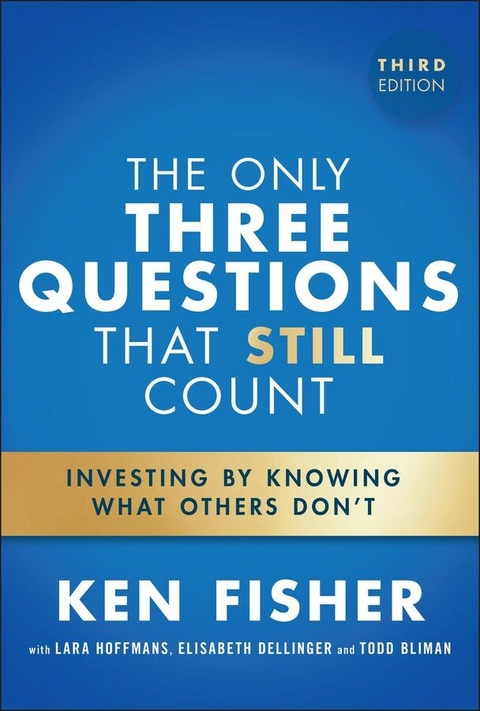
The Only Three Questions That Still Count (eBook)
559 Seiten
Wiley (Verlag)
978-1-394-31886-5 (ISBN)
An insightful and practical guide to beating the markets
In the newly revised third edition of The Only Three Questions That Still Count: Investing By Knowing What Others Don't, renowned investor Ken Fisher delivers an innovative and insightful strategy you can use in your own life to understand and profit from the markets. He offers updated info on how to navigate an increasingly interconnected world, showing investors can improve their odds of success by answering just three questions using only publicly available information.
The author provides a practical framework you can apply immediately-and in the rest of your investing career-to boost your chances of outsized returns. You'll also find:
- More than 100 visuals illustrating the straightforward investing concepts found within
- Strategies to help you challenge yourself, and your preconceived notions, to improve your investing returns
- Updated techniques and strategies that assist retail investors in developing innovative ways to beat the market
Perfect for professional and individual investors, The Only Three Questions That Still Count is also an invaluable resource for anyone with an interest in the markets and investing behavior.
KEN FISHER is the Founder, Executive Chairman, and Co-Chief Investment Officer of Fisher Investments, a $290-plus billion (as of 12/31/2024) investment adviser and money management firm serving large institutions and high-net-worth individuals. For over 32 years, Fisher wrote Forbes' 'Portfolio Strategy' column, making him the longest continuously running columnist in the magazine's venerable history. He now writes monthly, native-language columns in over 20 major media organs worldwide, including the New York Post, Britain's Daily Telegraph, Spain's elEconomista and Italy's Il Sole 24 Ore.
An insightful and practical guide to beating the markets In the newly revised third edition of The Only Three Questions That Still Count: Investing By Knowing What Others Don't, renowned investor Ken Fisher delivers an innovative and insightful strategy you can use in your own life to understand and profit from the markets. He offers updated info on how to navigate an increasingly interconnected world, showing investors can improve their odds of success by answering just three questions using only publicly available information. The author provides a practical framework you can apply immediately and in the rest of your investing career to boost your chances of outsized returns. You'll also find: More than 100 visuals illustrating the straightforward investing concepts found within Strategies to help you challenge yourself, and your preconceived notions, to improve your investing returns Updated techniques and strategies that assist retail investors in developing innovative ways to beat the market Perfect for professional and individual investors, The Only Three Questions That Still Count is also an invaluable resource for anyone with an interest in the markets and investing behavior.
PREFACE
Who Am I to Tell You Something That Counts?
Who am I to tell you anything, much less anything that counts? Or that there are only three questions that count and I know what they are? Why should you bother reading any of this? Why listen to me at all?
As I revisit this book for its third edition—a fact that amazes me to this day—I'm celebrating over half a century in the investment industry. I'm the founder, Executive Chairman, and co‐CIO of my firm, Fisher Investments. When I last updated this book, we were already among the world's largest independent discretionary money management firms. We've only grown since. My firm now stewards the portfolios of more than 100,000 American families—plus thousands in the UK, eurozone, Sweden, Norway, Denmark, Canada, Australia, New Zealand, and Saudi Arabia. Beyond high‐net‐worth individuals, we manage portfolios for an impressive roster of institutions—major corporate and public pension plans, sovereign states, endowments, and foundations—spanning the globe. In all, we manage more than $290 billion for our clients.
I wrote Forbes's “Portfolio Strategy” column from 1984 through 2016, a 32½ year run that made me the longest continuously running columnist in Forbes's long history. Now I write regular, monthly columns in 25 publications worldwide, including the New York Post, Britain's Daily Telegraph, Canada's Globe & Mail, Germany's Focus Money, Spain's elEconomista, Japan's Diamond Weekly, Saudi Arabia's Al Eqtisadiah, and more. I've written 11 books, including four New York Times bestsellers. Along the way, and without really aiming at it, I made the Forbes 400 list of richest Americans.
That's a lot for one lifetime and one professional career. But I'm here to tell you the prime cumulative lesson of my long career is when it comes to investing: There are only three questions that count. And my view on that hasn't changed since I first penned this book. In updating it, my belief in this statement only grew.
In reality, there really is only one question that counts. Or, at least, only one question that really counts. But I don't know how to express that one question in a way you can easily use for everyday investing decisions. If broken down into three subparts, I know how.
And what is that only question that counts? Finance theory is quite clear: The only rational basis for making an investment decision is if you believe somehow, some way, you know something others don't know. The only question that counts is: What do you know that others don't?
Most people don't know anything others don't. Most folks don't think they're supposed to know something others don't. We'll see why. But saying you must know something others don't isn't at all novel. Pretty much everyone who took a basic college investment class learned this, although most people conveniently forgot.
Without answering the question—what do you know that others don't—investing with an aim to do as well or better than the market is futile. I'll say that another way. Markets are pretty efficient at incorporating all currently known information into today's prices. There is nothing new about that statement. It's an established pillar of finance theory and has been repeatedly verified over the decades. If you make market decisions based on the same information others have (or have access to), you will likely do worse than you would have in just sitting passively and taking no action at all. If you try to outguess where the market will go or what sectors will lead and lag or what stock to buy based on what you read online, saw on social media, or chatter about with your friends and peers—no matter how smart or well‐trained you are—you will sometimes be right or lucky or both, but more often be wrong and overall do worse than had you made no trades or transactions at all. Luck, like hope, isn't a strategy. Investing on what everyone knows or sees or chatters about is a strategy for reaping poor investing results.
Perhaps you hate hearing that. But I already told you I didn't know how to express that truism as a single question in a way useful to you. What I can do is show you how to know things other people don't know.
Polling for Perfect Truth
Why is knowing something others don't so important? Financial markets are “discounters” of widely known information—all widely known or discussed information is reflected in securities prices faster than we can say “buy.”
Envision if someone could build an actually accurate poll of all the world's investors. (Yes, yes, I know political polls have proven to have huge blind spots in recent years—use your imagination.) It would include every possible type in just the right proportions. Institutional and retail. Growth and value fans. Small and big cap. Foreign and domestic. FX traders and cryptocurrency fanatics. Meme stock fad‐chasers and penny stock dreamers. Government bond, corporate bond, you name it. Whatever imaginable. Suppose the pollsters polled the sample and the consensus view was the market would rise next month—big time. Could it?
No.
If everyone tended to agree the market would rise next month, anyone with any buying power and a clear mind would buy before then. The market might rise before next month, but only a fool would wait for next month to buy. Hence, next month there would be no subsequent buying power to drive stocks up. It could fall. It could stay flat. But it couldn't rise much. This is an oversimplification, but it's a useful illustration of how whatever we agree on has already been priced into sufficiently liquid markets by the time we can articulate it, and, therefore, it can't occur. Since investors tend to be avid information seekers, the information they have access to has already been reflected in markets via the decisions they made. Think about how quickly a stock's price moves after it releases earnings. By the time you have even skimmed the results and formed a loose opinion, preprogrammed algorithms have traded on that same conclusion. The instant information appears, it is priced.
So it isn't what we all anticipate that moves markets most. It is surprises. The thing few previously fathomed.
Said differently: You may be smarter, wiser, or better trained than the next investor, but finance theory says that isn't enough. No matter how wise you think you are, it's foolhardy to think being smarter or better trained is enough to beat others based on commonly available news and information. And this book's aim is to show how to find things you can know that others can't.
Investing by Knowing What Others Don't
Investing is a difficult, lifetime pursuit. Just knowing the questions isn't enough. You must know what the questions really mean and how to use them. And then you must actually put them to use diligently. Over and over again! The Three Questions don't constitute a craft or a simple “Three Steps to Riches” list. It isn't some Investing Made Easy to‐do list for beating the market. If there were such a thing, I wouldn't be writing this book. You wouldn't read it. Instead, I would put it in a single column and you would glean all you needed to know from it. From there, you would go off and promptly become unimaginably wealthy, perhaps buying your own football team or tropical island. No, it isn't Investing Made Easy. Instead, it's Investing by Knowing What Others Don't.
If you can learn how to use the Three Questions, you can learn to start making better investing decisions. And that should give you an edge over your fellow investors.
Let's think about them. Your fellow investors.
Investing Isn't a Craft
You know some folks are clueless. You don't fear competing with them. But how will you compete with serious professionals who've had serious training, are seriously smart, and have scads of experience? The good news is, in my observation, even most professionals don't have much better long‐term results than average amateur investors. Why? Because, despite being taught they must know something others don't, they forget or ignore it. They fail to get that in their bones.
Typical investors cling to the false premise investing is a craft, like carpentry or doctoring. They don't treat investing like a scientific query session, which is what I'll teach you to do. Instead, consider how they approach it. Maybe they have a few favorite information sources—CNBC, a few news outlets, some blogs, YouTube feeds, and/or a newsletter from their guru du jour. Maybe they have software tracking price patterns. They may have specific rules they adhere to—momentum investing, buy the dips, buy on bad news. They look for clues or signals to buy or sell. They may wait for the S&P 500 and Nasdaq to correspondingly reach certain levels and then they buy or sell or just generally panic. They clock 90‐day moving averages and monitor the VIX (the S&P 500 volatility index) or some other supposedly predictive market indicator. (The VIX is a statistically provable worthless forecaster, by the way—but many people use it every day, applying a wasteful mythology losing more money than it makes.) They believe...
| Erscheint lt. Verlag | 3.11.2025 |
|---|---|
| Co-Autor | Lara W. Hoffmans, Elisabeth Dellinger, Todd Bliman |
| Sprache | englisch |
| Themenwelt | Wirtschaft ► Betriebswirtschaft / Management |
| Schlagworte | Beating the market • individual investing • investing career • investing education • investing framework • investing guide • investing handbook • investing information • investing strategy • investing tips • Investment Strategy • retail investing |
| ISBN-10 | 1-394-31886-3 / 1394318863 |
| ISBN-13 | 978-1-394-31886-5 / 9781394318865 |
| Informationen gemäß Produktsicherheitsverordnung (GPSR) | |
| Haben Sie eine Frage zum Produkt? |
 EPUB (Adobe DRM)
Kopierschutz: Adobe-DRM
Adobe-DRM ist ein Kopierschutz, der das eBook vor Mißbrauch schützen soll. Dabei wird das eBook bereits beim Download auf Ihre persönliche Adobe-ID autorisiert. Lesen können Sie das eBook dann nur auf den Geräten, welche ebenfalls auf Ihre Adobe-ID registriert sind.
Details zum Adobe-DRM
Dateiformat: EPUB (Electronic Publication)
EPUB ist ein offener Standard für eBooks und eignet sich besonders zur Darstellung von Belletristik und Sachbüchern. Der Fließtext wird dynamisch an die Display- und Schriftgröße angepasst. Auch für mobile Lesegeräte ist EPUB daher gut geeignet.
Systemvoraussetzungen:
PC/Mac: Mit einem PC oder Mac können Sie dieses eBook lesen. Sie benötigen eine
eReader: Dieses eBook kann mit (fast) allen eBook-Readern gelesen werden. Mit dem amazon-Kindle ist es aber nicht kompatibel.
Smartphone/Tablet: Egal ob Apple oder Android, dieses eBook können Sie lesen. Sie benötigen eine
Geräteliste und zusätzliche Hinweise
Buying eBooks from abroad
For tax law reasons we can sell eBooks just within Germany and Switzerland. Regrettably we cannot fulfill eBook-orders from other countries.
aus dem Bereich