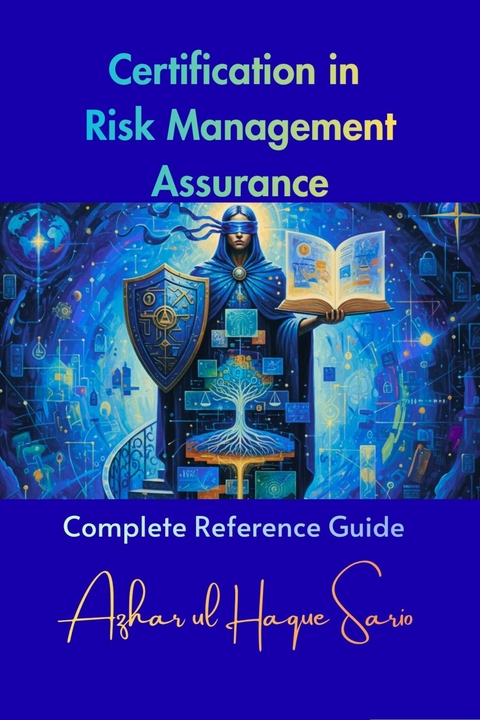
Certification in Risk Management Assurance (eBook)
198 Seiten
Azhar Sario Hungary (Verlag)
978-3-384-74454-8 (ISBN)
Ready to conquer the CRMA® exam and become a certified expert in risk management assurance?
This complete reference guide is your personal roadmap to mastering the Certification in Risk Management Assurance® (CRMA®) exam syllabus. This book is built around the three official domains of the exam. It starts with Section 1, which covers Internal Audit Roles and Responsibilities. This part is 20% of your exam. We will walk through the core competencies you need. You'll learn how to determine the right assurance and consulting services for risk management. The book covers how to maintain organizational independence. It also explains how to coordinate assurance efforts. This includes relying on other assurance providers. You will learn how to help create an organization-wide risk assurance map. Next, the guide dives deep into Section 2, Risk Management Governance. This domain makes up 25% of the exam. This part explains governance, risk, and control frameworks. You will learn to assess the organization's risk culture. This includes concepts like 'tone at the top'. We also cover how to integrate risk management into the organization's strategy. The book teaches you how to evaluate the organization's response to emerging risks. You will also understand how to examine risk reporting to stakeholders. The largest part of the book is dedicated to Section 3, Risk Management Assurance. This final section is 55% of your total score. We cover various approaches for assessing risk. You will learn key data analytics techniques. The book provides a full breakdown of assurance processes. This starts with evaluating management's risk identification process. You will learn to use frameworks to assess organization-wide risks. A key part is learning to prioritize audits to create a risk-based internal audit plan. We also cover managing audit engagements. The guide details how to evaluate cybersecurity, data privacy, and IT controls. Finally, we cover the communication process. This includes managing audit reports. You will learn how to communicate the effectiveness of risk management processes to the board.
This book provides value that other study guides often miss. Many books just present the information, but this Complete Reference Guide is built differently. We recognize that the official syllabus is just an outline. It tells you what you need to know, but not how to apply it. Our guide bridges that gap. It's structured to mirror the exam's official weights, dedicating the most focus to the critical third section, Risk Management Assurance, which makes up 55% of your score. We don't just list concepts like 'risk and control frameworks' or 'data analytics techniques'; we connect them. We explain how a risk-based internal audit plan is influenced by the organization's risk culture and how to communicate all of it effectively. This guide translates the syllabus from a checklist into a comprehensive learning experience, giving you the competitive advantage of understanding the connections between the domains.
Please note: This author has no affiliation with the board or The Institute of Internal Auditors (IIA). This book is an independent study aid produced under nominative fair use to help candidates prepare for the exam.
Section 1: Internal Audit Roles and Responsibilities
Roles and Competencies
Balancing the Dual Mandate: Appropriate IA Services for Risk Management
In today’s business landscape, volatility is the new normal. Organizations face a torrent of complex, interconnected risks, from global supply chain disruptions and sophisticated cyber-attacks to sudden regulatory shifts and the existential questions of climate change. In this environment, effective risk management is not just a compliance exercise; it is a core strategic competency. It is the mechanism that allows an organization to navigate uncertainty, protect its value, and seize new opportunities.
Within this high-stakes arena, the Internal Audit (IA) function is uniquely positioned. It holds an enterprise-wide view, reports directly to the board's audit committee, and is (or should be) staffed with professionals skilled in process, risk, and control. This position, however, presents a fundamental challenge. The board and stakeholders demand objective assurance—an independent, "cold-eyes" review of whether the company’s risk management processes are working. At the same time, management and the executive team crave practical consulting—forward-looking advice and partnership to help them build and improve those very processes.
This is the dual mandate of modern Internal Audit. It is a delicate, essential balance between being the independent auditor and the trusted advisor. The key to success is not choosing one role over the other, but skillfully determining the appropriate services for each, without ever compromising the independence that serves as the function's bedrock. This paper will explore this dual role, defining the specific, appropriate, and value-added services Internal Audit can—and should—provide for risk management.
The Foundation: Understanding the Dual Mandate
Before we can define "appropriate services," we must first clarify our terms. The Institute of Internal Auditors (IIA) formally defines internal auditing as "an independent, objective assurance and consulting activity designed to add value and improve an organization's operations." The definition itself bakes in this dual mandate.
Risk management, particularly Enterprise Risk Management (ERM), is the formal process management uses to identify, assess, respond to, and monitor risks to achieve its objectives. It’s management's job to own this process, full stop.
The central tension lives in one non-negotiable principle: objectivity. Internal Audit's primary value to the board is its independence. If IA becomes responsible for managing risk, it can no longer provide objective assurance over it. This would be like a student grading their own exam.
So, we must view all services through these two distinct lenses:
Assurance Services: These involve an objective assessment of evidence to provide an independent opinion or conclusion. The core question for assurance is: "Is our risk management process designed correctly and working as intended?" This is often a look-back or a current-state review.
Consulting Services: These are advisory in nature and are generally performed at the specific request of management. The key is that management retains full ownership of the outcome. The core question for consulting is: "How can we improve our risk management process?" This is forward-looking and collaborative.
From a "lived experience" perspective, this is the daily tightrope a Chief Audit Executive (CAE) walks. The Audit Committee Chair calls and asks, "I want your independent assurance that management’s new cybersecurity risk program is effective." An hour later, the Chief Information Security Officer (CISO) calls and says, "I'm building that new cyber program and I’d value your team’s advice on best practices for control design." The CAE must serve both masters, and the answer to both is, "Yes." It's all in how it's done.
The Auditor's Lens: Appropriate Assurance Services on Risk Management
Assurance is Internal Audit's home turf. When it comes to risk management, IA should provide assurance over the process, not over the risks themselves. (IA does not, for example, opine on "whether our credit risk is at the right level." It opines on "whether the process for identifying, measuring, and reporting credit risk is effective.")
Here are the primary, appropriate assurance services IA should provide:
1. Auditing the Risk Management Framework (Design Adequacy)
This is a fundamental audit. IA assesses the design of the ERM framework itself, long before looking at any specific risks.
What it is: IA reviews the organization's chosen framework (e.g., COSO ERM, ISO 31000) and compares it to the company's size, complexity, and strategic goals.
Key Questions: Is the framework comprehensive? Does it clearly define roles and responsibilities? Does it cover all relevant risk categories (strategic, operational, financial, compliance)? Is the "risk appetite statement" approved by the board clear and communicated effectively?
Case Study Example: IA at a rapidly growing financial technology (fintech) company performed a "design adequacy" review of its ERM program. The program was copied from the CEO's prior firm, a traditional, slow-moving insurance company. The audit finding was clear: the framework's design was inadequate. It was too bureaucratic, focused on financial and compliance risks, and almost completely ignored the company's primary strategic risks: speed of innovation, talent retention, and platform scalability. This assurance report gave the board the leverage to demand a framework that fit the actual business.
2. Auditing the Risk Management Process (Operating Effectiveness)
This is the "boots-on-the-ground" audit. The company has a framework; is anyone actually following it?
What it is: IA tests the execution of the ERM process. This involves sampling, interviews, and examining documentation.
Key Questions: Are risk assessments actually performed consistently? Is the risk register a living document used for decision-making, or is it "shelf-ware" that's dusted off once a year for the board meeting? Are risk owners actively managing their identified risks?
Case Study Example: At a large consumer goods company, IA audited the supply chain risk management process. The ERM policy stated that all "critical sole-source" suppliers must have a documented and tested contingency plan. IA selected a sample of 20 such suppliers. They found that while the suppliers were correctly identified, 18 of them had no contingency plan on file. The risk was known, but the management process was broken. This assurance finding on process effectiveness led to an immediate overhaul of the procurement team's risk management duties.
3. Evaluating the Accuracy and Relevance of Risk Information
This is one of the most critical assurance roles. The board and executive team make multi-billion dollar decisions based on risk reports. IA must provide assurance that this information is trustworthy.
What it is: IA audits the data pipeline and aggregation logic that feeds into key risk dashboards and reports (e.g., KRI - Key Risk Indicator reports).
Key Questions: Is the data timely, accurate, and complete? Is risk information aggregated correctly from business units to the enterprise level? Are the right risks being reported? Is there a "watermelon" effect (where everything looks "green" on the report, but underneath it's "red")?
Case Study Example: A global bank’s board received a monthly "Liquidity Risk Dashboard" showing healthy reserves. The IA team, as part of its annual plan, audited the data sources feeding that dashboard. They discovered that one of the core systems, based in an Asian subsidiary, was transmitting its data on a 48-hour delay. In a fast-moving liquidity crisis, this 48-hour-old data would be dangerously misleading. The assurance report didn't question the bank's liquidity; it questioned the integrity of the data used to measure it.
4. Assessing the Effectiveness of Risk Responses (Control Audits)
This is IA's traditional "bread and butter," but viewed through an ERM lens.
What it is: Management identifies a risk (e.g., "data breach") and implements a response, which is usually a set of internal controls (e.g., firewalls, encryption, access controls). IA's job is to test those controls to see if they are working and effectively mitigating the risk to an acceptable level.
Key Questions: Are the key controls designed properly? Are they operating effectively? Is the "residual risk" (the risk left over after controls) truly as low as management claims?
Example: Management identifies "inaccurate financial reporting" as a key risk. The control response is "monthly account reconciliations." IA performs an audit by re-performing a sample of those reconciliations. This provides direct assurance on whether the risk response is effective.
The Advisor's Hat: Appropriate Consulting Services for Risk Management
Here, IA changes hats. The goal is to advise, improve, and empower, not to opine. This is where IA can add immense value, but it is also where the "red lines" of independence are most easily crossed. All consulting work...
| Erscheint lt. Verlag | 1.11.2025 |
|---|---|
| Sprache | englisch |
| Themenwelt | Wirtschaft ► Betriebswirtschaft / Management |
| Schlagworte | CRMA • CRMA Exam Prep • CRMA Study Guide • Internal Audit • risk assessment • risk governance • Risk Management Assurance |
| ISBN-10 | 3-384-74454-3 / 3384744543 |
| ISBN-13 | 978-3-384-74454-8 / 9783384744548 |
| Informationen gemäß Produktsicherheitsverordnung (GPSR) | |
| Haben Sie eine Frage zum Produkt? |
 EPUB (Ohne DRM)
Digital Rights Management: ohne DRM
Dieses eBook enthält kein DRM oder Kopierschutz. Eine Weitergabe an Dritte ist jedoch rechtlich nicht zulässig, weil Sie beim Kauf nur die Rechte an der persönlichen Nutzung erwerben.
Dateiformat: EPUB (Electronic Publication)
EPUB ist ein offener Standard für eBooks und eignet sich besonders zur Darstellung von Belletristik und Sachbüchern. Der Fließtext wird dynamisch an die Display- und Schriftgröße angepasst. Auch für mobile Lesegeräte ist EPUB daher gut geeignet.
Systemvoraussetzungen:
PC/Mac: Mit einem PC oder Mac können Sie dieses eBook lesen. Sie benötigen dafür die kostenlose Software Adobe Digital Editions.
eReader: Dieses eBook kann mit (fast) allen eBook-Readern gelesen werden. Mit dem amazon-Kindle ist es aber nicht kompatibel.
Smartphone/Tablet: Egal ob Apple oder Android, dieses eBook können Sie lesen. Sie benötigen dafür eine kostenlose App.
Geräteliste und zusätzliche Hinweise
Buying eBooks from abroad
For tax law reasons we can sell eBooks just within Germany and Switzerland. Regrettably we cannot fulfill eBook-orders from other countries.
aus dem Bereich