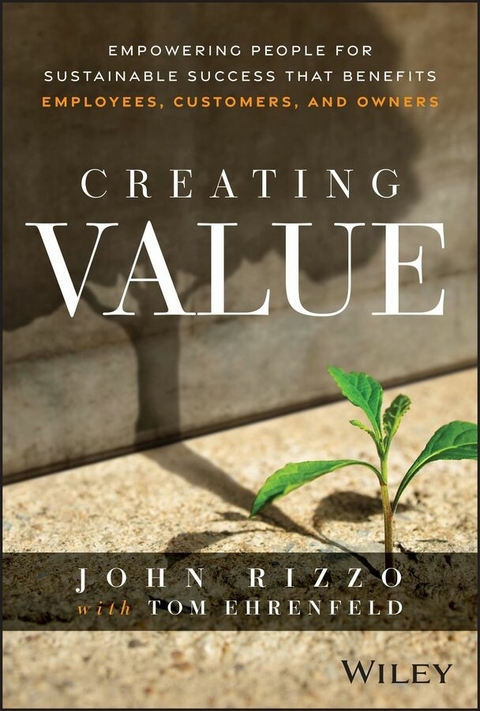
Creating Value (eBook)
210 Seiten
Wiley (Verlag)
978-1-394-34284-6 (ISBN)
Guide to create unlimited value in any organization, supported by rich, granular company stories
Drawing from real stories of how companies relentlessly improved quality, delivery, service, and cost structure, Creating Value: Empowering People for Sustainable Success that Benefits Employees, Customers, and Owners offers simple, powerful ways to think and act to unlock the nascent value of any enterprise. This book shares a dynamic business system that, when practiced authentically, taps into a more focused and productive organization to deliver superior value to customers in a way that improves consistently over time. Author John Rizzo draws from 30 years of leading successful business transformations in a wide range of industries. His approach, which creates sustainable success by empowering people to improve processes continuously, features the following principles:
- Apply a Holistic Business System: Develop a complete framework that integrates strategy deployment, value stream analysis, workshops, and management systems
- Prioritize People Development: Employ techniques that tap the wisdom of those who do the work-the true source of sustainable improvement
- Learning as the Foundation: Discover how hands-on improvement creates deeper understanding and represents the most fundamental type of continuous improvement
- Produce Quality at the Source: Build excellence into processes rather than inspecting for it afterward
- Leverage the Compounding Power of Improvement: Realize the power of small improvements accumulating into breakthrough performance
Creating Value reveals how pursuing excellence leads to outstanding results that endure over years. It is an essential resource for business leaders to dramatically boost employee participation and agency, while steadily increasing profits and boosting enterprise value leading to widely shared creation of value.
JOHN RIZZO has led transformational change at companies including Basin Holdings, Talus Holdings, Crouse-Hinds, and McQuay International, creating billions in value across manufacturing, healthcare, retail, and nonprofit sectors. Through working with 1,000+ teams at 50+ organizations he has proven that sustainable success comes from being present where work happens, listening to those who do it, and developing people at all levels. His approach, refined through learning from Toyota and continuous improvement pioneers demonstrates that engaging frontline workers creates value that top-down management cannot match.
TOM EHRENFELD is a freelance journalist and editorial consultant whose books include The Gold Mine, Lead With Respect, Managing to Learn, and The Lean Strategy. Eleven books that he has edited have won the Shingo Award for Editorial Excellence.
Chapter 1
Move the Machine Six Inches
“Listen to the machine operator and move the machine six inches,” my mentor, Bill Moffitt, who was coaching me in a team improvement workshop, advised me.
My colleagues and I were gathered on the factory floor of the Crouse-Hinds Company on a Monday morning in Syracuse, New York. Crouse-Hinds (then a part of Cooper Industries, now a subsidiary of Eaton Corporation) is a leading manufacturer of electrical equipment, specializing in products designed to withstand hazardous and harsh conditions.
The stakes are high when manufacturing this type of equipment. When a worker is doing electrical installation on an offshore drilling rig in the Gulf of Mexico, for example, an explosion-proof electrical enclosure can mean the difference between a straightforward day on the job and a catastrophic explosion.
On this cold and snowy Syracuse day in 1993, we were gathered to conduct a team improvement workshop. Based on lessons learned by our mentor from Toyota, this workshop was the first of its kind at Cooper Industries. The team consisted of production workers, union officials, supervisors, and management. It is fair to say that everyone in attendance was apprehensive. The members of the team represented a diverse array of disparate—or even competing—interests and agendas.
The goal of that 1993 event was to create flow. Flow is a term that describes any work in process that moves forward without pausing and each piece is completed individually rather than in a batch. Prior to this event, the manufacturing equipment on the factory floor was divided into distinct functional departments. The divisions between the functional departments had prevented work from flowing between stations without conveyance or other delays.
During this workshop, the team brought all the workers together to create a unit called a cell. This reconfigured way of working reduced lead times by shortening the distance the parts had to travel, as well as reducing the amount of time the parts spent “sitting around.”
The potential benefits of the new cell were significant. By eliminating the siloed functional departments and creating cells, we enabled faster delivery, immediate identification of quality issues, lower cost from less handling, and less inventory.
Making these changes produced human and organizational benefits that extended far beyond the immediate logistic—and even financial—advantages created by moving equipment. Culturally, we were making it clear in the moment that we were serious about change—and that every person involved was empowered to be change agents. Workshops have a bias for action, meaning there is little to no delay between decision-making, planning, and implementation. When we made the decision to create the cells, we got them up and running in the same week.
Implementing the new structure was simple but not easy. Moving multi-ton manufacturing equipment to create cells is an intensive process. Due to the size and weight of the equipment, we needed to bring in an outside contractor—a “rigger”—to make the move. Demonstrating our bias for action, we hired the rigger and moved the equipment on the third day of the weeklong workshop. Improvements that can be made in real time often yield the best outcomes.
By the end of the third day, the rigger had repositioned the machines. When we came in the morning after we moved the equipment and asked the machine operators for their feedback on the new layout, one worker said, “If this machine was turned six inches, I wouldn’t have to walk an extra step. I could just turn and reach.”
My initial thought was about the expenditure needed to rehire the rigger to move the machine a scant six inches, adding time and cost to the process. And yet my coach, Bill Moffitt, said something that permanently opened my eyes. He looked at me and said, “Listen to the operator. Move the equipment six inches.” I trusted Bill to do so, and so we reluctantly brought the riggers back and repositioned the equipment.
And this operator eventually said, “My gosh, they actually listened to me and did what was best!” His conviction made my job easier moving forward. While the union was initially suspicious of what we were doing, that simple act got the ball rolling in terms of building trust and mutual respect. Change driven by the people who do the work proved to be more successful than the traditional “top-down” manufacturing management approach. We got to the point where the union started suggesting areas of improvement and volunteering to participate in workshops.
In that instant, Bill Moffitt helped me understand the enduring value of listening to the people who are doing the work and acting on it swiftly. I truly do not know where my career would be today if we hadn’t moved that piece of equipment six inches and made that operator’s job a little better, while simultaneously making delivery to the customer a little faster.
By immediately acting—agreeing simply to move the equipment in that moment—we sent a key message not just in the moment, but for the long term, responding to and validating what this operator shared based on his years of experience.
That was the start of my continuous improvement journey. That event laid the seeds for the convictions that have guided me for decades. At that moment, on the factory floor, we saw what was going on, listened to the operator, and made improvements.
This simple interaction marked the start of the continuous improvement journey at Crouse-Hinds. We earned buy-in from the operators almost immediately. Notably, the operator who suggested moving the equipment six inches was a union steward. He saw that the continuous improvement team observed the work being done, sought his input, and took his feedback seriously. He then told his colleagues in the union to give it a try. There was little written at the time about this improvement process, and he put his trust in us based on our actions.
Over the coming months and years, we would radically transform how this producer of electrical construction materials organized the way they made their products, in a way that would serve their customers far more powerfully and productively than they had before. We eliminated their archaic method of breaking work down into functional departments (like machining, wash, assembly, warehousing, and more), and created eight business units that were organized by value stream instead. Now each business unit incorporates everything needed to get a product to a customer—including administrative functions such as engineering, purchasing, and accounting—that were previously siloed. Doing so allowed us to produce items in a state of flow where work traveled seamlessly from raw materials to a finished product.
This huge change delivered benefits far beyond the cost savings from having pieces in process sitting around waiting to be passed to the next step. We reduced the many costs associated with waiting, overproduction of parts, overprocessing of materials, excessive inventory, and more. We would now have positive pressure on fixing problems as they occurred. In addition, implementing flow produced enormous gains in on-time delivery and quality, because, as quality issues emerged, workers would discover and immediately resolve the source of the defect then and there.
From such small gains we cumulatively garnered significant achievements. Over time, we reduced inventory levels by 50 percent, reduced operating costs by 15 percent, reduced defects by 80 percent, and set new records for customer service with an on-time delivery mark of 100 percent. Filtering out all the excessive inventory, work, and capital from how we made things, coupled with greater customer satisfaction, improved cash flow for the business by more than $30 million.
That moment represented more than the start of the journey of continuous improvement for Crouse-Hinds. That workshop and all the beliefs embedded in it (whether known or simply suggested at the time) generated foundational ideas that have informed my entire career. That was the first time I deeply understood the importance of being present, seeing the work being done, and listening to the people doing the work.
Sure, we reaped the expected operational benefits, and the cell ended up reducing lead times by several weeks by producing parts in one-piece flow versus moving large batches between different departments. Our customers were delighted by our ability to serve them faster and more flexibly. But more than that, I discovered enduring and repeatable cultural lessons that have guided me and my colleagues over a range of successful turnarounds and breakthrough transformations.
Over the last 30 years I have led or participated in more than 1,000 workshops through my work as an executive, an investor, or a consultant with Moffitt, helping implement a better way. I’ve seen this approach improve the work in hospitals and mattress retailers, in temporary medical staffing firms and laboratory animal science companies. I’ve seen it boost the quality, on-time delivery, service, and cost structure of companies that make everything from men’s suits to steel doors to rocket fuel to drywall. I’ve seen this apply in every type of company and firm; I know that it works as effectively at a global manufacturing company as it does in a small museum, zoo, governmental agency, or nonprofit. I don’t know where my career...
| Erscheint lt. Verlag | 30.10.2025 |
|---|---|
| Sprache | englisch |
| Themenwelt | Wirtschaft ► Betriebswirtschaft / Management ► Logistik / Produktion |
| Schlagworte | Competitive advantage • Continuous Improvement • cost reduction • Customer Satisfaction • Customer service • Employee development • Kaizen • Lean empowerment • Management • Operational Excellence • Profitability • quality • respect • Toyota Production System • Value |
| ISBN-10 | 1-394-34284-5 / 1394342845 |
| ISBN-13 | 978-1-394-34284-6 / 9781394342846 |
| Informationen gemäß Produktsicherheitsverordnung (GPSR) | |
| Haben Sie eine Frage zum Produkt? |
 EPUB (Adobe DRM)
Kopierschutz: Adobe-DRM
Adobe-DRM ist ein Kopierschutz, der das eBook vor Mißbrauch schützen soll. Dabei wird das eBook bereits beim Download auf Ihre persönliche Adobe-ID autorisiert. Lesen können Sie das eBook dann nur auf den Geräten, welche ebenfalls auf Ihre Adobe-ID registriert sind.
Details zum Adobe-DRM
Dateiformat: EPUB (Electronic Publication)
EPUB ist ein offener Standard für eBooks und eignet sich besonders zur Darstellung von Belletristik und Sachbüchern. Der Fließtext wird dynamisch an die Display- und Schriftgröße angepasst. Auch für mobile Lesegeräte ist EPUB daher gut geeignet.
Systemvoraussetzungen:
PC/Mac: Mit einem PC oder Mac können Sie dieses eBook lesen. Sie benötigen eine
eReader: Dieses eBook kann mit (fast) allen eBook-Readern gelesen werden. Mit dem amazon-Kindle ist es aber nicht kompatibel.
Smartphone/Tablet: Egal ob Apple oder Android, dieses eBook können Sie lesen. Sie benötigen eine
Geräteliste und zusätzliche Hinweise
Buying eBooks from abroad
For tax law reasons we can sell eBooks just within Germany and Switzerland. Regrettably we cannot fulfill eBook-orders from other countries.
aus dem Bereich