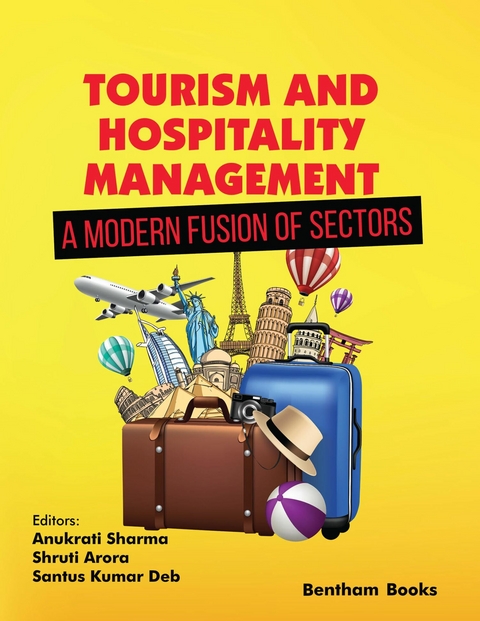
Tourism and Hospitality Management - A Modern Fusion of Sectors (eBook)
269 Seiten
Bentham Science Publishers (Verlag)
979-8-89881-006-1 (ISBN)
Tourism and Hospitality Management - A Modern Fusion of Sectors assess the evolving landscape of global tourism, highlighting how tradition and innovation intersect to shape new forms of travel and hospitality. Through interdisciplinary perspectives, this collection explores emerging trends such as digital detox tourism, virtual reality in guest experiences, robotic technologies in kitchens, and the growth of e-tourism across regions like India, Sri Lanka, Bangladesh, and Turkey. The book investigates both the technological and cultural transformations driving the sector, while also addressing post-pandemic shifts in traveler behavior, sustainability concerns, and the importance of community-based tourism models. Strategic frameworks like the e-Tourism Value Chain Model (e-TVCM) are presented to help bridge theory and practice. Key features: Integrates perspectives from sociology, tech, marketing, and cultural studies Highlights sustainable, mindful, and community-based travel models Analyzes 'next-normal' tourism behaviors and ethical concerns Presents strategic tools and models for industry application
New Wine in Old Bottle: How Far Is It Relevant to the 21st Century Tourism Perspective?
Samik Ray1, *
Abstract
In the post-1950s, the increasing tourist mobility en masse has become an indicator of economic success for most tourist destinations. The success caused the dramatic overgrowth of tourism. As a result, the perceived resource carrying capacity and guest-host experience degrade. The authentic or real-time socio-cultural experiences during the visit were, by and large, missing. Environment-friendly tourism activities were not evident. Thus, a severe inconvenience to live in or visit a destination occurred. It became a serious concern to both the hosts and tourists. The overgrowth of tourism, known as the overtourism phenomenon, and its effects contradicted. Contradiction champions the need for new wine, i.e., niche forms, to counter the mass mobility and overtourism phenomenon. New forms emerge with a focus on the environmental accountability of tourism. They become known by various terms. The world then came to know about Adventure tourism, Agro-tourism, Farm tourism, Rural tourism, Cultural tourism, Doom tourism, Border tourism, Experiential tourism, War tourism, Accessible tourism, Dark Tourism, and more. They are diverse in understanding and different in the contents emphasized by the modifiers of the terms, but identical in their goals, ideological preoccupations, values, and agendas.
The present chapter will deal with the rationale of the origin and growth of new forms of tourism since they set the story of redefining tourism business ecology and market dynamics. It will also focus on how those forms are pragmatic to the neo-technological and new-touristic demand perspective.
* Corresponding author Samik Ray: National Award Winner Guide (IITG since 1984), Government of India, India; E-mail: samikray331@gmail.com
INTRODUCTION
Leisure and recreation-based travel was predominantly a venture of the wealthy class in the preindustrial epoch. It was either a pilgrimage or a wellness tour. The industrial society featured the mobility of capital and labour for the market. The emerging neo-riches of the industrial society preferred recreation-linked tours in
nature or knowledge-seeking tours at cultural marvels at the behest of tour companies. The post-industrial society features the rise of the service economy. The high mobility of new capital, ventures, and people for leisure and recreation stands as the marked feature of this society (Ray, 2021a). The movement of the capital and people multiplied faster, making leisure-recreation-linked tourism a global culture. Post-1950, mobility drove tourism to grow at a massive scale, acclimating tourism contents such as space, inhabitants, culture, and nature to the needs and progress of the contemporary market and economy (Ray, 2017b). Hence, the mass consumerism syndrome has emerged in the name of 'mass tourism'. It attempts to commoditise all types of tourism content and quantifies tourist consumption with frequent swaps from authentic to pseudo experiences (Ray, 2017a).
In the late 20th century, disquiets arose within a significant section of the hosts and guests against mass tourism. The need for niche forms in the market as the alternative became the demand of the day. Niche forms set goals to counter mass tourism and its effects. The primary goal is to control tourists’ arrival within a considerable limit (Ray, 2021b). Alternatives promote particularised gaze and limited edge guest-host interaction for the unique visitation experience. Thus, a shift from standard to special packages becomes crucial. The particularised gaze substitutes for the bubble gaze. The visits undertaken for particularised gaze-based unique experiences supersede the practice of mere visits for attractions. Alternative niche forms thereby attempt to minimise the cumulative effect of mass tourism.
With the Web revolution in the 21st century, the world enters the information age. A techno-cultural class comprising hundreds of millions across all edges of society, called netizens or digital literates, has emerged (Ray, 2021b). They create, upload, and share images and information about their visits in digital media. They perceive the destination in real-time while in the travel-related virtual interactions during and after the visitation. It takes place across time and boundaries. Indeed, nearly 70% of the social media content is of vacation and holiday tales. Those contents influence 50% of netizens in deciding on their vacation plans. (Kimberlee, 2015) The changes in tourist expectations, choices, perceptions of destination realities, and purchase decisions appear. It sets the story of disruption in tourism culture, business ecology, and market dynamics in motion. Neither bubble nor secluded settings of tourist gaze can cope with changes in progress. Hence, new forms require fresh brewing to redefine tourism culture and translate the changes into practice.
Approaches
Industry and academics assume that tourist mobility at a mass scale is the tourism success indicator. To them, it contributes toward an enormous makeover in the earnings from tourist spending at many destinations. (Greenwood, 1972; Boissevain, 1977; Dekadt, 1979; Loukissan, 1982; Sezgin &Yolal, 2012; Naumov & Green, 2016; Butcher, 2020) Comparatively, more studies focused on the ill impacts of mass tourism on the physical and socio-cultural environment (Perez, 1973; Cohen, 1978; Britton, 1983; McMinn, 1992; Singh, 1992). A defensive approach to minimize the ill impacts had appeared. The priority was to limit tourist footfall within the carrying capacity for sustainable growth (Rodenburg, 1980;Getz, 1983; Shelby& Heberlein, 1984; Krippendorf, 1992; McIntyre, 1993; Henry, 1996; Hawkins& Middleton, 1998; Price, 1999; Berrow, 2003; Bramwell, 2004; Kennell, 2016). Hence, the alternatives to mass tourism, not as a mere term but as a concept, have emerged(Holden, 1984; Cohen, 1987 & 1992; Butler, 1992; Singh, 1992; Price, 1992; Ray, 2004; Vainikka, 2013; Jovicic, 2014; Theng et al., 2015). The most dramatic and logical extension to mass tourism is the rise of ‘turismofobia’ (Milano, 2017; Martin et al., 2018; Martins, 2018) or Overtourism (Goodwin, 2017; Milano, 2017; Anuar et al., 2019; Clancy, 2019; Cheung & Li, 2019; Dodds & Butler, 2019; Sæþórsdóttir& Hall, 2020; Żemła, 2020; Ray, 2021a &b; Sharma & Hassan, 2021; Tiwari et al., 2021; Santos-Rojo et al., 2023; Pechlaner et al., 2024). Indeed, limited or mass-scale tourist mobility in a bubble or an isolated tourist setting, such as a ghetto (Krippendorf, 2002), encourages profit progression at interest groups’ behest (Ray, 2021a & b). Hence, both ignore the authentic gaze at the visitation. As a counter-reaction, shifts from pseudo to authentic experience and delusion to reality perception commence (Ray, 2017a, 2021a). Mass tourism and its early alternatives slowly became extraneous. Thus, it prompts fresh brewing to redefine alternatives (Wearing, 2001; Karlsson, 2005; Lyons and Wearing, 2008; Sin, 2009; Urry & Larsen, 2011; Macek, 2012; Cheia, 2013; Ong et al., 2014; Ray, 2021a&b).
Method
The chapter used the dialectic reasoning method. The study will open a dialogue between the narrative embedded within mass tourism and the counter-narrative that raises the need for alternatives. It further seeks to understand how far the emergence of freshly brewed and new rising counter alternatives in tourism business culture and market is pragmatic to the newly emerging digital world and tourist demand perspective.
Post-Industrial Tourism
Overt Reflections
Post-industrial tourism features travel-demand escalation, leading to tourist mobility at a mass scale at the outset. The tourist mobility paradigm drives post-industrial tourism, then. Indeed, the fast growth of tourism makes mass tourism’s emergence viable. The tourism boom brought smiles to new investors in tourism. Its contribution to the destination economy was crucial, too. The cross-cultural interactions between guests and hosts intensified to a great extent. The development of overtourism at the behest of mass tourism was thus logical by the end of the 20th century.
Primary Narrative: Pro mass mobility
Post-1950 tourist mobility at a mass scale made mass tourism grow immensely. Mass tourism acclimated leisure, recreation, space, and culture to its progress and thus caused the growth potential of the industrial smoke-free economy. This perception creates a growth-linked narrative at the new capital and the entrepreneur's behest. The narrative created a myth about the high tourist mobility-led mass tourism. Hence, to counter the effect of industry pollution, it portrayed mass tourism as a smoke-free economic growth initiative at the tourism destinations. The growth in local employment, host welfare, foreign exchange earnings, and GDP (Ray, 2021b) is thus binding. The narrative attempted to make the world...
| Erscheint lt. Verlag | 10.10.2025 |
|---|---|
| Sprache | englisch |
| Themenwelt | Wirtschaft |
| ISBN-13 | 979-8-89881-006-1 / 9798898810061 |
| Informationen gemäß Produktsicherheitsverordnung (GPSR) | |
| Haben Sie eine Frage zum Produkt? |
 EPUB (Ohne DRM)
Digital Rights Management: ohne DRM
Dieses eBook enthält kein DRM oder Kopierschutz. Eine Weitergabe an Dritte ist jedoch rechtlich nicht zulässig, weil Sie beim Kauf nur die Rechte an der persönlichen Nutzung erwerben.
Dateiformat: EPUB (Electronic Publication)
EPUB ist ein offener Standard für eBooks und eignet sich besonders zur Darstellung von Belletristik und Sachbüchern. Der Fließtext wird dynamisch an die Display- und Schriftgröße angepasst. Auch für mobile Lesegeräte ist EPUB daher gut geeignet.
Systemvoraussetzungen:
PC/Mac: Mit einem PC oder Mac können Sie dieses eBook lesen. Sie benötigen dafür die kostenlose Software Adobe Digital Editions.
eReader: Dieses eBook kann mit (fast) allen eBook-Readern gelesen werden. Mit dem amazon-Kindle ist es aber nicht kompatibel.
Smartphone/Tablet: Egal ob Apple oder Android, dieses eBook können Sie lesen. Sie benötigen dafür eine kostenlose App.
Geräteliste und zusätzliche Hinweise
Buying eBooks from abroad
For tax law reasons we can sell eBooks just within Germany and Switzerland. Regrettably we cannot fulfill eBook-orders from other countries.
aus dem Bereich