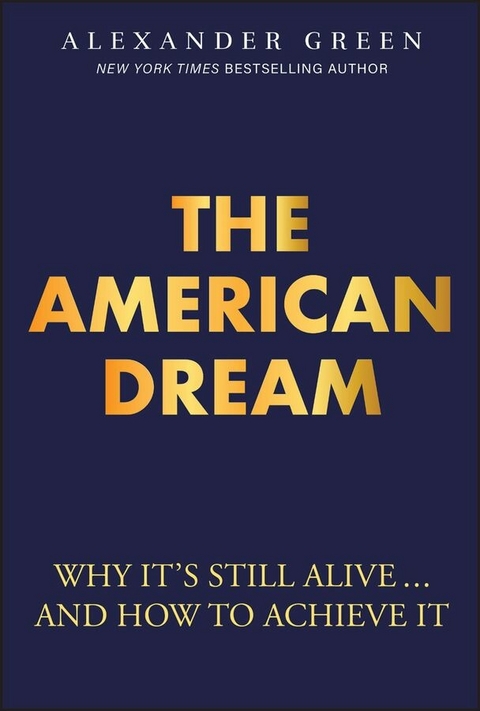
The American Dream (eBook)
347 Seiten
Wiley (Verlag)
978-1-394-36167-0 (ISBN)
An optimistic, inspiring look at America's capitalist system-and how to use it to achieve your most important goals
In The American Dream: Why It's Still Alive...And How to Achieve It, author Alexander Green extols America's exceptionalism, underscoring its unmatched economic dominance, technological innovation, and cultural influence, and highlights the importance of American ideals and the nation's capacity to provide upward mobility and prosperity to its citizens.
He stresses that economic success in the U.S. is attainable through education, hard work, saving, and investing and provides an action plan for achieving financial independence, with information on maximizing income, reducing expenses, saving, and investing wisely.
In this book, readers will find detailed insights on:
- Motivating economic trends, such as the fact that the percentage of U.S. households earning more than $100K has increased significantly since 1980
- Why the U.S. remains a land of opportunity due to a robust economy, leading global companies, and significant contributions to science and technology
- The life-enhancing value of embracing 'Radical Responsibility'
- Why we are living in a new 'Golden Age' for investors
- How to shorten the road to financial independence by embracing 'The World's Simplest Investment Portfolio'
The American Dream: Why It's Still Alive...And How to Achieve It earns a well-deserved spot on the bookshelves of all ambitious individuals seeking long-term financial prosperity-and to experience the ultimate feeling of earned success.
ALEXANDER GREEN has spent the last 40 years as a research analyst, portfolio manager and financial writer. He is the Chief Investment Strategist of The Oxford Club and Liberty Through Wealth. He is also the bestselling author of The Gone Fishin' Portfolio, The Secret of Shelter Island, Beyond Wealth and An Embarrassment of Riches. He lives in Florida and Virginia with his wife, Karen.
An optimistic, inspiring look at America's capitalist system and how to use it to achieve your most important goals In The American Dream: Why It's Still Alive...And How to Achieve It, author Alexander Green extols America's exceptionalism, underscoring its unmatched economic dominance, technological innovation, and cultural influence, and highlights the importance of American ideals and the nation's capacity to provide upward mobility and prosperity to its citizens. He stresses that economic success in the U.S. is attainable through education, hard work, saving, and investing and provides an action plan for achieving financial independence, with information on maximizing income, reducing expenses, saving, and investing wisely. In this book, readers will find detailed insights on: Motivating economic trends, such as the fact that the percentage of U.S. households earning more than $100K has increased significantly since 1980 Why the U.S. remains a land of opportunity due to a robust economy, leading global companies, and significant contributions to science and technology The life-enhancing value of embracing Radical Responsibility Why we are living in a new Golden Age for investors How to shorten the road to financial independence by embracing "e;The World's Simplest Investment Portfolio"e; The American Dream: Why It's Still Alive...And How to Achieve It earns a well-deserved spot on the bookshelves of all ambitious individuals seeking long-term financial prosperity and to experience the ultimate feeling of earned success.
Introduction
To be successful at anything, the truth is you don't have to be special. You just have to be what most people aren't: consistent, determined, and willing to work for it. No shortcuts.
—Quarterback Tom Brady
While I've written five previous books, I don't recall the exact moment when the inspiration to undertake each project hit me. But I certainly remember the genesis of this one.
I was sitting on my brother‐in‐law's front porch, reading the paper, when a short news item caught my attention. A July 2024 Wall Street Journal/NORC poll found that belief in the attainability of the American Dream had fallen to a record low. Only 36% of Americans believed it was still possible – that hard work leads to success and upward mobility. Nearly half said the Dream was once possible but no longer is. Seventeen percent claimed it was never real.
That astonished me – and still does. Could it be that millions of immigrants risked their lives – and often their children's lives – to come here in search of opportunities that most Americans don't even believe exist?
Apparently so. A few months earlier, an ABC News/Ipsos poll showed just 27% of Americans still believed in the Dream. Another poll from Axios in late 2023 echoed the Journal's findings: 36%. That's a steep decline from 2012, when – even in the aftermath of the Great Recession – 52% still believed in the Dream.
I found this so disturbing that I wrote this book‐length counterargument.
The American Dream – the pursuit of a better, richer, and fuller life, regardless of where we start – is our national ethos. It shapes our identity.
What makes us uniquely American is not just the possibility of upward mobility. It is the fundamental belief that this possibility exists for all of us. Unlike societies built on rigid class structures or inherited privilege, America was founded on the radical notion that merit, effort, and character matter more than bloodline or social status.
The Dream says, “Your future is not predetermined by your past. Your efforts matter. Your choices have consequences. You can be the author of your own story.”
The American Dream encourages innovation, risk‐taking, and resilience. It provides direction when the path is unclear and hope when obstacles seem insurmountable. Belief in it turns setbacks into steppingstones and failures into learning experiences.
It places the power of change squarely in the hands of the individual, and it provides the conviction that ordinary people can turn their vision into a reality. It is not a guarantee of outcomes but of opportunity. It doesn't promise that everyone will become wealthy or famous. It promises that everyone will have the chance to improve their circumstances through their own efforts.
In communities across our nation, the evidence of its enduring power is everywhere. The veterans who use their military training to start a cybersecurity firm. The teachers whose evening classes help them become a principal. The small business owners whose food trucks become a restaurant chain. Their success stories remind us that the Dream adapts and evolves but never disappears.
The American Dream remains vital because it addresses the deepest human needs: the need for purpose, the hunger for progress, and the desire to build something lasting for future generations.
In a world increasingly divided by cynicism and despair, the American Dream stands as a beacon of possibility. It has drawn millions to our shores and has guided millions more who were born here. It is who we are as a people. It fueled America's past, unifies our present, and inspires our future.
It survives because it speaks to something eternal in the human spirit: the belief that tomorrow can be better than today, and that we have the power to make it so. That belief is part of what makes the United States exceptional.
That is what the Dream means to me. But what does it mean to those polled, especially the ones who don't believe it is attainable?
In my research, I found that conceptions of the Dream vary. Yet most fall into one of two broad categories:
- The traditional view. This is the classic idea: that anyone – regardless of background – can rise as far as their talents, ambition, and persistence will take them.
- The contemporary view. This one has a financial tilt: “I can afford to buy a home, raise a family, maintain some work‐life balance, and retire comfortably.”
Both views are reasonable. And both are achievable for anyone willing and able to work, save, and invest.
So why all the pessimism? I've learned it's partly a matter of perception.
Despite living in the most prosperous, free, and opportunity‐rich nation in human history, many Americans – especially younger ones – have a surprisingly dim view of their country. According to a 2025 Gallup poll, a record‐low 58% of US adults say they are “extremely” (41%) or “very” (17%) proud to be an American. (That's down from 90% in 2004.) Among Gen Z (born 1997–2012), that number plummets to just 47%. That's not just a generational gap. It's a crisis of confidence.
America has real challenges. But the souring of national sentiment isn't driven by facts as much as by narratives. When every institution you trust – your school, the media, even your political party – emphasizes America's sins over its successes, it's easy to internalize the message that this country is fundamentally flawed – and the Dream is no longer real.
So who's lost faith? Mainly two groups: lower‐income Americans and young people. (And yes, there's quite a bit of overlap.) Many are barely staying afloat – juggling rent, bills, and basic needs. But in most cases, they simply don't know how or where to begin. That's not a moral failing. It's a knowledge gap. Most of us were never taught to budget, save, or invest – by schools or parents.
Younger folks especially need to hear this: financial stress is usually temporary. As your skills and experience grow, so will your income. Generally speaking, the older someone is the richer they are. The difference between what I earned starting out and what I earned at the peak of my career? Night and day. And my story is far from unique.
Time is the great advantage of youth. They may not have much money, but they have a lot of years ahead of them. That's critical when they start investing. Compounding is a powerful force. But it needs time to work its magic.
Older Americans, it turns out, are far more likely to believe in the American Dream – perhaps because they've seen it play out, even if imperfectly. More educated individuals tend to believe in it, too, likely because education is linked to higher income – and higher income creates more possibilities.
Black Americans are less likely than whites to believe in the Dream, which no doubt reflects our nation's long history of discrimination. Still, conditions have improved dramatically since the 1960s. And the principles I'll discuss in this book apply equally across race, gender, and class.
Democrats are more pessimistic than Republicans, perhaps because progressives focus more on perceived structural unfairness.
Interestingly, women are slightly more optimistic about the Dream than men – perhaps because men tend to equate it with career and income, while women often associate it with family, security, and fulfillment. Once again, the women appear to be on to something.
My goal with this book is to better align perceptions with reality. I wrote it for three kinds of readers:
- Disbelievers. They don't believe the Dream is real because they don't know what to do, aren't doing it, or don't realize they are already living it. (That last claim is provocative but stick with me.)
- Frustrated Dreamers. They know the Dream exists, but it feels out of reach. In the pages ahead, I'll provide them with the knowledge – and a concrete action plan – that will enable them to move forward.
- Dream Achievers. They've lived some version of the Dream themselves. But they worry about their kids and grandkids. Or they want to help other Americans find the path.
Why do I feel so strongly about the Dream that I felt compelled to write this book? Because this country stands on three pillars:
- The Declaration of Independence, which declares that we are a free people whose rights preexist government
- The US Constitution, which both empowers and limits government to protect those rights
- The American Dream, which is how we exercise our right to pursue happiness
Without these three pillars, the structure falters. (Without them, we are not the same nation. Not the same people.) The Dream isn't some sentimental slogan. It's part of our national identity – and the reason why millions throughout history risked everything to get here.
America is not perfect. It never has been. But it remains the best environment on Earth for ordinary people to build extraordinary lives.
Our markets are open. Our culture rewards effort, talent, and innovation. Our financial system allows for investing, borrowing, and wealth creation. Our freedoms protect dissent, belief, expression, and...
| Erscheint lt. Verlag | 27.10.2025 |
|---|---|
| Sprache | englisch |
| Themenwelt | Sachbuch/Ratgeber ► Beruf / Finanzen / Recht / Wirtschaft ► Geld / Bank / Börse |
| Wirtschaft ► Betriebswirtschaft / Management | |
| Schlagworte | beginner investment • career advice • Economic Trends • Entrepreneurship • Financial advice • financial freedom • increase income • investment advice • make money • reduce expenses • Unemployment • US Economy • Wealth Creation |
| ISBN-10 | 1-394-36167-X / 139436167X |
| ISBN-13 | 978-1-394-36167-0 / 9781394361670 |
| Informationen gemäß Produktsicherheitsverordnung (GPSR) | |
| Haben Sie eine Frage zum Produkt? |
 EPUB (Adobe DRM)
Kopierschutz: Adobe-DRM
Adobe-DRM ist ein Kopierschutz, der das eBook vor Mißbrauch schützen soll. Dabei wird das eBook bereits beim Download auf Ihre persönliche Adobe-ID autorisiert. Lesen können Sie das eBook dann nur auf den Geräten, welche ebenfalls auf Ihre Adobe-ID registriert sind.
Details zum Adobe-DRM
Dateiformat: EPUB (Electronic Publication)
EPUB ist ein offener Standard für eBooks und eignet sich besonders zur Darstellung von Belletristik und Sachbüchern. Der Fließtext wird dynamisch an die Display- und Schriftgröße angepasst. Auch für mobile Lesegeräte ist EPUB daher gut geeignet.
Systemvoraussetzungen:
PC/Mac: Mit einem PC oder Mac können Sie dieses eBook lesen. Sie benötigen eine
eReader: Dieses eBook kann mit (fast) allen eBook-Readern gelesen werden. Mit dem amazon-Kindle ist es aber nicht kompatibel.
Smartphone/Tablet: Egal ob Apple oder Android, dieses eBook können Sie lesen. Sie benötigen eine
Geräteliste und zusätzliche Hinweise
Buying eBooks from abroad
For tax law reasons we can sell eBooks just within Germany and Switzerland. Regrettably we cannot fulfill eBook-orders from other countries.
aus dem Bereich