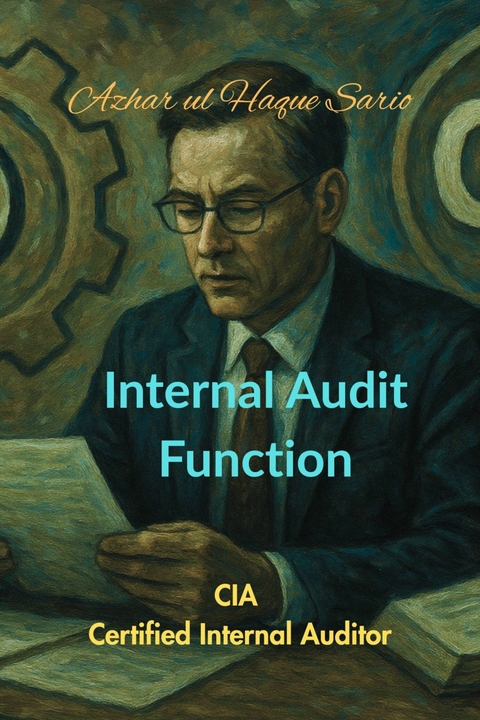
Internal Audit Function (eBook)
206 Seiten
Azhar Sario Hungary (Verlag)
978-3-384-74060-1 (ISBN)

Ready to conquer the CIA Part 3 exam and master the Internal Audit Function?
This book is your complete, focused guide to passing Part 3 of the Certified Internal Auditor exam. We cover the entire syllabus, starting with Section A, Internal Audit Operations (25%). You'll learn to plan, organize, and monitor audit operations. We cover managing all key resources: financial, human, and IT. This includes budgeting , recruiting , and training your team. You will learn to align the internal audit strategy with stakeholder expectations. Plus, we cover the Chief Audit Executive's (CAE) crucial role in communicating with the board and senior management. Next, we dive into Section B, the Internal Audit Plan (15%). You'll discover how to identify potential engagements. We show you how to define the audit universe. You'll master developing a risk-based audit plan. This section also covers coordinating with other assurance providers. Then, we move to Section C, Quality of the Internal Audit Function (15%). This part explains the required Quality Assurance and Improvement Program (QAIP). You'll understand the difference between internal and external assessments. You'll learn the correct way to disclose nonconformance with The IIA's Standards. We also teach you to establish key performance indicators (KPIs) to measure your function's performance. Finally, we tackle the largest domain, Section D: Engagement Results and Monitoring (45%). You'll master how to effectively communicate engagement results. We break down the key components of an audit report, like objectives, scope, and conclusions. You will learn how to develop recommendations and manage action plans , even when you have disagreements with management. This section also covers assessing residual risk , communicating risk acceptance , and the vital process for monitoring and escalating action plans.
Many study guides are just a dry collection of facts. This book is different. We wrote it in simple, natural English, making complex topics easy to understand. It's designed to be conversational, not a dense textbook. We don't just list the syllabus points; we explain them using the official expanded test specifications as our guide. This book's competitive advantage is its structure. The table of contents perfectly mirrors the official CIA Part 3 syllabus. This logical flow lets you connect what you're reading directly to the four domains of the exam, making your study time more efficient. We cut out the fluff and focus only on what you need to know to pass. This clear, practical approach builds your confidence by ensuring you understand the why behind the concepts, not just memorizing terms.
Copyright Disclaimer: This author has no affiliation with The Institute of Internal Auditors (IIA). This book is independently produced under the nominative fair use doctrine.
Section A. Internal Audit Operations (25%)
Part 1: Methods for Managing External Providers of Internal Audit Services
Bringing external providers into your internal audit function—whether for a single engagement (co-sourcing) or for the entire department (full outsourcing)—is a significant strategic decision.
You can delegate the work, but you can never delegate the responsibility. The Chief Audit Executive (CAE) or the designated in-house leader remains ultimately accountable to the Audit Committee and the organization for the quality and effectiveness of all internal audit assurance.
Managing this relationship effectively requires a structured methodology that covers the entire lifecycle, from planning the engagement to monitoring its successful completion.
Planning the Need for External Providers
Before you even send out a request, a rigorous planning phase is essential. This is where you define why you need help and what that help looks like.
First, you must conduct a thorough needs assessment. This is an honest look at your in-house team's capabilities versus the demands of the audit plan. This gap analysis typically highlights a few common needs:
Capacity: You simply don't have enough people to execute the approved audit plan.
Capability (Skills Gap): The audit plan includes highly specialized areas where your team lacks deep expertise. This is common for complex IT audits, cybersecurity, data analytics, intricate financial instruments, or niche regulatory compliance.
Geographic Reach: Your company has expanded to a new country, and you lack local resources who understand the language, culture, and local regulations.
Once you know why you need help, you must precisely define the scope. "We need IT audit help" is not a scope. A proper scope document is precise. For example: "We require an external provider to conduct a full-scope penetration test of our customer-facing e-commerce platform (XYZ.com) and a review of the underlying firewall configurations, to be completed by Q3."
This scope document is the foundation for everything that follows. It must be clear, measurable, and agreed upon internally before you contact any potential vendors.
This planning phase also includes a risk assessment of the outsourcing arrangement itself. What are the risks? They are numerous:
Confidentiality Risk: You are giving an outside party access to your company's most sensitive data.
Conflict of Interest Risk: Does this provider also offer consulting services to the departments they will be auditing? This is a major independence concern.
Reputational Risk: If the provider does a poor job, it reflects directly on the internal audit function.
Loss of Institutional Knowledge: Over-reliance on outsiders can prevent your in-house team from developing new skills.
Organizing the Selection and Contracting Process
With a clear scope in hand, you move to the selection phase. This needs to be a formal, transparent, and defensible process.
It starts with a Request for Proposal (RFP). This document packages your scope, evaluation criteria, required vendor qualifications (like certifications and specific industry experience), technology expectations, and data handling protocols. It asks the provider to detail their proposed methodology, the specific team (resumes and all) that will do the work, and their pricing structure.
Evaluating the proposals is the next step. It is a critical mistake to simply choose the cheapest option. You must conduct thorough due diligence.
Check references. Talk to other companies who have used this provider for similar work.
Interview the actual team that will be assigned to your engagement, not just the slick sales partner.
Evaluate their methodology. Does it align with your own? Do they understand your business and your industry's specific risks?
Once you've selected a provider, the contracting and Service Level Agreement (SLA) stage begins. This is perhaps the most important organizational tool you have. The contract must be reviewed by your legal department and must be watertight.
It must include an ironclad confidentiality (NDA) clause.
It must define data handling, return, and destruction policies.
It must clearly state that the internal audit function (your company) owns all workpapers and reports.
It must grant you the "right to audit" the provider to ensure they are meeting their obligations.
It must detail liability, insurance requirements, and what happens if there is a data breach.
The SLA is the operational part of the contract. It defines success. It should include metrics for timelines (e.g., "Draft report due within 5 working days of fieldwork completion"), communication protocols, and the specific format for deliverables.
Directing the External Provider During the Engagement
Now the work begins. You cannot just "set it and forget it." Active direction and oversight are non-negotiable.
The process starts with a formal onboarding. Don't just give them a badge and a laptop. They need a proper orientation.
Introduce them to key stakeholders and auditees.
Explain your company's culture, values, and "how things get done here."
Provide secure, read-only, and time-bound access to the minimum systems necessary for their work.
Clear communication channels are your best friend. You must establish a single point of contact (SPOC) on your in-house team and on the provider's team. Schedule regular meetings:
A formal kick-off meeting to align on scope, timelines, and protocols.
Weekly (or even daily) status check-ins during fieldwork.
A clear escalation path for when problems or significant findings arise.
Most importantly, you must provide active oversight of the fieldwork. This is not micromanagement; it is quality control. You should be reviewing their audit plan, their sampling methodology, and their preliminary findings as they emerge. Don't wait for the draft report to find out they misunderstood the scope or went down an unproductive rabbit hole.
If you are using a co-source model, team integration is key. You must clearly define roles. Who is leading the engagement? Who is reviewing whose work? This prevents friction and ensures a unified, professional front when dealing with the business.
Monitoring the Provider's Performance and Quality
Finally, you must monitor the provider's performance, both for the specific engagement and for the overall relationship.
The first level of monitoring is a rigorous quality review. The CAE (or their in-house delegate) must review the external provider's workpapers and draft report. This review should be just as thorough, if not more so, than for an in-house audit.
Does the evidence in the workpapers fully support the findings?
Are the findings accurate, and are the root causes correctly identified?
Are the recommendations practical, cost-effective, and truly aligned with the business's objectives?
You must also track performance against the contract and SLAs. Did they meet the deadlines? Did they stay on budget? Did they provide the team they promised in the RFP?
Gather feedback from auditees and stakeholders. This is invaluable. Did the provider's team act professionally? Did they demonstrate a good understanding of the business operations? Or were they disruptive and academic?
Lastly, focus on knowledge transfer. If you brought in a provider for their special skills, don't let that expertise walk out the door. Make knowledge transfer a contractual requirement. This could be a formal training session for your in-house team, a detailed methodology guide, or pairing your staff with theirs during the engagement. This is how you manage the risk of "knowledge drain" and get the maximum long-term value from the relationship.
Part 2: Methods for Monitoring Internal Audit Operations
Monitoring your own internal audit operations is the hallmark of a mature, professional, and high-performing function. It is how you provide assurance to the Audit Committee not just on the company's controls, but on the quality of your own work.
This is formally known as a Quality Assurance and Improvement Program (QAIP). The Institute of Internal Auditors (IIA) Standards mandate it (Standard 1300). A robust QAIP isn't about catching people doing things wrong; it's about a culture of continuous improvement and demonstrating the value you add to the organization.
A QAIP has two primary components: ongoing, internal monitoring and periodic, formal assessments.
Planning and Organizing the...
| Erscheint lt. Verlag | 27.10.2025 |
|---|---|
| Sprache | englisch |
| Themenwelt | Wirtschaft ► Betriebswirtschaft / Management |
| Schlagworte | certified internal auditor • CIA Part 3 • Engagement Results and Monitoring • Internal Audit Function • Internal Audit Operations • Quality Assurance QAIP • Risk Based Audit Plan |
| ISBN-10 | 3-384-74060-2 / 3384740602 |
| ISBN-13 | 978-3-384-74060-1 / 9783384740601 |
| Informationen gemäß Produktsicherheitsverordnung (GPSR) | |
| Haben Sie eine Frage zum Produkt? |
 EPUB (Ohne DRM)
Digital Rights Management: ohne DRM
Dieses eBook enthält kein DRM oder Kopierschutz. Eine Weitergabe an Dritte ist jedoch rechtlich nicht zulässig, weil Sie beim Kauf nur die Rechte an der persönlichen Nutzung erwerben.
Dateiformat: EPUB (Electronic Publication)
EPUB ist ein offener Standard für eBooks und eignet sich besonders zur Darstellung von Belletristik und Sachbüchern. Der Fließtext wird dynamisch an die Display- und Schriftgröße angepasst. Auch für mobile Lesegeräte ist EPUB daher gut geeignet.
Systemvoraussetzungen:
PC/Mac: Mit einem PC oder Mac können Sie dieses eBook lesen. Sie benötigen dafür die kostenlose Software Adobe Digital Editions.
eReader: Dieses eBook kann mit (fast) allen eBook-Readern gelesen werden. Mit dem amazon-Kindle ist es aber nicht kompatibel.
Smartphone/Tablet: Egal ob Apple oder Android, dieses eBook können Sie lesen. Sie benötigen dafür eine kostenlose App.
Geräteliste und zusätzliche Hinweise
Buying eBooks from abroad
For tax law reasons we can sell eBooks just within Germany and Switzerland. Regrettably we cannot fulfill eBook-orders from other countries.
aus dem Bereich