Internal Audit Engagement (eBook)
196 Seiten
Azhar Sario Hungary (Verlag)
978-3-384-73933-9 (ISBN)
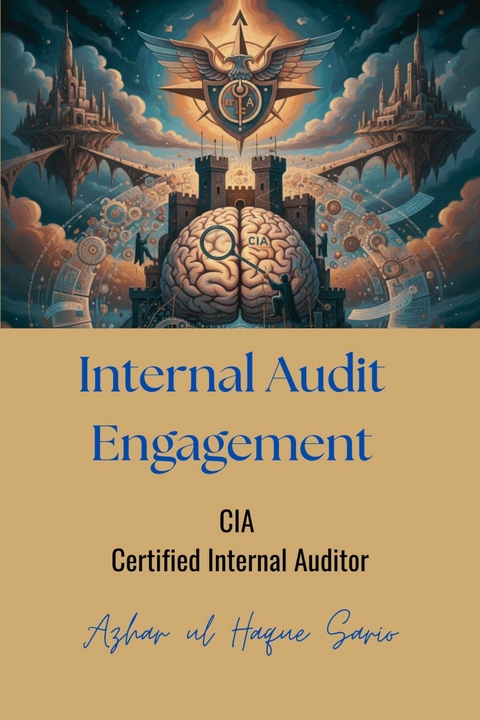
Feeling overwhelmed by the sheer scope of the CIA Part 2 exam? This guide, Internal Audit Engagement, is your focused, easy-to-understand partner for mastering the syllabus.
This book is designed specifically for the 'Internal Audit Engagement' exam. It precisely follows the official syllabus. We dedicate the majority of the book to Section A, Engagement Planning. This is the most critical area, worth 50% of your exam score. You will learn how to properly determine engagement objectives and scope. We show you how to establish the right evaluation criteria for your audit. You'll master planning the engagement to assess key risks and controls. This includes modern challenges like cybersecurity and business continuity. We also cover essential finance and accounting concepts. You will understand different engagement approaches, like agile and remote auditing. A major focus is on completing a detailed risk assessment. We guide you on how to prepare a thorough engagement work program. This includes creating procedures to test control design and effectiveness. Finally, this section teaches you to determine the resources and skills needed for the job. Next, we dive into Section B, Information Gathering, Analysis, and Evaluation. This section is worth 40% of the exam. You will learn the best methods for obtaining information, like interviews and data analysis. We teach you to evaluate evidence for relevance, sufficiency, and reliability. You'll explore modern audit technologies like artificial intelligence and data analytics. We cover process mapping and various analytical techniques. You'll learn to identify the root causes of findings. Preparing clear and supportive workpapers is a key skill you'll develop. The book concludes with Section C, Engagement Supervision and Communication. This part is 10% of your exam. It covers the supervisor's responsibilities and effective stakeholder communication.
Many CIA exam books are overly academic. They are often dense, hard to read, and filled with information that isn't directly tested. This book is different. Its competitive advantage is its laser focus. We don't waste your time with content outside the official syllabus. Our structure is the syllabus. We've weighted the content to match the exam, dedicating 50% of the book to Planning , 40% to Information Gathering , and 10% to Supervision. This precise mapping means your study time is 100% efficient. You study what matters. We explain complex concepts like risk assessment , control testing , and data analysis methods in simple, straightforward English. This targeted approach builds your confidence and ensures you are focusing your efforts where they will have the greatest impact on your score.
Disclaimer: This book, 'Internal Audit Engagement: CIA Certified Internal Auditor,' is an independent publication. The author and publisher are not affiliated with, sponsored by, or endorsed by The Institute of Internal Auditors, Inc. (The IIA). The IIA is the sole owner of the Certified Internal Auditor® (CIA®) and other trademarks. This study guide is independently produced and is intended for educational and review purposes only. All trademarks are used for identification purposes only under the doctrine of nominative fair use.
Section A. Engagement Planning (50%)
Determine engagement objectives and scope
Part A: Applying Topical Requirements in Engagement Planning
When we, as audit, risk, or finance professionals, begin to plan an engagement, we aren't starting with a blank piece of paper. We're stepping into a world that already has rules. Think of "Topical Requirements" as the specific, non-negotiable rules of the road for the area we are about to examine. They are the laws, regulations, industry standards, and critical policies that govern the topic of our engagement.
Recognizing how to apply these requirements is the difference between a high-value, relevant engagement and a superficial exercise that misses the point. If we are auditing the company's new data privacy initiative, the "topic" is data privacy. The "topical requirements" would therefore be regulations like the GDPR in Europe or the CCPA in California. These aren't suggestions; they are the benchmark for success or failure.
So, how do we practically apply them when building our objectives and scope?
First, we must identify them. This is an act of due diligence. We can't just guess. This step involves research and inquiry. We talk to the company's legal counsel. We meet with the compliance department. We read the latest regulatory updates from industry bodies. If we are looking at a bank's lending practices, we need to know the specific requirements of the Equal Credit Opportunity Act (ECOA) or the Truth in Lending Act (TILA). We list these requirements out. They form the primary "criteria" against which we will audit.
Once identified, the next step is to understand their impact. Not all requirements are created equal. A violation of one requirement might result in a minor internal penalty. A violation of another—say, an anti-money laundering (AML) regulation—could result in massive government fines, loss of a banking license, and severe reputational damage. We have to perform a micro-risk assessment on the requirements themselves. Which ones represent the greatest risk to the organization if they fail?
This risk assessment directly shapes our engagement objective. The objective must explicitly reference these critical requirements.
Let's look at a weak objective versus a strong one.
A weak objective might be: "To review the new customer onboarding process."
This is vague. What does "review" mean? What are we looking for?
A strong objective, built by applying topical requirements, would sound like this: "To provide assurance that the customer onboarding process, as redesigned in Q3, is in full compliance with the 'Know Your Customer' (KYC) provisions of the Bank Secrecy Act (BSA) and the bank's internal AML policy."
See the difference? This objective is sharp. It's measurable. It tells everyone—the audit team, management, and the board—exactly what we are testing and why it matters. The topical requirements (BSA, AML policy) are baked directly into the objective statement.
Now, let's talk about scope. The objectives define "what" we want to achieve. The scope defines "how much" and "where" we will look. The topical requirements are the single most important factor in defining a responsible scope.
If our objective is to audit for GDPR compliance, our scope cannot be limited to one office in one country. The GDPR's requirements on data sovereignty and cross-border data transfer force our scope to be global. We must look at how data flows between the EU and the US, or between the EU and data centers in Asia. The requirement itself dictates the boundaries of our work.
Similarly, the requirements define the nature and depth of our testing. A simple internal policy might only require us to interview people and confirm they've read it. A complex financial regulation like Sarbanes-Oxley (SOX) Section 404 is a topical requirement that demands deep, substantive testing. We can't just ask, "Do you perform this control?" We must select a sample of transactions and prove the control was performed effectively, over and over again. The requirement sets the level of evidence we need to obtain.
Applying these requirements also protects the audit function. Management in a business unit might ask for a "quick, high-level review" of their new trading platform. But if our initial research shows that this platform is subject to specific SEC and FINRA regulations (the topical requirements), we must professionally push back. We must explain that a "quick review" is not possible. The requirements demand a more thorough engagement to provide any meaningful assurance. Our scope must be sufficient to answer the question, "Are we compliant with the law?" We cannot, and should not, agree to a scope so limited that it prevents us from testing the most critical requirements.
In essence, topical requirements are our anchor. They ground our engagement in reality. They move our work from the realm of opinion ("I think this process looks okay") to the realm of fact ("This process is non-compliant with regulation X, and here is the evidence"). By identifying, risk-assessing, and embedding these requirements directly into our objectives and scope, we ensure our work is relevant, credible, and provides the exact level of assurance the organization needs to manage its most significant compliance and regulatory risks.
Part B: Elements Considered in Developing Engagement Objectives
Crafting the right engagement objective is an art and a science. It's where we, as assurance and advisory professionals, demonstrate our true understanding of the business. An objective is our mission statement for a specific project. It defines our "why." To get it right, we have to synthesize information from many different sources. The topical requirements we just discussed are the foundation, but they are only one piece of the puzzle. A truly effective objective is shaped by a whole constellation of elements.
Let’s walk through the key elements we must consider, beyond just the regulations.
1. The Organization’s Strategy and Objectives
This is the big one, and it's what separates a modern, value-adding internal audit function from an old-school, "green-eyeshade" compliance checker. We must ask: What is the company trying to achieve? Is the strategy to be a low-cost provider? Is it to innovate rapidly? Is it to expand into new global markets?
Our audit objectives should align with this strategy. If the company's core strategy is "rapid international expansion," a high-value audit objective wouldn't be "to check T&E expense reports for minor policy violations." A much better objective would be: "To assess whether the company's treasury function has the necessary controls, currency hedging strategies, and cash repatriation processes in place to support the planned launch in three new countries, mitigating financial and operational risks." This objective directly connects our work to the organization's primary goal.
2. Governance, Risk Management, and Control Processes
This is our home turf. We need to evaluate the maturity of the company's own "three lines of defense."
Governance: Who is in charge? Is there a clear line of sight from the board and its committees (like the Audit Committee) down to management? If governance is weak, our objective might be to "evaluate the effectiveness of the Risk Management Committee's oversight of key strategic risks."
Risk Management (ERM): Does the company have a good process for identifying its own risks? If their Enterprise Risk Management (ERM) process is mature, our objective might be to "validate the key risks identified by management's ERM process for the supply chain." If it's immature, our objective might be to "independently identify and assess key operational risks in the supply chain" because we can't rely on their work.
Control Processes: This is the traditional "are the controls working?" part. Our objective here is often very direct: "To test the design and operating effectiveness of key automated and manual controls within the procure-to-pay (P2P) process."
3. Risk Appetite and Tolerance
This is the organization's personality. Is it a cautious, conservative utility company or a risk-seeking tech startup? This "flavor" dramatically changes our objectives.
For the conservative utility (low-risk appetite), our objective would be very traditional: "To provide assurance that all key financial controls are operating effectively and in full compliance with policy."
For the tech startup (high-risk appetite), they want to take risks to innovate. An objective focused on stamping out all risk would be useless. A better objective would be: "To assess whether the new product development process has a clear and effective framework for consciously identifying, evaluating, and accepting go-to-market risks, ensuring that decisions are made at the appropriate management level." We aren't auditing for no risk; we are auditing for well-managed risk.
4. Internal Policies
These are the company's own rulebooks. They represent management's intent. A primary function of internal audit is to provide assurance that this intent is being followed in practice. This leads to very common, but important, objectives: "To determine the level of compliance with the company's new remote work and data security policy" or "To assess whether employee expense reports comply with the corporate T&E...
| Erscheint lt. Verlag | 25.10.2025 |
|---|---|
| Sprache | englisch |
| Themenwelt | Wirtschaft ► Betriebswirtschaft / Management |
| Schlagworte | Audit Procedures • Audit risk assessment • Audit Workpapers • certified internal auditor • CIA Part 2 • Engagement Planning • internal audit engagement |
| ISBN-10 | 3-384-73933-7 / 3384739337 |
| ISBN-13 | 978-3-384-73933-9 / 9783384739339 |
| Informationen gemäß Produktsicherheitsverordnung (GPSR) | |
| Haben Sie eine Frage zum Produkt? |
 EPUB (Ohne DRM)
Digital Rights Management: ohne DRM
Dieses eBook enthält kein DRM oder Kopierschutz. Eine Weitergabe an Dritte ist jedoch rechtlich nicht zulässig, weil Sie beim Kauf nur die Rechte an der persönlichen Nutzung erwerben.
Dateiformat: EPUB (Electronic Publication)
EPUB ist ein offener Standard für eBooks und eignet sich besonders zur Darstellung von Belletristik und Sachbüchern. Der Fließtext wird dynamisch an die Display- und Schriftgröße angepasst. Auch für mobile Lesegeräte ist EPUB daher gut geeignet.
Systemvoraussetzungen:
PC/Mac: Mit einem PC oder Mac können Sie dieses eBook lesen. Sie benötigen dafür die kostenlose Software Adobe Digital Editions.
eReader: Dieses eBook kann mit (fast) allen eBook-Readern gelesen werden. Mit dem amazon-Kindle ist es aber nicht kompatibel.
Smartphone/Tablet: Egal ob Apple oder Android, dieses eBook können Sie lesen. Sie benötigen dafür eine kostenlose App.
Geräteliste und zusätzliche Hinweise
Buying eBooks from abroad
For tax law reasons we can sell eBooks just within Germany and Switzerland. Regrettably we cannot fulfill eBook-orders from other countries.
aus dem Bereich