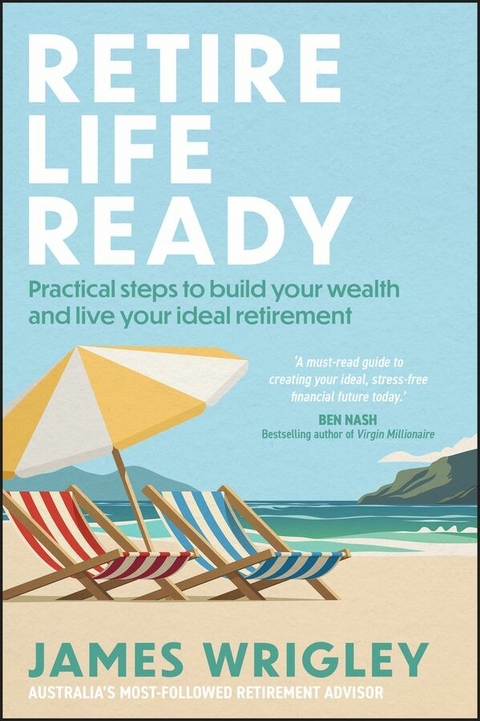
Retire Life Ready (eBook)
288 Seiten
Wiley (Verlag)
978-1-394-33408-7 (ISBN)
A no-nonsense guide to maximising your money, designing your future and retiring on your own terms
Retirement isn't just about how much money you've saved. It's also about the kind of life you want to live when you stop working. Whether your retirement feels a long way off or just around the corner, the simple choices you make now can make a big difference later. In Retire Life Ready, financial adviser James Wrigley shows you what you already have, what else you'll need and what steps you can take to build the life you're aiming for.
From getting on top of your super and investments to making the most of your assets, Retire Life Ready will help you build a secure plan that's shaped around you.
- Identify the cost in dollars for the lifestyle you want when you retire
- Understand superannuation as a powerful tool for your financial future
- Get strategies to pay down debt and your home loan
- Grow your wealth long-term with smart, simple investing strategies
- Plan ahead for healthcare and the pension, for yourself and for your parents
- Protect what you've built and create a legacy for the people you love with insurance and estate planning
The best retirement plans don't just secure your finances. They unlock the life you want to live. Where do you want to be, and what makes you happiest? Retire Life Ready gives you the tools to stress less, plan smarter and love the life you've worked for, both now and in your retirement years.
JAMES WRIGLEY is one of Australia's most-followed financial advisers. With over two decades of experience, he's known for making money matters simple and relatable. James helps thousands of Australians to take control of their finances and retire life ready.
A no-nonsense guide to maximising your money, designing your future and retiring on your own terms Retirement isn t just about how much money you ve saved. It s also about the kind of life you want to live when you stop working. Whether your retirement feels a long way off or just around the corner, the simple choices you make now can make a big difference later. In Retire Life Ready, financial adviser James Wrigley shows you what you already have, what else you ll need and what steps you can take to build the life you re aiming for. From getting on top of your super and investments to making the most of your assets, Retire Life Ready will help you build a secure plan that s shaped around you. Identify the cost in dollars for the lifestyle you want when you retire Understand superannuation as a powerful tool for your financial future Get strategies to pay down debt and your home loan Grow your wealth long-term with smart, simple investing strategies Plan ahead for healthcare and the pension, for yourself and for your parents Protect what you ve built and create a legacy for the people you love with insurance and estate planning The best retirement plans don t just secure your finances. They unlock the life you want to live. Where do you want to be, and what makes you happiest? Retire Life Ready gives you the tools to stress less, plan smarter and love the life you ve worked for, both now and in your retirement years.
CHAPTER 1
What are you retiring to?
Before we get into the what and the how of planning for your retirement, I want to introduce a different idea to you, a way of thinking about your future retirement that you may not have done before. I want you to open your thinking to what you are retiring to.
While retirement is the end of your working life, it's also the beginning of the next stage of your life.
According to the Australian Bureau of Statistics (ABS), in the 2022–23 financial year, there were 4.2 million people over the age of 45 who were retired: 2.3 million of them women and 1.9 million of them men. The average age at retirement (for all retirees) was 56.9, however, the average age people intend to retire is 65.4 years, with both of these ages trending upwards over time.
In my experience working in this space every day, a ‘young’ retirement these days (makes me sound old when I say phrases like that) is around 60. Lots of people in their 40s and 50s I speak to talk about working until around 65, but I feel more people retire under 65 than over 65, and this is backed up by the ABS data. So keep in mind with your own retirement planning that you may not work as long as you think you will — perhaps by choice, perhaps forced upon you.
You'll probably spend more time in retirement than you think. Then, when you look at longevity, according to the ABS, a 60-year-old male is likely to live another 24 years while a female is likely to live another 27.
Goodbye routine, hello free time
During your working years, your life is governed by the routine of working life: Get up, sort out the kids, get them to school, get to work, work the day, home, dinner, clean-up, sleep, repeat. While many of us live that life, and it can feel never-ending at times, the routine gives our day structure, it gives us a purpose and reason to get out of bed in the morning. We need routine in our lives.
Holidays, during our working years, are an opportunity to stop, to break up the routine and do something different for a couple of weeks before going back to the routine of our day-to-day life.
But what happens when you stop working? What happens when the routine you've been so used to for all those years stops? What happens when all your time becomes leisure time? What will you do then? What will get you out of bed in the morning? What will give you purpose and belonging? What will make you feel fulfilled? What will be the break (that holidays once were) from endless leisure time?
While the idea of not having to be anywhere at any particular time, no-one expecting anything of you and every day being a Sunday (I joke with all my retired clients), you really do need something to do — I've seen what happens when you don't.
In my job as a financial adviser, helping hundreds of people navigate the transition into retirement over the years, I've seen some people navigate this really well and others really struggle.
Client story: The value of staying connected
I'm reminded of one particular client, let's call him Bruce. Bruce really loved his work (as many people do), but he just worked too long. Bruce worked selling beer to pubs around Melbourne. I don't know how beer is sold to pubs in Melbourne now, but Bruce was from an era where you'd go door to door, one pub after another. Certainly, the number of customers he had grew smaller as the years went by, but he had his regulars. Bruce's wife would joke about trying to get him to retire but he wouldn't. Deep down I think Bruce's worries were twofold: I think he worried about not having enough money to retire on (which shouldn't have been a worry for him; more shortly), but I also think he had no idea of what to do if he stopped working. Many of his friends had already passed away, getting around a golf course would have been difficult, and if he stopped working, he wouldn't see all the people that he got to talk to in his work. Bruce loved a chat and to share a story.
On the financial front, Bruce and his wife had long paid off their house and saved up many hundreds of thousands of dollars in super and cash savings. Bruce and his wife were in the sweet spot where they didn't spend a large amount of money living, would qualify for a small part age pension and have plenty of their own money to supplement their retirement.
While Bruce could have retired many years before he did, he just couldn't think of what else he would do if he didn't go to work every day. Bruce worked well into his late 70s and then just stopped. With nothing to do, no purpose, nothing to get him out of bed, his health deteriorated and, unfortunately, his retirement only lasted a couple of years before he passed. I'm no doctor, but I'm sure his working as long as he did, with nothing else to go to didn't help his health.
I don't want you to be like this.
The big retirement dreams
So what do people typically do once they retire? Some popular goals are:
- overseas travel
- domestic travel
- home renovations and repairs
- spending time with grandkids
- community engagement/volunteering.
Without a doubt, a long overseas holiday is at the very top of just about every retiree's wish list and, in my experience, it's rarely a one-off aspiration. People want to travel overseas annually for the first ten or so years of their retirement. For some people, they may have already started doing regular overseas holidays during their working lives. If the kids have grown up and left home or are working themselves, the mortgage has been paid off and super balances are looking healthy, I'm all for encouraging people to start travelling before they finish work. It's a whole lot easier to pay for when you have an income coming in. In many cases, I encourage them to go business class, because, why not?
What does it cost? For a couple, I say you'll be lucky to get change out of $30 000 for a four- or five-week overseas trip. Then, it depends if you are flying business or economy, what room you take on the cruise ship, if you're staying in an Airbnb or 5-star hotels and on it goes …
Client story: Designing your own retirement
I have one client, let’s call her Jane, who has travelled consistently since the day she retired. A hike was one of the first things Jane did when she finished up work and from there she got the bug. Jane finds new friends everywhere, and every trip results in new buddies that she does other trips with.
Jane would pride herself on how light she could pack, often travelling for weeks on end (well into her 60s mind you) with just a backpack. She jokes with me now, more than ten years into her retirement, that she can’t quite pack like she used to. Jane spends six to nine months a year travelling around Australia and the world, and she wouldn’t have it any other way. Finding time for our four-monthly check-in is always a challenge because she has adventures planned 18 months in advance, but we make it work.
On the financial front, Jane travels at incredibly low cost and that $30 000 allowance for the couple I mentioned previously would cover Jane’s annual travels — she loves staying in backpackers’ hostels.
One other thing Jane has done that not many other clients have is purchased time share — and quite a bit of it. Jane has the money to buy it so that’s not a worry, but what it does is force her to keep going away and taking her friends with her because she doesn’t want to see the time shares go to waste. It works really well for her lifestyle.
What's on most retirement wish lists?
Most retirees gear up for the overseas holiday; that's the big thing they are looking forward to. Also towards the top of that list for most people heading into retirement is to do those jobs around the house that you didn't quite find the time to do while you were working. Perhaps it's repainting, maybe it's updating the bathroom or kitchen now that you have a little more time to plan.
From a financial planning perspective, we really like to have an idea about what's on the home reno list and what it might cost. If you go dropping $150 000 on a new kitchen and a couple of bathrooms in the first 12 months of your retirement, and haven't planned for it, it could mean your retirement savings run out a whole lot earlier than is comfortable.
Part of this home renovation work can be setting your house up for the next stage of your life. I'm not talking ramps and grab handles, but if you're like Jane who spends six to nine months a year away from her home, you need that set up. During COVID, Jane re-did a lot of her garden, making it much more low-maintenance and installing irrigation, and fixed up the kitchen and bathroom. Jane made the decision that she wasn't going to downsize from her house, so she needed to spend a bit of money bringing it up to standard for the next 15 to 20 years, but also making her garden a whole lot less work to come back to after a holiday. Clients tell me there is nothing worse than coming home from five weeks away on some amazing holiday only to have to spend the next two weeks fixing up the garden.
Lots of people buy a new caravan and car, the combination of...
| Erscheint lt. Verlag | 24.10.2025 |
|---|---|
| Sprache | englisch |
| Themenwelt | Sachbuch/Ratgeber ► Beruf / Finanzen / Recht / Wirtschaft ► Geld / Bank / Börse |
| Wirtschaft ► Betriebswirtschaft / Management | |
| Schlagworte | Aged Care • age pension • aging parents • Australia • Ben Nash • Centrelink • closing the gap • Compounding • debt • ETFs • Financial Planning • first financial • gen x finance • good vs bad debt • great wealth transfer • how much money do I need to retire • iamjameswrigley • Inheritance • inheritance planning • investing for retirement • Investment Management • investment strategies • investment types • millennial finance • Personal development • personal finance • property investing • replace your salary by investing • retirement guide • retirement planning • Services Australia • share investing • SMSF • spending number • superannuation • Tax Strategies • travel in retirement • Virgin Millionaire |
| ISBN-10 | 1-394-33408-7 / 1394334087 |
| ISBN-13 | 978-1-394-33408-7 / 9781394334087 |
| Informationen gemäß Produktsicherheitsverordnung (GPSR) | |
| Haben Sie eine Frage zum Produkt? |
 EPUB (Adobe DRM)
Kopierschutz: Adobe-DRM
Adobe-DRM ist ein Kopierschutz, der das eBook vor Mißbrauch schützen soll. Dabei wird das eBook bereits beim Download auf Ihre persönliche Adobe-ID autorisiert. Lesen können Sie das eBook dann nur auf den Geräten, welche ebenfalls auf Ihre Adobe-ID registriert sind.
Details zum Adobe-DRM
Dateiformat: EPUB (Electronic Publication)
EPUB ist ein offener Standard für eBooks und eignet sich besonders zur Darstellung von Belletristik und Sachbüchern. Der Fließtext wird dynamisch an die Display- und Schriftgröße angepasst. Auch für mobile Lesegeräte ist EPUB daher gut geeignet.
Systemvoraussetzungen:
PC/Mac: Mit einem PC oder Mac können Sie dieses eBook lesen. Sie benötigen eine
eReader: Dieses eBook kann mit (fast) allen eBook-Readern gelesen werden. Mit dem amazon-Kindle ist es aber nicht kompatibel.
Smartphone/Tablet: Egal ob Apple oder Android, dieses eBook können Sie lesen. Sie benötigen eine
Geräteliste und zusätzliche Hinweise
Buying eBooks from abroad
For tax law reasons we can sell eBooks just within Germany and Switzerland. Regrettably we cannot fulfill eBook-orders from other countries.
aus dem Bereich