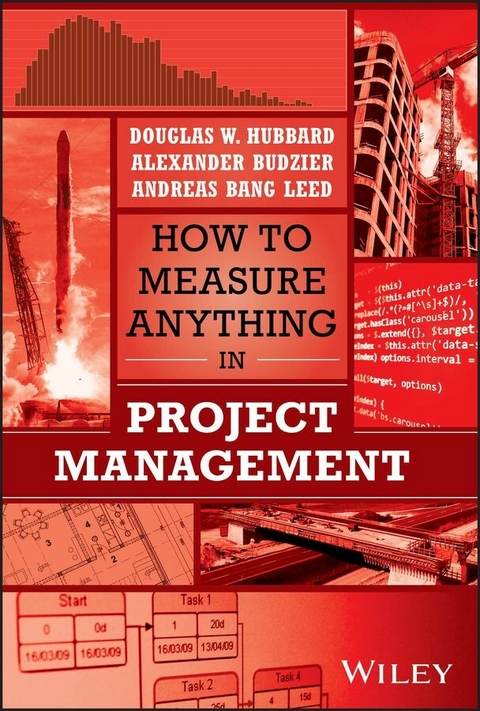
How to Measure Anything in Project Management (eBook)
625 Seiten
Wiley (Verlag)
978-1-394-23982-5 (ISBN)
Uncover common project management myths to improve project success
How to Measure Anything in Project Management explains why popular methods for measurement in project management are flawed and describes how to conduct measurements that better inform decisions, reduce project risks, and improve the chance of project success. The authors argue that anything that matters to project management at all is measurable and that these measurements address many of the problems in project management. The authors leverage an exclusive survey on the state-of-the-art of measuring projects, new case studies of things that are seemingly hard to measure and a database, collected by Oxford Global Projects, of thousands of projects in software development, construction, energy, and many other fields, including some of the biggest projects in history. The book is accompanied by a set of useful spreadsheet-based 'power tools' that support the more technical aspects of quantifying project risk, forecasting outcomes, and conducting seemingly difficult measurements. In this book, readers will learn:
- Why many of the methods they have been taught to use are little more than a type of 'analysis placebo'
- Why many popular methods lead to extreme overconfidence in estimates
- How some of the most important measurements a project could conduct are currently rarely used
How to Measure Anything in Project Management earns a well-deserved spot on the bookshelves of managers, executives, auditors, controllers, and consultants seeking to improve project performance through superior measurement methodology.
DOUGLAS W. HUBBARD has 35 years' experience as a management consultant with a focus on the application of quantitative methods in decision making. He is the founder and president of Hubbard Decision Research and the creator of the 'Applied Information Economics' method. He is also the author of the original How to Measure Anything: Finding the Value of Intangibles in Business as well as other books in measurement, risk analysis and decision making.
ALEXANDER BUDZIER, PHD, is a Fellow at the University of Oxford's Saïd Business School. He specializes in IT, infrastructure, energy, mega-events and change.
ANDREAS BANG LEED is the Head of Data Science at Oxford Global Projects. He specializes in data-driven project planning and risk analysis for some of the world's most ambitious mega-projects.
Uncover common project management myths to improve project success How to Measure Anything in Project Management explains why popular methods for measurement in project management are flawed and describes how to conduct measurements that better inform decisions, reduce project risks, and improve the chance of project success. The authors argue that anything that matters to project management at all is measurable and that these measurements address many of the problems in project management. The authors leverage an exclusive survey on the state-of-the-art of measuring projects, new case studies of things that are seemingly hard to measure and a database, collected by Oxford Global Projects, of thousands of projects in software development, construction, energy, and many other fields, including some of the biggest projects in history. The book is accompanied by a set of useful spreadsheet-based "e;power tools"e; that support the more technical aspects of quantifying project risk, forecasting outcomes, and conducting seemingly difficult measurements. In this book, readers will learn: Why many of the methods they have been taught to use are little more than a type of analysis placebo Why many popular methods lead to extreme overconfidence in estimates How some of the most important measurements a project could conduct are currently rarely used How to Measure Anything in Project Management earns a well-deserved spot on the bookshelves of managers, executives, auditors, controllers, and consultants seeking to improve project performance through superior measurement methodology.
Chapter 1
A World-scale Risk and a World-scale Opportunity
Virtually everything we take for granted in the modern world was someone’s project at one point. The smartphone and computer you use, the house you live in, the car you drive, the roads it drives on, and the energy you use were brought into existence by a project. This book was a project. Ideas for a better future will come down to a series of projects, some of which will rate among the most ambitious endeavors humans have made.
Many of the projects that have changed our lives for the better had benefits that justified the time and resources spent. Clear project successes, however, are not the most common outcomes. Cost and schedule overruns with benefits short of what was expected are not the exception but the norm. And some of the biggest failures not only end up wasting the resources committed to that effort but have repercussions beyond the cost of the projects themselves.
The persistence of these issues is not for a lack of efforts to solve them. For several decades now, there have been attempts to improve the situation with better standards, methods, software, and professional certifications. Yet, evidence of real improvements is elusive.
We will argue that a large part of these problems come down to inadequate measurements. The solution is better measurements before, during, and even after the project. These will include measurements that may have been dismissed as impossible to compute but, as the title of this book indicates, we will argue that anything that matters to your project is measurable.
The Size of Projects
Projects can be very large endeavors, but they don’t have to be. Indeed, the definitions that many separate sources have proposed for a project don’t define a size at all. Consider this definition:
Project: A temporary endeavor with a beginning and an end and it must be used to create a unique product, service or result.
This is the definition proposed by the Project Management Body of Knowledge (PMBOK),1 which was developed by the Project Management Institute (PMI), the largest professional organization of project managers in the world. There are at least a dozen similar definitions from other recognized sources like the PRojects IN Controlled Environments 2 (PRINCE2), International Project Management Association (IPMA), Association for Project Management (APM), and NASA.
The general agreement among these sources is that projects are temporary endeavors with a defined start and end time. By all these definitions, a project is considered distinct from continuous processes. However, there is less agreement on whether the output needs to be “unique.” Some definitions add that a project is held to defined quality standards (IPMA) or should be based on a business case (PRINCE2). But none require that these endeavors be a given size or complexity to constitute a project. By many of these definitions, making breakfast is a project—especially if it was a unique breakfast with stated quality standards. But when people pursue careers as project managers and study for project management certifications, most are thinking of something bigger.
For our purposes, and to specify the type of project that would be of interest to our readers or nearly anyone pursuing a career in project management, we add the conditions that projects are at least a couple of weeks long, involve multiple individuals or parties with separate responsibilities who need to coordinate efforts, and are complex enough to require some sort of deliberate plan. Additionally, at least one person on the project is the project manager. Of course, the projects we will discuss will include not only the smallest of these but also projects that cost billions of US dollars, take many years—perhaps decades—and involve the efforts of hundreds or thousands of workers.
When we add up the projects of all sizes and attempt to estimate their impact on the entire world’s economy, that’s when we see the true scale of projects. This may sound like a difficult measurement, but it is possible to use existing data to provide some rational bounds on the economic impact. Oxford Global Projects (OGP), a consulting firm cofounded by leading project management researchers, Bent Flyvbjerg and Alexander Budzier (Budzier is a coauthor of this book), can provide insights on questions like this. Since 2010, OGP has gathered data on projects in many sectors, including IT, transportation infrastructure, power generation, architecture, nuclear waste disposal, defense, and more. At the time of this writing, the OGP data had more than 20,000 projects with costs totaling over $6 trillion.
Of course, the OGP database, as large as it is, contains a small fraction of all projects worldwide. To estimate project work on a global scale, Alexander Budzier and another researcher, Harvey Maylor, built on previous surveys of workers that assess how much of their effort went toward project work in various industry sectors.2,3 These studies surveyed more than 950 separate organizations, and even though they used different methods of assessing economic value, their findings were consistent with one another. The methods used “gross value added” (GVA) as the measure of contribution to the world economy. GVA is an economic metric which adds up the contribution to value at each stage of production. It is useful in this context because it can avoid some of the potential double counting that could come from metrics like gross domestic product (GDP).
Combining all the studies, Budzier extrapolated the sector data across 54 other countries for which data are available and weighted the findings based on national GVA. He found that projects accounted for about $20.9 trillion, which is roughly the size of the whole 2019 US economy. Note that this estimate of GVA excludes huge economies like China4 and South Korea. But, if the proportions of projects in these large economies are similar to others, and the weighted average proportion of 40% were simply applied to the entire global GVA of about $110 trillion in 2024, then the weighted average contribution to GVA is more than $44 trillion.5,6
If we need more evidence for how much of the world economic output is in the form of projects, other back-of-the-envelope calculations put us in the same ballpark. For example, PMI estimates that there are about 65.9 million project managers worldwide who earn an average of $105,000 annually, accounting for $6.9 trillion annually.7 Of course, the total salaries in projects would be a multiple of this given that each project manager manages, on average, a team of five or six other people with annual salaries of about $90,000. Even if those project managers don’t spend all their time on projects, an estimate of $20 trillion is in the ballpark. Finally, other studies look at total spending in some areas like R&D, infrastructure, and IT, and how much of each of those is new projects versus maintenance or overhead.8,9,10 Again, those add up to something more than $10 trillion in the most conservative sums.
Every way we check this puts projects in the same general range of 10% to 40% of the world economy. Clearly, project work comprises an enormous share of the global economy. But again, the products and services we now take for granted are mostly examples of relatively successful projects—successful, at least, in the sense that they finished and produced something we use.
The Size of Project Problems
The projects that comprise so much of the global economy must come with an expectation that the benefits will justify the costs. Yet, various surveys raise serious doubts as to whether these resources are well spent. The surveys varied on how they defined “failure” versus “success”, and they covered different types of projects, but none of the research casts a positive light on outcomes. One source reported that 18% of IT projects were canceled after considerable time and money had been spent with nothing to show for it in the end.11 Another source reported that 70% of projects experienced what it defined as “significant” cost and schedule overruns.12
And yet, those are somewhat lenient measures of failure. In the OGP database, if we counted success only for those where budget, schedule, and expected benefits were all met, then we would find that just 0.4% are successes by all three criteria. Note that all of these were projects that were at least, eventually, completed. This does not include projects that were canceled after spending time and money on the project (see Figure 1.1). We’ve summarized the findings from the OGP data in further detail in Appendix 2.
FIGURE 1.1 Share of projects meeting requirements of budget, schedule, and benefits or better.
As bad as a 0.4% complete success rate appears to be, there are worse outcomes than merely falling short of expectations and those even worse still than just being canceled partway through the effort. Failed projects can have costs beyond the resources spent directly on the project, even beyond the overruns. There are cases where a project generated costly disruptions in the very areas they were meant to help. Businesses have lost market share, or even gone bankrupt, because of a project that went terribly wrong.
For example, the Hershey Chocolate’s SAP Enterprise Resource Planning (ERP) implementation in 1999 was so problematic...
| Erscheint lt. Verlag | 22.10.2025 |
|---|---|
| Sprache | englisch |
| Themenwelt | Wirtschaft ► Betriebswirtschaft / Management ► Projektmanagement |
| Schlagworte | Project failure • Project Management • project management confidence • project management data • project management decisions • project management research • project management risks • Project Management Tools • project success |
| ISBN-10 | 1-394-23982-3 / 1394239823 |
| ISBN-13 | 978-1-394-23982-5 / 9781394239825 |
| Informationen gemäß Produktsicherheitsverordnung (GPSR) | |
| Haben Sie eine Frage zum Produkt? |
 EPUB (Adobe DRM)
Kopierschutz: Adobe-DRM
Adobe-DRM ist ein Kopierschutz, der das eBook vor Mißbrauch schützen soll. Dabei wird das eBook bereits beim Download auf Ihre persönliche Adobe-ID autorisiert. Lesen können Sie das eBook dann nur auf den Geräten, welche ebenfalls auf Ihre Adobe-ID registriert sind.
Details zum Adobe-DRM
Dateiformat: EPUB (Electronic Publication)
EPUB ist ein offener Standard für eBooks und eignet sich besonders zur Darstellung von Belletristik und Sachbüchern. Der Fließtext wird dynamisch an die Display- und Schriftgröße angepasst. Auch für mobile Lesegeräte ist EPUB daher gut geeignet.
Systemvoraussetzungen:
PC/Mac: Mit einem PC oder Mac können Sie dieses eBook lesen. Sie benötigen eine
eReader: Dieses eBook kann mit (fast) allen eBook-Readern gelesen werden. Mit dem amazon-Kindle ist es aber nicht kompatibel.
Smartphone/Tablet: Egal ob Apple oder Android, dieses eBook können Sie lesen. Sie benötigen eine
Geräteliste und zusätzliche Hinweise
Buying eBooks from abroad
For tax law reasons we can sell eBooks just within Germany and Switzerland. Regrettably we cannot fulfill eBook-orders from other countries.
aus dem Bereich