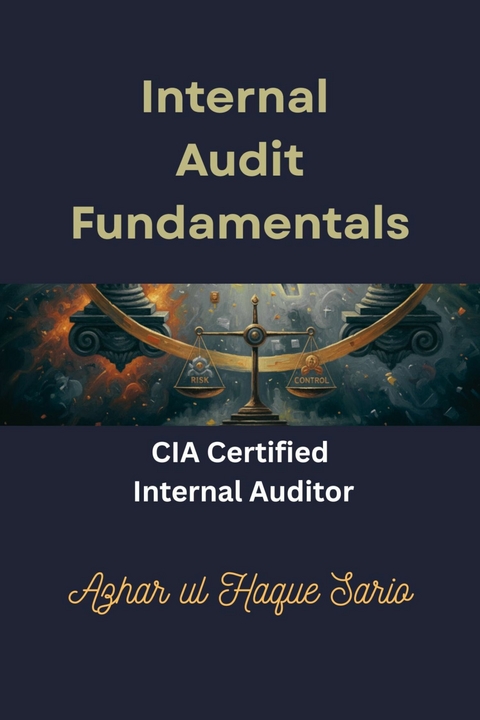
Internal Audit Fundamentals (eBook)
200 Seiten
Azhar Sario Hungary (Verlag)
978-3-384-73689-5 (ISBN)
Finally, a straightforward guide to mastering the fundamentals of the CIA exam.
This book is your complete guide to the core topics. It covers the foundations of internal auditing. We start with the basics. You will learn the core principles of the profession. We'll explore the official IIA Standards. This book explains independence and objectivity. These are crucial concepts. We cover the difference between assurance and consulting services. This section makes up 35% of the content, just like on the exam. Next, we move into ethics and professionalism. This is 20% of your focus. You will master the IIA's Code of Ethics. We cover integrity, objectivity, confidentiality, and competency. Then, we dive deep into GRC. This means Governance, Risk Management, and Control. This is a major 30% section. You'll learn how organizations are structured and managed. We explore how to identify and assess risks. You will understand internal control frameworks. We make complex ideas simple. Finally, the book tackles fraud risks. This last section is 15% of the material. You will learn about different types of fraud. We show you how to spot red flags. You'll understand the internal auditor's responsibility regarding fraud.
So, why is this book different? Many other study guides are simply too complicated. They are dense, academic, and overwhelming. They often feel like a data dump. This book provides value by being clear, concise, and focused. We strip away the unnecessary jargon. We get straight to the point. Our competitive advantage is efficiency. The book is built exactly to the exam syllabus. We don't just list the topics; we follow the exact exam percentages. This structure helps you prioritize your study time perfectly. You won't waste hours on minor topics. You'll focus your energy just like the exam does. It's written in simple, natural English. We want you to understand the concepts, not just memorize them. Think of this book as your personal tutor. It's the practical, no-fluff resource that respects your time and is designed for one purpose: to help you understand the fundamentals and pass your certification.
Copyright Disclaimer: The author of this book is not affiliated with nor endorsed by The Institute of Internal Auditors (IIA). This guide is independently produced. The 'CIA' and 'Certified Internal Auditor' designations are trademarks of the IIA. This publication is intended for educational and preparation purposes under the nominative fair use doctrine.
Section B. Ethics and Professionalism (20%)
Demonstrating Integrity in Finance: A Practical Guide
(a) Applying Honesty and Professional Courage in Ethical Dilemmas
In the world of finance, "integrity" is a word that gets used a lot. It’s on corporate websites, in annual reports, and in compliance manuals. But what does it really mean? It’s not just a buzzword. It’s the bedrock of the entire industry. Finance, at its core, runs on one thing: trust. When you manage someone else's money, advise them on their future, or value a company, you are making a promise. Honesty and professional courage are the tools you use to keep that promise, especially when it’s hard.
Let's break down these two ideas. Honesty is the "what." It’s the commitment to the truth. It’s accuracy in your spreadsheets, transparency in your client reports, and fairness in your dealings. Professional courage is the "how." It’s the action of being honest when it would be much, much easier to be quiet. It’s speaking up when you see something wrong, even if it puts you in a difficult position with a boss, a client, or your own team.
An ethical dilemma isn't usually a simple choice between right and wrong, like "Should I steal money?" (The answer is obviously no.) A real dilemma is often a choice between two "rights" or two "wrongs." It’s the grey area. It’s the situation where the pressure to perform, to meet a quarterly target, or to please a powerful client conflicts directly with your duty to be truthful.
Consider a common scenario. You’re an analyst. Your team has been working for weeks on a pitch for a major client. The night before the presentation, you’re running the numbers one last time and you find a flaw. A small, subtle error in a model’s assumption. When you correct it, the projected returns on the proposed strategy drop by 15%. They are still positive, but they are no longer market-beating. They are just… average.
What do you do?
The pressure is immense. Your managing director, who has been championing this strategy, is counting on this win. Your team is exhausted. Pointing out the error means a sleepless night of re-doing the entire deck, and it makes the "sale" much harder. It might even cost the firm the client. The temptation to stay quiet is overwhelming. "It's just one assumption," a voice might say. "The model is only a projection anyway."
This is where honesty and courage must collide.
Honesty is the part of you that knows the client deserves to see the real numbers, not the inflated ones. They are making a significant financial decision based on your work. Providing them with flawed data is, at its core, a lie. It's a failure of your professional duty.
Professional courage is the act of picking up the phone at 10 PM and calling your managing director. It’s saying, "I've found a problem. The numbers are not what we thought they were. We have to change the presentation."
This is terrifying. You might get yelled at. You might be blamed for not finding it sooner. You might be seen as "not a team player." But this is the absolute definition of integrity. It's choosing the hard right over the easy wrong. It's prioritizing the long-term trust of the client and the reputation of the firm over a short-term win.
Firms with a strong culture of integrity survive. They build relationships that last decades. Firms that cut these corners, that allow small lies to slide, eventually face a day of reckoning. It might not be tomorrow, but it will come.
So, how do you apply this in practice? You can develop a personal framework.
First, recognize the dilemma. Learn to spot the red flags. If something feels "off," if you feel pressured to cut a corner, or if a situation seems "too good to be true," pause. That "gut feeling" is your ethical alarm system. It’s often a sign that a technical problem is about to become an ethical one.
Second, gather the facts. Don't act on pure emotion. What are the hard facts? What is the specific data point, rule, or policy at issue? In our analyst example, it’s the flawed assumption. What are the rules? This includes not just the law (like SEC or FINRA regulations) but also your firm’s internal Code of Conduct and, if you have one, your professional designation’s ethical code (like the CFA Institute’s Code of Ethics and Standards of Professional Conduct).
Third, identify the stakeholders. Who will be affected by your decision? There's you (your career, your stress). There's your boss (their bonus, their reputation). There's the firm (its revenue, its reputation). And, most importantly, there’s the client. In finance, we must always anchor on the client. What is our duty to them? Are we acting as a true fiduciary, putting their interests first?
Fourth, evaluate your options. Lay them out clearly.
Do nothing. Stay quiet. Hope no one notices. (This is the path of least resistance and highest future risk).
Report it, but soften the blow. "The numbers are a bit different, but it's probably fine." (This is a weak compromise).
Report it clearly and directly. "The data is wrong. The conclusion is flawed. We must fix it." (This is the courageous option).
Fifth, act with courage. Once you've chosen the right path, you have to walk it. This means communicating clearly, professionally, and without blame. Focus on the problem, not the person. "I found an issue with the model" is better than "You messed up the model." Be solution-oriented: "I found an issue. I've already started re-running the numbers, and we should regroup in an hour to adjust the narrative."
Finally, reflect. After the dust settles, think about what happened. Did the firm support your honesty? If so, great. That’s a firm you can build a career with. If you were penalized for it, you learned something just as valuable: you might be in the wrong place.
Professional courage also applies to others. What if you see a colleague engaging in questionable behavior? Maybe it's a trader who seems to be front-running client orders. Maybe it's a salesperson pushing a clearly unsuitable, high-fee product to an elderly client. This is, in many ways, even harder. It’s not your mistake.
The same framework applies. Gather the facts (don't accuse on a hunch). Understand the rules. Then, you must act. This is why firms have whistleblower hotlines and clear escalation paths to compliance and legal departments. Using them is the ultimate act of professional courage. You are protecting the client, the firm, and the integrity of the market itself. It's not about being a "tattletale"; it's about being a professional.
Ultimately, honesty is a state, but courage is an action. You can be an honest person who is too afraid to act. In finance, that's not good enough. The industry demands both. It demands the integrity to know what's right and the courage to do what's right, especially when no one is watching, or when everyone is watching and hoping you'll do the wrong thing.
(b) Practicing Legal and Professional Behavior in All Situations
While ethical dilemmas are the high-stakes, dramatic moments of your career, practicing legal and professional behavior is what you do every other day. It's the 99% of the job. It's the foundation upon which your ability to handle that 1% dilemma is built. If you aren’t professional every day, you won't have the credibility or the character to be courageous when it matters most.
We need to clearly separate "legal" and "professional."
Legal behavior is the absolute floor. It is the minimum standard of conduct. These are the bright, clear lines drawn by lawmakers and regulators (like the SEC, FINRA, the Department of Labor, the Fed, and so on). Breaking these rules doesn't just get you fired; it can get you fined, barred from the industry, or even sent to prison.
Practicing legal behavior means:
No Insider Trading. This is the classic. If you have material, non-public information (MNPI), you cannot trade on it, and you cannot share it with anyone who might (this is "tipping"). This is a simple, hard rule.
Adhering to AML/KYC. Anti-Money Laundering (AML) and Know Your Customer (KYC) rules are not just "paperwork." They are the financial system's frontline defense against terrorism, drug trafficking, and other crimes. Practicing this means being diligent, asking the right questions about the source of funds, and escalating suspicious activity.
Accurate Reporting. All reports, whether internal, for a client, or for regulators, must be true and accurate. There is no such thing as "creative accounting"; there is only accounting and fraud.
No Misappropriation. This is basic: you never use a client's assets for your own benefit.
Honest Marketing. You cannot promise guaranteed returns. You cannot mislead clients about the risks of an investment. All communications must be "fair and balanced."
Practicing legal behavior is, in theory, simple. The rules are in a book. The firm provides mandatory training. You read the manual, you follow the rules. But it requires constant, active vigilance. It’s not a "one and done" task. It’s a daily process of checking your own actions. Before sending an email, you ask: "Does this contain MNPI?" Before placing a trade, you ask:...
| Erscheint lt. Verlag | 22.10.2025 |
|---|---|
| Sprache | englisch |
| Themenwelt | Wirtschaft ► Betriebswirtschaft / Management |
| ISBN-10 | 3-384-73689-3 / 3384736893 |
| ISBN-13 | 978-3-384-73689-5 / 9783384736895 |
| Informationen gemäß Produktsicherheitsverordnung (GPSR) | |
| Haben Sie eine Frage zum Produkt? |
 EPUB (Adobe DRM)
Größe: 323 KB
Kopierschutz: Adobe-DRM
Adobe-DRM ist ein Kopierschutz, der das eBook vor Mißbrauch schützen soll. Dabei wird das eBook bereits beim Download auf Ihre persönliche Adobe-ID autorisiert. Lesen können Sie das eBook dann nur auf den Geräten, welche ebenfalls auf Ihre Adobe-ID registriert sind.
Details zum Adobe-DRM
Dateiformat: EPUB (Electronic Publication)
EPUB ist ein offener Standard für eBooks und eignet sich besonders zur Darstellung von Belletristik und Sachbüchern. Der Fließtext wird dynamisch an die Display- und Schriftgröße angepasst. Auch für mobile Lesegeräte ist EPUB daher gut geeignet.
Systemvoraussetzungen:
PC/Mac: Mit einem PC oder Mac können Sie dieses eBook lesen. Sie benötigen eine
eReader: Dieses eBook kann mit (fast) allen eBook-Readern gelesen werden. Mit dem amazon-Kindle ist es aber nicht kompatibel.
Smartphone/Tablet: Egal ob Apple oder Android, dieses eBook können Sie lesen. Sie benötigen eine
Geräteliste und zusätzliche Hinweise
Buying eBooks from abroad
For tax law reasons we can sell eBooks just within Germany and Switzerland. Regrettably we cannot fulfill eBook-orders from other countries.
aus dem Bereich