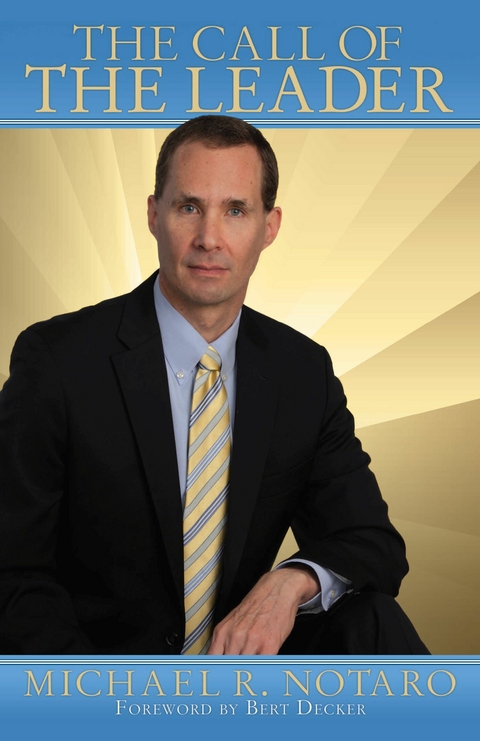
Call of the Leader (eBook)
180 Seiten
Bookbaby (Verlag)
979-8-3178-1791-6 (ISBN)
Michael Notaro is a lawyer, mediator, and recognized leader in both the business and nonprofit worlds. Born in Chicago and a proud graduate of the University of California, Berkeley, he was selected as a commencement speaker in 1985-an early sign of his powerful communication skills. He later served as a congressional intern in Washington, D.C., before building a career rooted in entrepreneurship and professional service. In 1995, he founded Phoenix Commercial Real Estate, and a decade later, he established the Notaro Law Group to represent commercial real estate investors and developers. His leadership extends beyond the boardroom; as the 2011-2012 Toastmasters International President, he led a global re-branding initiative, 'Toastmasters: where leaders are made,' which implemented a new visual identity for the nonprofit organization. Driven by a passion for helping new leaders find their voice and build personal confidence, Michael is a seasoned keynote speaker with over 600 speeches delivered on five continents. His book, The Call of the Leader, reflecting his personal mission, focuses on how anyone can become a transformative leader. Michael, who served in the United States Coast Guard Auxiliary, currently resides in Alameda, California, where he continues to inspire audiences worldwide.
In his book, The Call of the Leader, Michael Notaro presents a new model for authentic leadership that moves beyond traditional formulas and techniques. He argues that effective leadership stems from a deep, internal journey, outlining seven core principles that define the path of leadership excellence: calling, passion, purpose, power, rhythm, courage, and legacy. The journey begins by listening to the inner calling, a personal and intuitive guide that reveals a leader's true purpose. This purpose is the "e;why"e; behind their actions, providing meaning beyond a paycheck and acting as a compass to guide difficult decisions. This purpose is then ignited by passion, the visible enthusiasm and energy that drives a leader to overcome obstacles and inspires a shared sense of commitment within their team. According to Notaro, by aligning purpose and passion, a leader accesses their inner power, which is not about controlling others but about a true sense of authority in one's conviction. This power must be applied with rhythm, an understanding of timing knowing when to push forward and when to pull back to create a sustainable pace that prevents burnout. This power also drives personal courage - the willingness to take risks and challenge the status quo, which turns a good leader into a great one. Finally, the book emphasizes the enduring value of a positive legacy, which is the lasting impact a leader creates by cultivating a strong, positive culture and developing future leaders. It is the story people tell about a leader, a force that enhances their effectiveness and amplifies their influence long after they are gone. The Call of the Leader helps readers recognize, respond to, and fulfill their calling by overcoming fear and pressing forward to high achievement, transforming their reality into something better for future generations.
Chapter 1 Calling
I heard the call of the leader on a hot summer day in August 2007, sitting in a crowded conference room at the Marriot’s Desert Ridge Resort in Phoenix, Arizona. I was attending the last day of the Toastmasters International convention, concluding my two-year term on the Toastmasters International board of directors. Happy memories filled my mind. I relished the travel, friendships, and spirited board discussions, which shaped the future of Toastmasters International. But after many years of district and international leadership, I felt my time was over. The transition of power was evident as new, talented leaders emerged. I checked out of the hotel and had my shuttle booked to the airport for my flight back to Oakland, California. Then everything changed.
The closing event of the convention was the Past International Director luncheon. With a grateful heart, I attended in order to chat with new and old friends. Past directors stood and spoke, reflecting on the convention and hopes and dreams for the coming year ahead. The meeting also had a political aspect. At the end, a few past directors stood and announced their intent to run for third vice president of Toastmasters International. This is the officer position that leads directly to Toastmasters International president.
When the luncheon concluded, I gathered my belongings and walked intently toward the exit—my final exit. Just before I reached it, Toastmaster Don Ensch greeted me with a smile and said “Michael, did you announce yourself as a candidate for third vice president?”
“Who me?” I said.
“Yes, are you running for third vice president?”
“Don, I do not think that is for me,” I said. “Besides, it would be a lot of work. I have done my time on the board of directors. Running for a big office like that would require an international campaign.”
Don looked at me with a long, sympathetic pause. “Young man,” he said, “your campaign has already begun!” And he walked away.
At that moment, I felt the call of the leader—a mix of excitement, terror, and anticipation. Don’s subtle message was potent and powerful, and the answer calling inside of me was “Yes.” But saying yes did not make logical sense at the time. I was planning to step down, not step up. I wanted to fly home, take a break from Toastmasters, and grow my law practice. But Don’s words lingered in my heart during the flight home. Somehow, I felt this would not be my last Toastmasters journey.
By the time the plane landed in Oakland, I had mentally prepared to launch my campaign. I quickly announced my candidacy for third vice president, spent a year campaigning, and won election the following year at the Toastmasters International convention in Calgary, Alberta, Canada in 2008. Four years later I served as the 2011–2012 Toastmasters International president.
A calling is defined as “a strong inner impulse toward a particular course of action especially when accompanied by conviction of divine influence.”5 The call of the leader is the decisive force that pulls you toward a daring adventure—a big dream. The voice of opportunity beckons you to fess up, look up, and step up. A larger, richer, and nobler future appears on your landscape. You sense a divine alignment of your talent, spirit, and motivation. A calling may reveal itself through the prodding of others (like my friend Don) or in a moment of quiet reflection (as I felt on the flight home to Oakland). The call of the leader can come in a moment, but it can take a lifetime to find your moment.
The call to leadership is more than a job, task, or activity. It connects who you are with what you are meant to become. A calling provides a reason to lead. In fact, when you feel the call of the leader, the real question to ask is not “Why?” but “Why not?” The call beckons you to a bigger and better future. It resonates in your heart, mind, and soul; it is your best opportunity to add big value to the world. If something fails to move your spirit, it is probably not your calling.
Finding your calling is not something to dread or fear. The call of the leader will expand your vision and impact in the world. Whether you are young or old, discovering your calling is an exciting adventure.
Recognize the Calling
We recognize the call of the leader as an inner voice. While modern life is filled with external voices—bombarding us with demands, expectations, and deadlines—the inner voice is a truer, deeper message. The inner voice comes mainly through feelings, emotions, and thoughts, rather than audible sounds. Our core being communicates moment by moment, providing a wise indicator of inner truth—if we listen. The inner voice is much more than just intuition. Intuition is immediate sensory cognition. A calling lingers much longer, providing an authentic indicator of personal certainty and understanding. Discount your inner voice at your own peril.
But you cannot listen to the inner voice and outer voice at the same time. Listening to the inner voice requires silencing the external voice for a period. Take a break from the muddle of noise and clutter that fills our world. Mindfulness, meditation, and journaling provide helpful internal listening tools. When we shut down the technology (it is possible!) and spend time in silence, focusing on breath, openness, and writing, we experience heightened awareness of thoughts and feelings. If you have never done this, you may experience an aggressive inner critic, a voice of negativity and judgment, trying to disrupt the process. Let the inner critic wind down, and resist the temptation to focus on negative thoughts. Soon, you will feel an internal space emerging. Notice as influential ideas hang around a little longer than others. Like children clamoring for attention, they want your attention. They deserve your attention.
Soon, you will feel the inner voice pulling and tugging at your heartstrings. A calling is the genuine sound resonating within, drawing you toward something bigger than yourself. The ring of authenticity echoes truth within. We find a calling in the heart, not the head. A calling is an exercise of FAITH (Finding Answers in the Heart).
Listen for the hopeful calling, the hard calling, the hidden calling, and the higher calling:
• Hopeful Calling: The hopeful calling inspires you to fulfill a heartfelt dream that captivates your spirit. Inspiration powers the calling.
• Hard Calling: The hard calling challenges you to develop your full potential when pursuing a difficult challenge. Challenge powers the calling.
• Hidden Calling: The hidden calling invites you to pursue the overlooked aspiration of your heart. Fear of loss powers the calling.
• Higher Calling: The higher calling stirs you to do noble things that transcend and transform the spirit. Spiritual motives power the calling.
As a grade school student, I was fascinated by the way kids come together and organize themselves. I wanted to see my friends come together and have fun without damaging themselves (the hopeful calling). My favorite subject at school was recess. The energy of my rambunctious classmates playing, laughing, and screaming always made my day. Often, I was called on by adults to maintain order on the playground. Initially, I did not like it much (the hard calling). I felt it ruined my fun, since I liked being the rambunctious one. Over time, however, the peacemaker role started to grow on me (the hidden calling); I realized that if I did not do it, nobody would do it. I felt a transcendent longing to bring diverse groups of kids together (the higher calling).
At that young age, a calling was the furthest thing from my mind, but I knew my peers listened to and respected me. I refereed kickball games, counseled angry kids, and even broke up fights when necessary, keeping the peace despite outbursts from bullies, comics, and cynics. I even came to enjoy eradicating disorder and chaos. Soon, adults asked me to solve behavior problems with kids I had nothing to do with. As I grew older, I kept solving problems for bigger and bigger kids. Today, my law practice solves problems for the biggest kids.
Life presents countless opportunities to discover and develop your calling. Everyone has a calling waiting to be discovered. Notice the times when you feel energized and curious. Ask questions and test assumptions. The merger of facts (objective life experiences) with feelings (intense emotional responses) and faith (conviction of the future) signals a potential calling sweet spot. Here are some notable examples:
1. Early Calling: David Copperfield is the most successful magician of my generation, grossing over $4 billion in revenue.6 By the age of twelve, Copperfield was so consumed with magic that he was invited into the prestigious Society of American Magicians. His calling was unmistakable very early in life.
2. Mid-life Calling: Academy-award-winning actor John Houseman (The Paper Chase) was a successful grain speculator in the international grain markets as a young adult. Only after the stock market crash of 1929 did the thirty-one-year-old Houseman try his luck at theater. He found his calling in the middle of his career. Often, an unexpected crisis, divorce, or firing can be the impetus for discovering your...
| Erscheint lt. Verlag | 16.10.2025 |
|---|---|
| Sprache | englisch |
| Themenwelt | Wirtschaft ► Betriebswirtschaft / Management ► Unternehmensführung / Management |
| ISBN-13 | 979-8-3178-1791-6 / 9798317817916 |
| Informationen gemäß Produktsicherheitsverordnung (GPSR) | |
| Haben Sie eine Frage zum Produkt? |
 EPUB (Ohne DRM)
Größe: 812 KB
Digital Rights Management: ohne DRM
Dieses eBook enthält kein DRM oder Kopierschutz. Eine Weitergabe an Dritte ist jedoch rechtlich nicht zulässig, weil Sie beim Kauf nur die Rechte an der persönlichen Nutzung erwerben.
Dateiformat: EPUB (Electronic Publication)
EPUB ist ein offener Standard für eBooks und eignet sich besonders zur Darstellung von Belletristik und Sachbüchern. Der Fließtext wird dynamisch an die Display- und Schriftgröße angepasst. Auch für mobile Lesegeräte ist EPUB daher gut geeignet.
Systemvoraussetzungen:
PC/Mac: Mit einem PC oder Mac können Sie dieses eBook lesen. Sie benötigen dafür die kostenlose Software Adobe Digital Editions.
eReader: Dieses eBook kann mit (fast) allen eBook-Readern gelesen werden. Mit dem amazon-Kindle ist es aber nicht kompatibel.
Smartphone/Tablet: Egal ob Apple oder Android, dieses eBook können Sie lesen. Sie benötigen dafür eine kostenlose App.
Geräteliste und zusätzliche Hinweise
Buying eBooks from abroad
For tax law reasons we can sell eBooks just within Germany and Switzerland. Regrettably we cannot fulfill eBook-orders from other countries.
aus dem Bereich