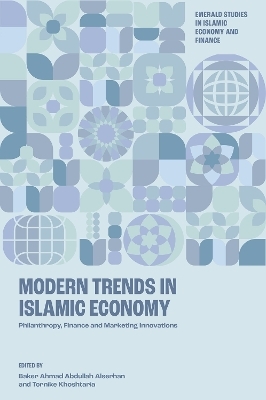
Modern Trends in Islamic Economy
Emerald Publishing Limited (Verlag)
978-1-80592-544-6 (ISBN)
- Noch nicht erschienen (ca. April 2026)
- Versandkostenfrei
- Auch auf Rechnung
- Artikel merken
The book examines the pivotal role of Islamic philanthropy, particularly waqf (endowments) and zakat (charitable giving), as mechanisms for addressing socio-economic inequalities and fostering community resilience. Innovations like cash waqf and sukuk (Islamic bonds) are analyzed, showcasing their capacity to create sustainable funding models for addressing issues such as disaster relief, education, and poverty alleviation. Practical case studies offer real-world examples of how these tools are effectively utilized in various regions, including South Asia, North Africa, and the Middle East.
Emerald Studies in Islamic Economy and Finance (ESIEF) is dedicated to advancing the knowledge and understanding of Islamic economics and finance. In an era where the global economic landscape is constantly evolving this will series seeks to contribute significantly to the academic discourse surrounding Islamic economy and finance building on the rich heritage of Islamic economic thought while embracing contemporary perspectives and challenges. The series is also committed to fostering rigorous academic inquiry promoting scholarly collaboration and ultimately enriching the understanding of Islamic economics and finance in the global context.
Baker Ahmad Abdullah Alserhan, Professor and head of the department of Business Administration at Princess Sumaya University for Technology in Amman, Jordan. Tornike Khoshtaria is Programme Leader for the MSc Digital Marketing at QFBA Northumbria University in Doha, Qatar.
Chapter 1. Islamic Philanthropy in Action: Exploring Waqf as a Strategic Tool for Enhancing Disaster Resilience; Fatima Kassab Hmoud Al-Khalidi
Chapter 2. The Antecedents of Halal Food Purchase Intention: Perceived Product Quality, Perceived Product Healthiness, Food Safety, and Compatibility with Dietary Nutrition; Mehmet Özer Demir and Burak Arslan
Chapter 3. The Role of Digital Technology in Enhancing Islamic Marketing: Current Realities and Future Trends; Reema Al Qaruty
Chapter 4. Exploring the Role of Social and Environmental Values in Shaping Muslim Consumer Religiosity; Johari Bin Abdullah, Firdaus Abdullah, Saimi Bin Bujang, Abang Hamizam Bin Abang Mohar, Ida Izumi Binti Abdollah, Ellen Chung, and Voon Boo Ho
Chapter 5. Inclusive Stakeholder Engagement in Islamic Marketing: Ethical Crisis Management in Sustainability and Health; Daina Yesuraj and Reema Al Qaruty
Chapter 6. A Consideration and Overview of the Popular Religiosity Measures for and by Muslims in Business Research; Bronwyn P Wood (Aisha), Salieu Senghore, and Taha Yahya Abdulrahman
Chapter 7. Examining the Drivers of Switching Intention from Conventional Banks to Islamic Banks in Morocco; Hind Lebdaoui, Alaaeddine Dahbi, Asmae Hassanain, Mustapha Saad Moudafi, Othmane Daoud, Salaheddine Dahbi, Anass Ben Sliman, and Youssef Chetioui
Chapter 8. An Impact Assessment of Islamic Microfinance on Achieving Sustainable Development Goals (SDGs): A Comparative Study in Bangladesh, Malaysia, and Turkey; Norma Bt. Md Saad, Md Nazim Uddin, Yusof Bin Ismail, and Lutfun Nahar
Chapter 9. Education Financing Services in Islamic Banks; Ali Abu Aliz, Reema Al Qaruty, Abdul Rahman Al-Kilani, Wided Dafri, and Samer Abdel Hadi
Chapter 10. The Investigation of Green Sukuk Compliance with Maqasad Shariah; Mohamed Sadok Gassouma
Chapter 11. Impact of Covid-19 Pandemic on Sharia Compliance Banks – A Camel Approach Framework Applied to Saudi Banks; Rahma Boubaker and Amira Kaddour
| Erscheint lt. Verlag | 13.4.2026 |
|---|---|
| Reihe/Serie | Emerald Studies in Islamic Economy and Finance |
| Verlagsort | Bingley |
| Sprache | englisch |
| Maße | 152 x 229 mm |
| Themenwelt | Wirtschaft ► Betriebswirtschaft / Management ► Unternehmensführung / Management |
| Wirtschaft ► Volkswirtschaftslehre | |
| ISBN-10 | 1-80592-544-X / 180592544X |
| ISBN-13 | 978-1-80592-544-6 / 9781805925446 |
| Zustand | Neuware |
| Informationen gemäß Produktsicherheitsverordnung (GPSR) | |
| Haben Sie eine Frage zum Produkt? |
aus dem Bereich