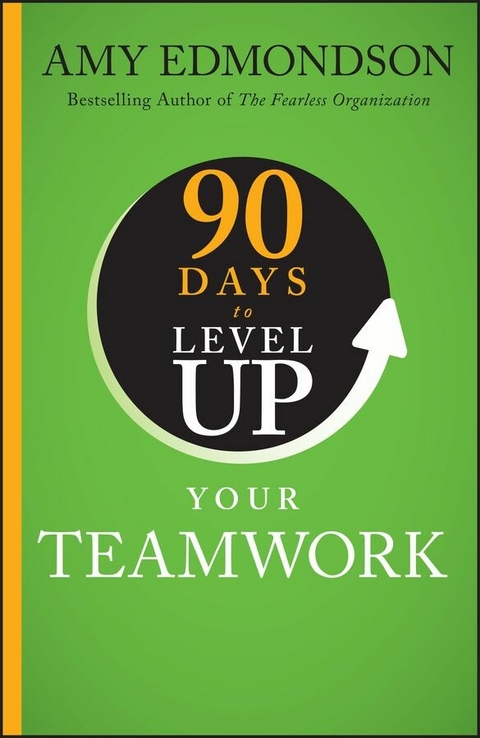
90 Days to Level Up Your Teamwork (eBook)
237 Seiten
Wiley (Verlag)
978-1-394-33552-7 (ISBN)
Supercharge your teamwork skills in just three months with expert advice from an industry leader
In 90 Days to Level Up Your Teamwork, bestselling author Amy Edmondson teaches you how to become a better team player by focusing on a specific element of cooperative achievement each week. From overcoming barriers to creating psychological safety, this book walks you through exactly how to develop your teamwork skills, one step at a time.
Inside you'll find:
- A crystal-clear, week-by-week roadmap to help you improve your teamwork skills
- Practical tasks and actionable steps you can apply immediately to become a better teammate
- Thoughtful prompts to help you think about how what you've learned applies to your own career
If you're ready to transform your career and achieve your goals in just one quarter, the 90 Days to Level Up series is for you. Whether you're brand-new to a business, stepping into a leadership role for the first time, or looking to enhance your skills, this series will be your personal guide to unlocking your potential and reaching new professional heights.
Amy Edmondson is a bestselling author and the Novartis Professor of Leadership and Management at the Harvard Business School. Her work is focused on teaming-dynamic forms of collaboration in environments characterized by uncertainty and ambiguity. She's also an expert in the role of psychological safety in teamwork and innovation.
Supercharge your teamwork skills in just three months with expert advice from an industry leader In 90 Days to Level Up Your Teamwork, bestselling author Amy Edmondson teaches you how to become a better team player by focusing on a specific element of cooperative achievement each week. From overcoming barriers to creating psychological safety, this book walks you through exactly how to develop your teamwork skills, one step at a time. Inside you'll find: A crystal-clear, week-by-week roadmap to help you improve your teamwork skills Practical tasks and actionable steps you can apply immediately to become a better teammate Thoughtful prompts to help you think about how what you've learned applies to your own career If you're ready to transform your career and achieve your goals in just one quarter, the 90 Days to Level Up series is for you. Whether you're brand-new to a business, stepping into a leadership role for the first time, or looking to enhance your skills, this series will be your personal guide to unlocking your potential and reaching new professional heights.
Week 1
Teaming Is a Verb
Benchmark goal: Understanding how teaming is different than teamwork.
Say the word team and the first image that comes to mind is probably a sports team: football players huddled in the mud, basketball players swarming in a full-court press, or baseball players turning a game-saving double play. In sports, great teams consist of individuals who have learned to trust one another. Over time, they have discovered each other’s strengths and weaknesses, enabling them to play as a coordinated whole. Similarly, musicians form bands, chamber groups, and orchestras that rely on interdependent talents. A symphony falls apart unless the string section coordinates with the woodwinds, brass, and percussionists. Even when a soloist is featured on stage, the orchestral score has a part for every musician. A successful performance is one in which the musicians complement one another and play in harmony. Like all good teams, they display synergy. The whole is greater than the sum of its parts. The players understand that they succeed or fail together—they win or lose as a team.
In today’s complex and volatile business environment, corporations and organizations also win or lose by creating wholes that are greater than the sum of their parts. Intense competition, rampant unpredictability, and a constant need for innovation are giving rise to even greater interdependence and thus demand even greater levels of collaboration and communication than ever before. Teaming is essential to an organization’s ability to respond to opportunities and to improve internal processes. Week 1 aims to deepen your understanding of why teaming and the behaviors it requires are so crucial for organizational success in today’s environment.
Delving into Teaming
Sports teams and musical groups are both bounded, static collections of individuals. Like most work teams in the past, they are physically located in the same place while practicing or performing together. Members of these teams learn how to interact. They’ve developed trust and know each other’s roles. Advocating stable boundaries, well-designed tasks, and thoughtfully composed membership, many seminal theories of organizational effectiveness explained how to design and manage just these types of static performance teams.
Harvard psychologist Richard Hackman, a preeminent scholar of team effectiveness, established the power of team structures in enabling team performance. According to this influential perspective, well-designed teams are those with clear goals, well-thought-out tasks that are conducive to teamwork, team members with the right skills and experiences for the task, adequate resources, and access to coaching and support. Get the design right, the theory says, and the performance will take care of itself. This model focused on the team as an entity, looking largely within the well-defined bounds of a team to explain its performance. Other research, notably conducted by MIT professor Deborah Ancona, showed that how much a team’s members interact with people outside the team boundaries was also an important factor in team performance. Both perspectives worked well in guiding the design and management of effective teams, at least in contexts where managers had the lead time and the run time to invest in composing stable, well-designed teams.
In these prior treatments, team is a noun. A team is an established, fixed group of people cooperating in pursuit of a common goal. But what if a team disbands almost as quickly as it was assembled? For example, what if you work in an emergency services facility where the staffing changes every shift, and the team changes completely for every case or client? What if you’re a member of a temporary project team formed to solve a unique production problem? Or you’re part of a group of managers with a mix of individual and shared responsibilities? How do you create synergy when you lack the advantages offered by the frequent drilling and practice sessions of static performance teams like those in sports and music?
The answer lies in teaming.
Teaming is a verb. It is a dynamic activity, not a bounded, static entity. It is largely determined by the mindset and practices of teamwork, not by the design and structures of effective teams. Teaming is teamwork on the fly. It involves coordinating and collaborating without the benefit of stable team structures, because many operations, such as hospitals, power plants, and military installations, require a level of staffing flexibility that makes stable team composition rare. In a growing number of organizations, the constantly shifting nature of work means that many teams disband almost as soon as they’ve formed. You could be working on one team right now, but in a few days, or even a few minutes, you may be on another team.
Fast-moving work environments need people who know how to team, people who have the skills and the flexibility to act in moments of potential collaboration when and where they appear. They must have the ability to move on, ready for the next such moments. Teaming still relies on old-fashioned teamwork skills such as recognizing and clarifying interdependence, establishing trust, and figuring out how to coordinate. But there usually isn’t time to build a foundation of familiarity through the careful sharing of personal history and prior experience, nor is there time for developing shared experiences through practice working together. Instead, people need to develop and use new capabilities for sharing crucial knowledge quickly. They must learn to ask questions clearly and frequently. They must make the small adjustments through which different skills and knowledge are woven together into timely products and services.
Why should managers care about teaming? The answer is simple. Teaming is the engine of organizational learning. By now, everyone knows that organizations need to learn—to thrive in a world of continuous change. But how organizations learn is not as well understood. Organizations are complex entities; many are globally distributed, most encompass multiple areas of expertise, and nearly all engage in a variety of activities. What does it mean for such a complex entity to “learn”? An organization cannot engage in a learning process in any meaningful sense—not in the way an individual can. Yet, when individuals learn, this does not always create change in the ways the organization delivers products and services to customers.
In spite of the obvious need for change, most large enterprises are still managed according to a powerful mindset I call organizing to execute.
Organizing to Execute
If you stood on a main street in Detroit around 1900, you would have seen electric trolleys sharing the streets with horse-drawn carriages. A mere decade later, cars had arrived in force. Though inefficient and unreliable, these increasingly popular cars brought with them the promise of a new, exciting world. For a short time, however, both horse and mechanical horsepower tried to share the streets, sometimes with devastating consequences. Many people found the collision of old and new worlds difficult, especially when those streets became even more crowded with young men from the countryside drawn to the city by the promise of manufacturing jobs.
In this transitional period, it was not obvious to the average worker how much the new industrial era would disrupt the social order by calling for new forms of obedience, unprecedented conformity to routine, and a new mindset that revered systems of control. Self-sufficient farmers and shopkeepers, who had for generations confronted vicissitudes of weather and illness and found ways to survive, would subtly but inexorably be transformed into order followers collecting paychecks from impersonal enterprises.
Organizing to execute found its seminal momentum in Henry Ford’s invention of the assembly line: workers focused on fitting cog to component and component to cog. Emphasizing routine procedures, Ford’s approach made the working life of employees menial and tedious. Reliable and predictable, Ford’s assembly line process was as much a novelty as its product. With the new century, age-old structures for self-reliance were being replaced with the small, repetitive steps that made mass production possible and brought about the modern world of products and services we know today. Ford’s success was contingent on a high level of managerial control over employee practices known today as command-and-control management, or top-down management. The practice of top-down management is one component of a broader organizational methodology known as scientific management.
Scientific Management
Ford’s intellectual partner as a pioneer in mass production was management expert Frederick Winslow Taylor, who complemented Ford’s assembly line with his efficiency methods and scientific measurement. Taylor and his followers devised ways to transform unpredictable and expensive customized work into efficient, economical systems of mass production. Long product life cycles enabled ample payback for the time invested in designing near-foolproof execution systems like the machine-paced assembly line. Periods of stability could be counted on. Products, processes, and even customers were mercifully uniform, minimizing the need for real-time improvisation to respond to unexpected problems, technological changes, or customer needs. Promoting the use of...
| Erscheint lt. Verlag | 14.10.2025 |
|---|---|
| Reihe/Serie | 90 Days to Level Up Series |
| Sprache | englisch |
| Themenwelt | Sachbuch/Ratgeber ► Beruf / Finanzen / Recht / Wirtschaft ► Bewerbung / Karriere |
| Wirtschaft ► Betriebswirtschaft / Management | |
| Schlagworte | business teamwork • hands-on teamwork skills • organizational teamwork • practical teamwork skills • teamwork at work • teamwork book • teamwork goals • teamwork guide • teamwork plan • teamwork roadmap • teamwork skills • teamwork strategies |
| ISBN-10 | 1-394-33552-0 / 1394335520 |
| ISBN-13 | 978-1-394-33552-7 / 9781394335527 |
| Informationen gemäß Produktsicherheitsverordnung (GPSR) | |
| Haben Sie eine Frage zum Produkt? |
 EPUB (Adobe DRM)
Kopierschutz: Adobe-DRM
Adobe-DRM ist ein Kopierschutz, der das eBook vor Mißbrauch schützen soll. Dabei wird das eBook bereits beim Download auf Ihre persönliche Adobe-ID autorisiert. Lesen können Sie das eBook dann nur auf den Geräten, welche ebenfalls auf Ihre Adobe-ID registriert sind.
Details zum Adobe-DRM
Dateiformat: EPUB (Electronic Publication)
EPUB ist ein offener Standard für eBooks und eignet sich besonders zur Darstellung von Belletristik und Sachbüchern. Der Fließtext wird dynamisch an die Display- und Schriftgröße angepasst. Auch für mobile Lesegeräte ist EPUB daher gut geeignet.
Systemvoraussetzungen:
PC/Mac: Mit einem PC oder Mac können Sie dieses eBook lesen. Sie benötigen eine
eReader: Dieses eBook kann mit (fast) allen eBook-Readern gelesen werden. Mit dem amazon-Kindle ist es aber nicht kompatibel.
Smartphone/Tablet: Egal ob Apple oder Android, dieses eBook können Sie lesen. Sie benötigen eine
Geräteliste und zusätzliche Hinweise
Buying eBooks from abroad
For tax law reasons we can sell eBooks just within Germany and Switzerland. Regrettably we cannot fulfill eBook-orders from other countries.
aus dem Bereich