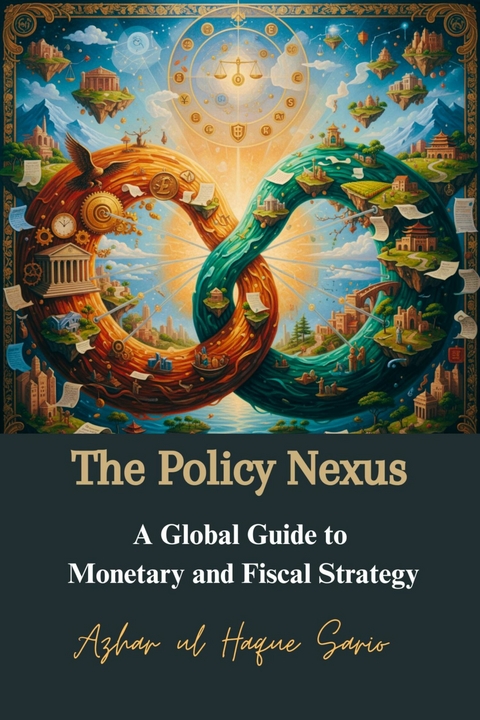
The Policy Nexus (eBook)
200 Seiten
Azhar Sario Hungary (Verlag)
978-3-384-73064-0 (ISBN)
Have you ever wondered how the world's most powerful economic decisions are actually made? This book, The Policy Nexus, takes you inside the engine rooms of global economic policy. It explores how nations manage their economies using monetary and fiscal strategies. We journey from the theories of Keynes to the modern challenges of inflation targeting. The book examines the tools central banks use, like interest rates and quantitative easing. It also dives into government tools like taxes and stimulus spending. You'll see these ideas in action through 15 distinct case studies from around the world. We'll look at the US Federal Reserve's post-pandemic strategy and Japan's long battle with deflation. We'll analyze Germany's shift away from austerity and China's management of its currency. From Brazil's fight against hyperinflation to the UK's path after Brexit , each chapter connects a core theme to a real country's experience. The book explains how recent crises have forced an unprecedented level of coordination between governments and central banks, blurring the traditional lines between them.
Most books treat monetary and fiscal policy as separate subjects. The Policy Nexus argues this view is outdated and no longer tenable. Instead of a dry, country-by-country survey, this book uses a unique theme-driven approach. This comparative framework provides a deep and nuanced understanding of how economic theory is applied in the real world. It allows you to see how different nations have grappled with shared challenges, from sovereign debt crises to the limits of central bank independence. The book gives you a holistic view, revealing the deep interdependencies between monetary, fiscal, and financial stability policies. It also digs into the political economy of these decisions-the pressures, institutions, and politics that are just as important as the economic models themselves. It is this focus on the interconnected, real-world policy nexus that offers a practical and insightful guide to the modern macroeconomic landscape.
This author has no affiliation with the Federal Reserve Board, the International Monetary Fund, or any other official institution mentioned herein. This work is independently produced and any references to such entities are for descriptive purposes only under the principle of nominative fair use.
Part I: Monetary Policy in Advanced Economies: New Frontiers and Old Constraints
Navigating the Post-Pandemic Monetary Landscape: The United States Federal Reserve's 2025 Framework
1.1 The 2025 Framework Review: A Pivot from FAIT to Flexible Inflation Targeting
The story of the Federal Reserve’s monetary policy in the 21st century is a story of adaptation. Think of it like a ship captain who, after years of navigating calm, predictable seas, is suddenly thrust into a hurricane. The old maps and tools are no longer sufficient. This is precisely the dilemma the Fed faced, leading to its landmark 2025 framework review. To truly understand this pivot, we have to go back to the world that created its predecessor, the 2020 framework known as Flexible Average Inflation Targeting, or FAIT.
For the entire decade following the 2008 Global Financial Crisis (GFC), the Fed’s biggest fear wasn’t a runaway economy; it was a stagnant one. Inflation wasn’t soaring; it was stubbornly, frustratingly low. The central bank would aim for its 2% inflation target, a level considered healthy for the economy, but repeatedly miss on the low side. This created a dangerous problem. If people and businesses start to expect inflation to always be low, they change their behavior. Workers don't ask for raises, companies don't raise prices, and the whole economy gets stuck in a low-growth rut. Even more concerning was the "zero lower bound" (ZLB)—the fact that interest rates can't be cut much below zero. This meant that in the next recession, the Fed’s primary tool for stimulating the economy would be effectively useless.
FAIT was the Fed’s ingenious solution to this specific problem. It was a promise. The Fed essentially said to the American public, "We know we've been running inflation a bit cold, below 2%. To make up for that, we are now going to intentionally let it run a bit hot for a while. We won't slam on the brakes the moment we hit 2%." The goal was to convince everyone that the Fed was serious about hitting its average target over time, thereby lifting inflation expectations. Alongside this, FAIT took an "asymmetric" view of the job market. It would only worry about "shortfalls" from maximum employment, not overshoots. In simple terms, the Fed wouldn't raise interest rates just because unemployment was low; it would wait for clear signs of problematic inflation. It was a framework built for a world where the primary danger was economic winter.
Then, the COVID-19 pandemic and its aftermath completely flipped the script. Instead of economic winter, a wildfire of inflation ignited. Supply chains snapped, government stimulus flooded the economy, and consumer demand, pent up for over a year, exploded. Inflation didn't just nudge above 2%; it skyrocketed to levels not seen in forty years.
Suddenly, the FAIT framework looked worse than obsolete; it looked counterproductive. The idea of the Fed intentionally trying to create an inflation overshoot seemed absurd, even reckless, when inflation was already the number one economic problem. The pledge not to act until employment was at its absolute maximum became a handicap, preventing the Fed from moving quickly to cool down the overheating economy.
This is the context for the 2025 pivot announced at Jackson Hole. Chair Jerome Powell's announcement was an act of pragmatic retreat. The Fed formally abandoned the promise of an inflation overshoot. The language was clear and direct: the world had changed, and so the Fed had to change with it. The new framework returned to a more traditional "flexible inflation targeting." The 2% target remains the North Star, but the strategy for reaching it is now more balanced and adaptable.
Crucially, the Fed replaced the one-sided focus on employment "shortfalls" with a "balanced approach." This is a significant shift. It means the Fed is once again looking at both of its mandated goals—maximum employment and stable prices—as two sides of the same coin. If inflation is threatening to get out of control, the Fed will now act to curb it, even if the job market isn't at its absolute peak. It signals a return to a more cautious stance, acknowledging that the risks are no longer just about a sluggish economy, but also about the corrosive power of high inflation on savings and household budgets. The 2025 framework is an admission that the post-GFC era is over. The Fed is retooling for a new landscape, one where inflation is a clear and present danger, and where policy must be nimble enough to fight battles on multiple fronts.
1.2 The Efficacy and Channels of Quantitative Easing (QE): An Unsettled Debate
If interest rate cuts are the Federal Reserve’s standard tool, then Quantitative Easing (QE) is its sledgehammer. Rolled out during the depths of the 2008 financial crisis, QE involves the central bank creating new money to buy massive quantities of government bonds and other securities from the open market. The goal is to push down long-term interest rates, encourage investment, and pump liquidity into a financial system on the brink of collapse. Yet, nearly two decades after its first use, economists and policymakers are still fiercely debating how, when, and even if it truly works as intended. The Fed’s 2025 framework review was notably quiet on this front, offering no new rulebook for its most powerful unconventional tool, a silence that speaks volumes about the deep uncertainty that remains.
The initial thinking behind QE was fairly straightforward and, according to early studies, quite effective. The theory centered on something called the "portfolio balance" channel. Imagine the entire market of investable assets. When the Fed steps in and buys trillions of dollars' worth of safe assets like U.S. Treasury bonds, it removes them from the hands of private investors. Those investors (like pension funds, banks, and individuals) are now flush with cash and have fewer safe places to put it. To get a return on their money, they are forced to "rebalance their portfolios" by moving into riskier assets, like corporate bonds or stocks. This surge in demand pushes up the prices of those assets and, critically, pushes down their yields. For a company, a lower bond yield means it can borrow money more cheaply to build a new factory. For a homebuyer, lower yields on mortgage-backed securities can translate into a lower mortgage rate. Early analyses of QE1 and QE2 seemed to confirm this, showing a clear impact on lowering long-term interest rates and calming panicked markets.
However, as QE became a more regular feature of the economic landscape, especially during the pandemic, the picture grew murkier. The link between QE and the real economy—things like job growth and, most importantly, inflation—has become much harder to prove. The massive QE programs undertaken in 2020 and 2021 were followed by a historic surge in inflation, but correlation is not causation.
This is where fascinating and challenging new research comes in. The hypothetical 2025 NBER working paper mentioned in the text points to a radical new idea: that under certain conditions, QE could actually be disinflationary. This theory turns the conventional wisdom on its head. It suggests we need to think about who receives the money from QE and who ultimately pays for it. The immediate beneficiaries are the bondholders, who tend to be wealthier households that save a large portion of their income. The ultimate cost of these programs, however, will be paid through future taxes, which fall on the broader population. The theory posits that these wealthier, "unconstrained" households, anticipating higher future taxes, might choose to work and save more in the present to prepare. An increased supply of labor could lead to lower wage growth and reduced production costs for businesses, thereby putting downward, not upward, pressure on inflation. While still a novel and debated theory, it illustrates just how complex and non-obvious the effects of QE might be.
This evolving debate suggests we need to reframe our understanding of QE. Perhaps it is not a blunt instrument for stimulating overall economic demand, but rather a specialized tool of financial engineering. In a full-blown crisis, its greatest strength may be its role as a massive liquidity provider, acting as a firefighter to stop a financial panic from spreading. When markets are frozen and no one is willing to lend, the Fed can step in as the ultimate buyer, restoring confidence and ensuring the basic plumbing of the financial system continues to function. Its other key role, especially when interest rates are already at zero, is "signaling"—by buying long-term bonds, the Fed signals its strong commitment to keeping interest rates low for a long time.
In the end, QE is not a magic wand. Its effects are "state-dependent," changing dramatically depending on the health of the economy and the state of financial markets. It is a powerful, messy, and unpredictable tool whose full consequences are still not fully understood. The Fed's reluctance to codify its use in the 2025 framework is a sign of intellectual humility, an acknowledgment that in the uncharted waters of modern monetary policy, their most powerful weapon is also their most mysterious.
1.3 The Zero Lower Bound (ZLB): A Receding but Persistent Constraint
Imagine a car driver whose only control is the gas pedal. To slow down, they ease off the pedal; to speed up, they press down. Now, imagine they're heading down a steep hill and need to slow down, but the pedal is already fully...
| Erscheint lt. Verlag | 14.10.2025 |
|---|---|
| Sprache | englisch |
| Themenwelt | Wirtschaft ► Volkswirtschaftslehre |
| Schlagworte | Central Banking • Fiscal Policy • Inflation Targeting • International Economics • Macroeconomics • monetary policy • Political Economy |
| ISBN-10 | 3-384-73064-X / 338473064X |
| ISBN-13 | 978-3-384-73064-0 / 9783384730640 |
| Informationen gemäß Produktsicherheitsverordnung (GPSR) | |
| Haben Sie eine Frage zum Produkt? |
 EPUB (Ohne DRM)
Digital Rights Management: ohne DRM
Dieses eBook enthält kein DRM oder Kopierschutz. Eine Weitergabe an Dritte ist jedoch rechtlich nicht zulässig, weil Sie beim Kauf nur die Rechte an der persönlichen Nutzung erwerben.
Dateiformat: EPUB (Electronic Publication)
EPUB ist ein offener Standard für eBooks und eignet sich besonders zur Darstellung von Belletristik und Sachbüchern. Der Fließtext wird dynamisch an die Display- und Schriftgröße angepasst. Auch für mobile Lesegeräte ist EPUB daher gut geeignet.
Systemvoraussetzungen:
PC/Mac: Mit einem PC oder Mac können Sie dieses eBook lesen. Sie benötigen dafür die kostenlose Software Adobe Digital Editions.
eReader: Dieses eBook kann mit (fast) allen eBook-Readern gelesen werden. Mit dem amazon-Kindle ist es aber nicht kompatibel.
Smartphone/Tablet: Egal ob Apple oder Android, dieses eBook können Sie lesen. Sie benötigen dafür eine kostenlose App.
Geräteliste und zusätzliche Hinweise
Buying eBooks from abroad
For tax law reasons we can sell eBooks just within Germany and Switzerland. Regrettably we cannot fulfill eBook-orders from other countries.
aus dem Bereich