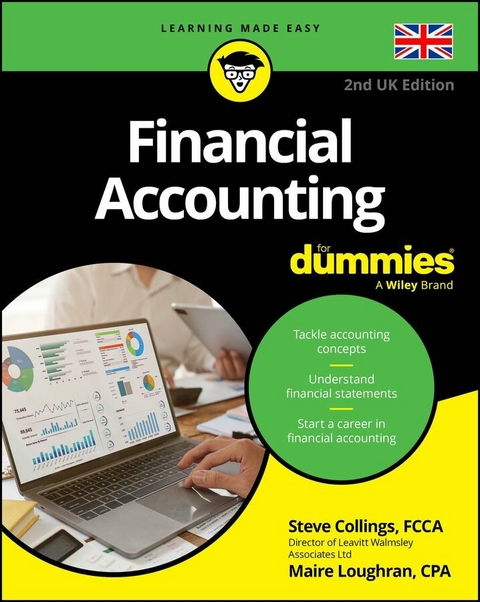
Financial Accounting For Dummies - UK (eBook)
502 Seiten
For Dummies (Verlag)
978-1-394-36649-1 (ISBN)
Essential concepts and terminology to turn you into a financial accounting wizard
They say accounting is the language of business, and like any new language, it takes time to achieve fluency. Financial Accounting For Dummies, UK Edition simplifies complex information into easily understandable terms to help you succeed in your classes and your career. In classic Dummies fashion, this guide demystifies complicated jargon and confusing rules, so you can understand all that you need to know to work in the financial accounting field. Discover the steps to becoming a qualified accountant and learn to handle bookkeeping, business transactions, and ledgers. When you're ready for the more advanced stuff, move on to balance sheets, investing, and analysing financial statements. Let Financial Accounting For Dummies simplify accounting, so you can achieve your goals, the easy way.
- Gain a thorough background in financial accounting concepts, with clear explanations
- Learn about the major changes to accounting standards and law in recent years
- Start off on the track of getting qualified as an accountant and beginning a rewarding career
- Understand profit and loss, financial statements, and other accounting must-knows
Financial Accounting For Dummies, UK Edition is invaluable for students pursuing a degree in accounting, finance, or business, as well as those working toward their ACA, ACCA, or CIMA qualifications.
Steve Collings, FCCA, is an internationally recognized speaker, writer, and commentator on financial reporting and auditing. He is the author of IFRS For Dummies and Interpretation and Application of International Standards on Auditing.
Maire Loughran, CPA, is an accountant and auditor with 20 years' experience as a full, adjunct accounting professor. She is the author of Financial Accounting For Dummies, Auditing For Dummies, and Intermediate Accounting For Dummies.
Chapter 1
Looking at the Bigger Picture of Financial Accounting
IN THIS CHAPTER
Knowing why financial accounting matters
Meeting the stakeholders
Exploring the most important principles in financial reporting
Introducing key accounting characteristics
Understanding the limitations of financial accounting
Accepting ethical responsibilities
I assume that you have a very good reason for buying this book; most people don’t randomly buy a title like Financial Accounting For Dummies. The chances are you’re embarking on your first accountancy course and want to be sure you do well in it. However, it may be the case that you’re a business owner wanting to get a better grip on the way your financial statements are prepared or to improve your bookkeeping. Whatever your reasons, this chapter is your key to the car to start the journey on the road of financial accounting.
I explain what financial accounting is and why it’s so important to many different individuals and businesses. I identify the various users of financial information and explain why they need that info. Finally, I briefly introduce two all-important characteristics of financial information: fundamental qualitative characteristics and enhancing qualitative characteristics. Whether you’re a financial accounting student or a business owner, you need to understand these crucial financial accounting terms as they underpin everything to do with financial statements right from the word ‘go’.
Knowing the Objective of Financial Accounting
Broadly speaking, accounting is the process of organising facts and figures and communicating the results of that organisation to any parties interested in that information. This process doesn’t just relate to numbers churned out by a computer software program; it pertains to any type of reconciliation.
Here’s an example that a parent can possibly relate to that doesn’t involve numbers or money: a teenager sneaks in after a curfew set by their parents, and their parents ask for a complete account of why they’re late. When the teenager tells them the facts, we have information (their car broke down in an area with no mobile phone signal), the individual producing the information (the mischievous teenager) and the interested party, also known as the user of the information (the worried parents).
The subject of this book, financial accounting, is a subset of accountancy. Financial accounting involves the process of preparing financial statements for a business. (Not sure what financial statements are? No worries – you find an overview of them in the next section.) Here are the key pieces of the financial accounting jigsaw:
- Information: Any accounting transactions taking place within the business during the accounting period. These include generating revenue from the sale of goods or rendering of services, paying business-related expenses, buying company assets and incurring debt to run the company.
- Business entity: The company incurring the accounting transactions.
- Users: The third parties that need to see the accounting transactions organised into financial statements to make informed decisions of their own. (You can find more about these users in the ‘Getting to Know the Users of Financial Statements’ section of this chapter.)
Preparing financial statements
If you’re starting an accountancy course, your entire course can well centre on the proper preparation of financial statements: the income statement (profit and loss account), balance sheet (statement of financial position), cash flow statement (statement of cash flows) and statement of changes in equity. Financial accountants can’t just stick accounting transaction information in the financial statements wherever they feel like. Many rules and regulations exist that dictate how financial accountants must organise the information in the financial statements; these rules are called generally accepted accounting practice (GAAP), and I discuss them in Chapter 4. The rules pertain to both how the financial accountant shows the accounting transactions and in which financial statements the information relating to the transactions appears.
Curious about the purpose of each financial statement? Here’s a run through of each one:
-
Income statement (or profit and loss account): This financial statement shows the results of business operations consisting of revenue, expenses, gains and losses. The end result is net profit or net loss. I talk about the income statement again in Chapter 3, and then I cover it from start to finish in Chapter 10. For now, here are the basic facts on the four different income statement components:
- Revenue: Sales earned by the company from selling its goods or services.
- Expenses: The costs a company incurs in earning its revenue.
- Gains: Income from non-operating-related transactions, such as selling a company asset.
- Losses: The flip side of gains, such as losing money when selling a company car.
A lot of accountants call the income statement a profit and loss account or simply a P&L (as it’s commonly known in the UK). These terms are fine to use because they address the spirit of the statement.
-
Balance sheet: This statement has three sections: assets, liabilities and equity. Standing on their own, these sections contain valuable information about a company. However, a user has to see all three interacting together on the balance sheet to form a reasonably reliable opinion of the company.
Part 3 of this book is all about the balance sheet, but for now, here are the basics about each balance sheet component:
- Assets: Resources owned by a company, such as buildings, equipment and cash.
- Liabilities: Debt the business incurs for operating and expansion purposes.
- Equity: The amount of ownership left in the business after deducting total liabilities from total assets.
- Statement of cash flows: This statement contains certain components of both the income statement and the balance sheet. The purpose of the statement of cash flows is to show cash sources and uses during a specific period of time – in other words, how a company brings in cash and for what costs the cash goes back out the door. This statement is often referred to as the cash flow statement in the UK.
- Statement of changes in equity: This statement shows any movements in the equity accounts of the balance sheet – such as share capital, share premium, revaluation reserve account and retained earnings. So if a company issues additional share capital, the additional capital it has issued during the accounting period is presented within the statement of changes in equity.
Showing historic performance
The information reflected in the financial statements allows its users to make reasoned decisions about the business, for example, whether or not they want to invest in it. But the users cannot make informed decisions based solely on one set of financial statements. Here’s why:
- The income statement is finite in what it reflects. For example, it may report net profit for the 12-month period ended 31 March 2026. This means any accounting transactions taking place prior to or after this 12-month window are not included.
- The statement of cash flows is also finite in nature, showing cash ins and outs only for the reporting period.
- The balance sheet only shows a snapshot of the state of a company’s affairs as at the close of play on the last working day of the accounting period.
Savvy financial statement users are interested in trends and performance over time and know that they need to compare several years’ worth of financial statements to get a true sense of business performance. Users employ tools such as ratios and measurements involving financial statement data (a topic I cover in Chapter 14) to evaluate the relative merit of one company over another by analysing each company’s historic performance.
Pulling information together for the annual accounts
After all the rigmarole of preparing the financial statements, many companies including publicly traded companies (those whose shares are bought and sold in the open market) employ independent professionally-qualified accountants to audit the financial statements for their inclusion in the annual report to the shareholders. The main thrust of a company’s annual report is not only to provide financial reporting but also to promote the company and satisfy any regulatory requirements.
The preparation of an annual report is a fairly detailed subject, and if you’re a student accountant, you probably won’t be expected to prepare a full annual report for your course but may need to know what goes in one. I provide a more in-depth look at annual reports in Chapter 16.
Getting to Know the Users of Financial Statements
Well, who are these inquisitive financial statement users I’ve been referring to so far in this chapter? If you’ve ever purchased some shares in a company or invested money in a pension plan,...
| Erscheint lt. Verlag | 8.10.2025 |
|---|---|
| Sprache | englisch |
| Themenwelt | Sachbuch/Ratgeber ► Beruf / Finanzen / Recht / Wirtschaft ► Wirtschaft |
| Wirtschaft ► Betriebswirtschaft / Management | |
| Schlagworte | aca study guide • acca study guide • accounting student uk • Brexit accounting • CIMA Study Guide • Financial Accounting • financial accounting basics • financial accounting book • Ireland accounting standards • uk accounting • uk accounting standards • uk financial accounting |
| ISBN-10 | 1-394-36649-3 / 1394366493 |
| ISBN-13 | 978-1-394-36649-1 / 9781394366491 |
| Informationen gemäß Produktsicherheitsverordnung (GPSR) | |
| Haben Sie eine Frage zum Produkt? |
 EPUB (Adobe DRM)
Kopierschutz: Adobe-DRM
Adobe-DRM ist ein Kopierschutz, der das eBook vor Mißbrauch schützen soll. Dabei wird das eBook bereits beim Download auf Ihre persönliche Adobe-ID autorisiert. Lesen können Sie das eBook dann nur auf den Geräten, welche ebenfalls auf Ihre Adobe-ID registriert sind.
Details zum Adobe-DRM
Dateiformat: EPUB (Electronic Publication)
EPUB ist ein offener Standard für eBooks und eignet sich besonders zur Darstellung von Belletristik und Sachbüchern. Der Fließtext wird dynamisch an die Display- und Schriftgröße angepasst. Auch für mobile Lesegeräte ist EPUB daher gut geeignet.
Systemvoraussetzungen:
PC/Mac: Mit einem PC oder Mac können Sie dieses eBook lesen. Sie benötigen eine
eReader: Dieses eBook kann mit (fast) allen eBook-Readern gelesen werden. Mit dem amazon-Kindle ist es aber nicht kompatibel.
Smartphone/Tablet: Egal ob Apple oder Android, dieses eBook können Sie lesen. Sie benötigen eine
Geräteliste und zusätzliche Hinweise
Buying eBooks from abroad
For tax law reasons we can sell eBooks just within Germany and Switzerland. Regrettably we cannot fulfill eBook-orders from other countries.
aus dem Bereich