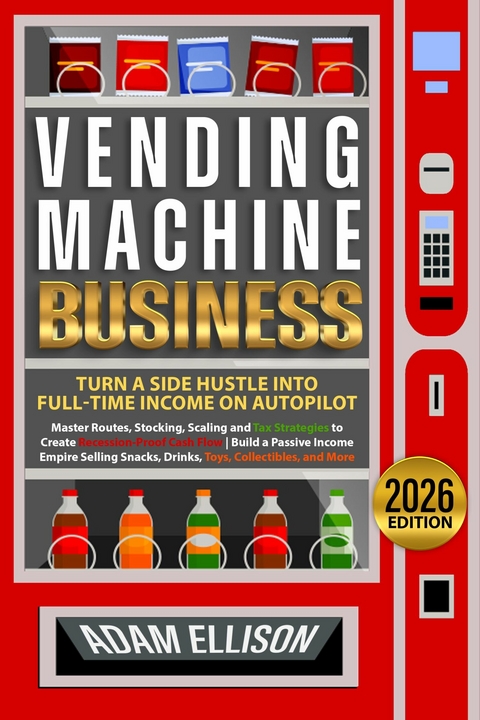
Vending Machine Business - Turn a Side Hustle into Full-Time Income on Autopilot (eBook)
126 Seiten
Publishdrive (Verlag)
978-0-00-106701-1 (ISBN)
⚠️ Vending Expert Reveals: The #1 Recession-Proof Cashflow System for Passive Income ⚠️
INTRODUCTION
1. Why Vending Machines Are a Modern Opportunity (mention snacks, toys, collectibles too)
In today’s fast-moving world, convenience drives consumer behavior. People value speed, ease, and accessibility more than ever before, and businesses that provide instant solutions have a powerful advantage. Vending machines, once seen as little more than dispensers of soda and chips, have transformed into one of the most adaptable and overlooked opportunities in the modern economy.
Far from being limited to snacks and drinks, vending machines now sell toys, trading cards, and collectibles, along with specialty and niche products tailored to specific audiences. Their presence is nearly everywhere—office buildings, schools, airports, shopping centers, and busy streets. They operate day and night without staff, generating sales whenever someone passes by with a need.
The opportunity lies in their ability to match the pace of modern life with an accessible, low-cost, and scalable business model.
Vending machines offer unmatched convenience. They are open 24/7, require no employees, and complete a transaction in seconds. This meets the expectations of time-pressed customers, whether they want a quick snack between meetings or a collectible card from a machine at a mall.
The variety of products has grown dramatically. While traditional items still sell, consumers are increasingly drawn to novelty and niche offerings. A toy machine outside a game store, a cosmetics machine in an airport, or a collectible pack machine near an arcade demonstrates how broad the demand can be. This diversity opens new revenue streams and often brings higher margins than food or beverages.
Technology has elevated the industry even further. Modern machines accept credit cards and mobile payments, monitor inventory remotely, and can deliver real-time sales data. Some even recommend products based on customer preferences. These advances simplify management for operators and create a smoother, more engaging experience for buyers.
For entrepreneurs, vending machines present several advantages:
-
Low startup costs compared to most businesses
-
Flexibility to begin with one or two machines and expand gradually
-
Scalability as profits are reinvested into new routes and products
A vending operation can start as a small side project and evolve into a large-scale business. Profitability depends heavily on choosing strong locations and stocking products that match customer demand, but the model itself is highly resilient and adaptable.
While vending machines are not a shortcut to instant wealth, they are a proven path to consistent income when approached with planning and discipline. Success depends on strategy, organization, and the ability to adapt to changing consumer trends.
Vending has become much more than a way to buy snacks. It is a modern system for delivering products instantly, from everyday essentials to high-hype items that capture attention and create excitement. For those seeking a business that aligns with today’s demand for speed, accessibility, and variety, vending machines stand out as a practical and profitable opportunity.
2. From Side Hustle to Scalable Empire
The vending machine business offers a unique pathway from a simple side hustle to a scalable source of wealth. The transition is not just about adding machines but about building a system that operates efficiently, generates consistent cash flow, and eventually runs with minimal daily involvement.
For many, the appeal begins with accessibility. Startup costs are low compared to most businesses, making it possible to get started with limited capital. Managing a small number of machines requires little time, which allows entrepreneurs to supplement their income while keeping a full-time job or balancing personal responsibilities. This combination of affordability and flexibility makes vending an attractive entry point into entrepreneurship.
Starting, however, is only the first stage. Growth requires strategy, discipline, and a clear understanding of how to scale. Success comes from making deliberate choices—selecting the right locations, diversifying the product mix, and adopting technology that simplifies operations. Each machine added should not only increase revenue but also strengthen the overall system.
Scaling effectively means:
-
Optimizing routes to save time and reduce costs
-
Offering products that match customer demographics and local demand
-
Using software and cashless payment systems to track sales in real time
-
Building processes that can be repeated as new machines are added
At the center of this growth is a strong supply chain. Reliable suppliers ensure products are available, costs are controlled, and inventory is managed efficiently. Forming lasting relationships with suppliers creates stability, while maintaining open communication keeps operations smooth as the business expands.
Equally important are the relationships built with location owners. These partnerships open the door to high-traffic spots where sales are strongest. Negotiating fair agreements, demonstrating professionalism, and showing how the machine adds value to the location are critical skills. The more trust and goodwill created, the easier it becomes to secure new placements and grow profitably.
Growth also demands compliance. Legal structures, tax responsibilities, and insurance cannot be ignored. Choosing the right business entity, keeping accurate financial records, and protecting the business with proper coverage are all part of building something sustainable. A vending machine business may start small, but long-term stability relies on doing things correctly from the beginning.
As the number of machines increases, the role of the owner changes. Early on, the operator may handle stocking, collections, and maintenance alone. Over time, the focus must shift from daily tasks to building systems. Outsourcing restocking, hiring part-time staff, or automating inventory tracking are all steps toward becoming a business owner rather than just a machine operator. The end goal is a structure that earns consistently, even without constant personal involvement.
This progression from side hustle to scalable empire is a process that requires patience, careful planning, and a willingness to adapt. It is not a shortcut to fast money, but it is a proven way to generate lasting income and move closer to financial independence.
For those drawn to entrepreneurship, vending provides a clear opportunity. It is a business that can be started with little risk, expanded steadily, and managed legitimately with attention to taxes, compliance, and sound organization. With the right approach, the vending machine industry reveals itself as far more than a way to earn extra cash—it becomes a blueprint for building a durable and profitable enterprise.
3. Busting Passive Income Myths
Few concepts are as misunderstood as passive income. The idea of earning money in your sleep is appealing, yet many misinterpret what it truly means. A vending machine business can indeed create reliable cash flow, but not without effort, patience, and planning. To build realistic expectations, let’s address the most common myths.
Myth 1: Passive income requires no work.
This is the biggest misconception. A vending machine business demands considerable effort at the beginning. Researching products, purchasing machines, securing profitable locations, negotiating with property owners, stocking inventory, and setting up tracking systems are all tasks that must be completed before a single dollar is earned. Only once these foundations are in place can the operation begin to resemble a hands-off source of income. Over time, with automation and staff support, the workload decreases, but there is always some level of oversight required.
Myth 2: Passive income is instant.
No business delivers immediate wealth. With vending, it can take months—or even more than a year—to recover the initial investment in machines and inventory. Building a customer base, fine-tuning the product mix, and identifying the best-performing locations take time. Patience is critical, and profits grow gradually as the system improves.
Myth 3: A vending machine business is a get-rich-quick scheme.
Expecting overnight riches is a recipe for disappointment. This business is closer to an investment portfolio than a lottery ticket. Just as investors diversify across many stocks, vending operators need multiple machines in varied locations to spread risk and build stable, compounding income. Long-term commitment and reinvestment of profits are what drive growth.
Myth 4: Passive income is guaranteed.
No source of income is completely risk-free. Consumer habits shift, competition can erode sales, and even small issues like broken card readers or vandalism can hurt earnings. Machines placed in once-profitable spots may underperform if foot traffic declines. Success requires ongoing monitoring, adapting to trends, and addressing problems before they escalate.
Myth 5: Passive income requires no skill.
Running a vending business calls for diverse abilities—market research, supply chain management, negotiation, financial planning, and basic technical knowledge of machines. These skills can be learned, but ignoring them limits success. Operators who understand their customers and manage their business strategically always...
| Erscheint lt. Verlag | 28.9.2025 |
|---|---|
| Sprache | englisch |
| Themenwelt | Wirtschaft ► Betriebswirtschaft / Management |
| ISBN-10 | 0-00-106701-X / 000106701X |
| ISBN-13 | 978-0-00-106701-1 / 9780001067011 |
| Informationen gemäß Produktsicherheitsverordnung (GPSR) | |
| Haben Sie eine Frage zum Produkt? |
 EPUB (Adobe DRM)
Größe: 597 KB
Kopierschutz: Adobe-DRM
Adobe-DRM ist ein Kopierschutz, der das eBook vor Mißbrauch schützen soll. Dabei wird das eBook bereits beim Download auf Ihre persönliche Adobe-ID autorisiert. Lesen können Sie das eBook dann nur auf den Geräten, welche ebenfalls auf Ihre Adobe-ID registriert sind.
Details zum Adobe-DRM
Dateiformat: EPUB (Electronic Publication)
EPUB ist ein offener Standard für eBooks und eignet sich besonders zur Darstellung von Belletristik und Sachbüchern. Der Fließtext wird dynamisch an die Display- und Schriftgröße angepasst. Auch für mobile Lesegeräte ist EPUB daher gut geeignet.
Systemvoraussetzungen:
PC/Mac: Mit einem PC oder Mac können Sie dieses eBook lesen. Sie benötigen eine
eReader: Dieses eBook kann mit (fast) allen eBook-Readern gelesen werden. Mit dem amazon-Kindle ist es aber nicht kompatibel.
Smartphone/Tablet: Egal ob Apple oder Android, dieses eBook können Sie lesen. Sie benötigen eine
Geräteliste und zusätzliche Hinweise
Buying eBooks from abroad
For tax law reasons we can sell eBooks just within Germany and Switzerland. Regrettably we cannot fulfill eBook-orders from other countries.
aus dem Bereich