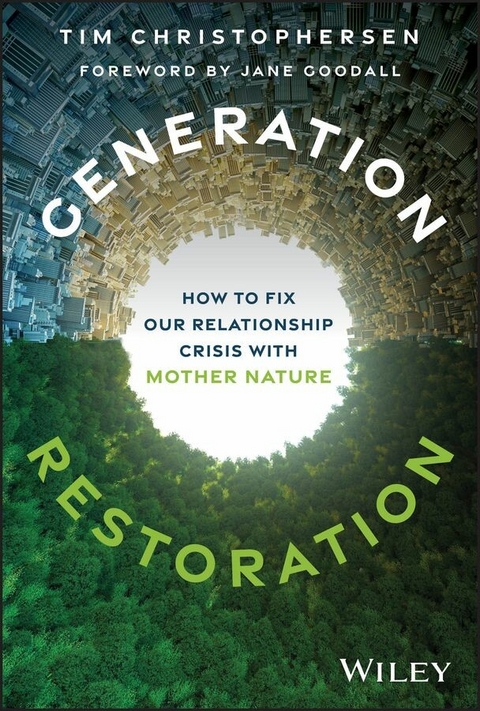
Generation Restoration (eBook)
334 Seiten
Wiley (Verlag)
978-1-394-32823-9 (ISBN)
Discover and define a new relationship between humanity and nature
In Generation Restoration: How to Fix Our Relationship Crisis with Mother Nature Vice President of Climate Action at Salesforce, Tim Christophersen, delivers a clarion call for a new kind of global ecological literacy. You'll discover how we can reset our relationship with nature, conceiving of ourselves as an integral part of it, rather than apart from it.
The book explains how we can change the way we interact with the world around us and rapidly increase the effectiveness of all 'green' initiatives. It's filled with stories and case studies of environmental success stories and failures from around the globe.
Inside the book:
- A recipe for a simple-but profound-shift in the way we view nature and the role of human beings within it
- How to resist the impulses towards doom and despair and choose hope instead
- The lessons we can learn from Indigenous peoples around the world, who understand important and obvious lessons about nature that have escaped other societies
Perfect for anyone interested in the future of our planet and our species, Generation Restoration is an inspiring and eye-opening discussion of an issue that's critical to all our survival and wellbeing.
TIM CHRISTOPHERSEN is the Vice President of Climate Action at Salesforce. With over 25 years of international experience across the public and private sector, including 15 years with the United Nations Environment Programme, Tim has dedicated his entire career to achieving harmony between humanity and nature.
Discover and define a new relationship between humanity and nature In Generation Restoration: How to Fix Our Relationship Crisis with Mother Nature Vice President of Climate Action at Salesforce, Tim Christophersen, delivers a clarion call for a new kind of global ecological literacy. You'll discover how we can reset our relationship with nature, conceiving of ourselves as an integral part of it, rather than apart from it. The book explains how we can change the way we interact with the world around us and rapidly increase the effectiveness of all green initiatives. It's filled with stories and case studies of environmental success stories and failures from around the globe. Inside the book: A recipe for a simple but profound shift in the way we view nature and the role of human beings within it How to resist the impulses towards doom and despair and choose hope instead The lessons we can learn from Indigenous peoples around the world, who understand important and obvious lessons about nature that have escaped other societies Perfect for anyone interested in the future of our planet and our species, Generation Restoration is an inspiring and eye-opening discussion of an issue that's critical to all our survival and wellbeing.
Chapter 2
A Century of Ecology
We must cultivate a deep sense of gratitude for the Earth, recognizing all that it provides and all that it has taught us.
—Robin Wall Kimmerer
In March 2024, I attended a conference in Livingstone, Zambia, at the iconic Victoria Falls. More than 500 ecosystem restoration experts from around the world had convened in a beautiful new hotel on the banks of the Zambezi River. Our Nature‐Based Solutions conference was mostly going well. However, the power went off several times each day in the hotel. That is not unusual in parts of Africa and other regions. Still, it was uncommon for Zambia, which has a stable and ample supply of hydropower that provides more than 80 percent of the country's electricity. But in the spring of 2024, the country was experiencing a record drought. It had not rained properly for several months, and President Hakainde Hichilema had just declared a national emergency. The usually reliable Kariba Dam, which is fed by the Zambezi River, came close to shutting down for the first time in its 65‐year history. To make matters worse, it was expected that more than 70 percent of the country's annual food crops would fail due to a lack of rain.
When faced with a potential breakdown of energy supply and food security, any government will shift into crisis mode. Suddenly, questions of ecology and nature restoration rose to the top of the president's agenda, as the country's future depended on them. The Zambezi River's only remaining water supply originated from a few intact mountain forest watersheds, where the deep roots of trees store rainwater in the soil, releasing it as a steady, clean flow over time. And the only farmers in Zambia who still expected a substantial harvest were those who had shifted from monoculture field crops to multistory and diverse agricultural systems, incorporating crops and trees, a method known as agroforestry. Right after the conference, President Hichilema invited the Global Evergreening Alliance, the conference organizer, to develop a border‐to‐border plan for ecosystem restoration in Zambia, as he rightly saw it as the only viable way to secure the country's future.1
I am sharing this story with you because it is what every country could be facing in the coming decades unless we address our relationship crisis with nature. Nature can easily cause a breakdown of any human society: She can shut us off from water, energy, and food overnight. The impacts are coming closer for all of us, even for those of us fortunate enough to live somewhere still somewhat protected from nature's imminent collapse and from the increasingly extreme weather events caused by a changing climate. This crisis has deep root causes, and one of them is our lack of understanding of our true relationship with nature. Our knowledge and application of ecology, the science of our common home, will determine whether we prosper or suffer in the years to come.
Examining our relationship with nature is the central focus of this book. Why does our reliance on nature not figure more prominently in the minds of politicians, investors, and other decision makers? Nature underpins all our activities, both as individuals and as our societies at large. Despite that dependency, we have allowed ourselves to slide into a relationship crisis with nature. For many people across all walks of life, nature is just an afterthought—if they ever think about nature at all. As we have with a stable global climate, we have taken functioning natural systems and processes for granted because nature has been there for us for as long as humanity can remember. But both the abundance and health of nature and the stability of the climate are now crumbling all around us.
To fix our relationship crisis with Mother Nature, we first need a basic understanding of our common home, which is the ancient Greek meaning of the word “ecology.” We need to know our options now that humanity is starting to crash into the so‐called Planetary Boundaries—a set of scientific metrics that delineate our safe operating space on Earth against nine essential life support parameters, including a stable climate, freshwater quality and quantity, and biodiversity.2 We need to renew our understanding of nature's ability to sustain all life and our own essential role as planetary ecosystem engineers. So, in this chapter, we look at how Planet Earth works.
Ecology: The Science of Our Only Home
Ecology studies the relationships between all living beings, including people, and their environment. It has long been a neglected field of science. Recently, however, much more research into the functioning of our Spaceship Earth is being undertaken, and the latest discoveries and research tools, such as artificial intelligence, make it clear that Earth is not a spaceship at all. It is unlike any machine or mechanism we know. Earth is a living, incredibly complex system of ever‐evolving relationships among genes, individual life‐forms, species, and their habitats, and even between different energetic states of matter. I suggest we examine a few basic ecological parameters and bust a few myths about nature before we turn our attention to a new relationship between us and nature and to restoration of nature at large scale.
Suzanne Simard and other authors, who discovered a complex underground network of communication, synergies, and exchanges of nutrients across forest ecosystems sometimes referred to as the “wood wide web,” triggered a recent shift in ecology.3 Simard's research, which numerous other studies have since confirmed, shows that collaboration between species is far more common in nature than competition. Darwin's “survival of the fittest” view of competition between and within species as the primary driver of evolution has become much more nuanced. The discovery of complex interspecies relationships in forests has led to the understanding that plants, like animals and every form of life, have a form of consciousness, albeit one that is very different from our own. This understanding is revolutionizing our view of agriculture and the immense importance of biodiversity within healthy soils as the main driver of plant growth. All of life exists within ecological communities. No being is an island. To truly understand nature, we should view it as a complex, interconnected entity, or a living system, if you prefer a more scientific term, rather than just a collection of individual species. And that entire collective called “nature” includes us.
Earth itself might be one giant, self‐regulating organism of sorts, according to James Lovelock's Gaia theory.4 The Gaia hypothesis proposes that life on Earth has actively shaped the planet's environment, creating optimal conditions for its own survival. In other words, our climate as well as the global cycles of life—of water, carbon, and nutrients—are largely a result of the interaction among living organisms, Earth's crust, and the atmosphere. Ecologists question the Gaia hypothesis, but it provides a useful mental image of nature as an indivisible whole, with us intricately connected, rather than as a collection of bits and pieces of genes, species, and ecosystems. We do know that we urgently need to stabilize the climate and Earth's major life support systems, such as the ocean, and to do that, we need to repair ecological functions and restore nature on a large scale. We are currently far from planetary‐scale nature restoration, but it is possible, and in fact, it is starting to happen, as we see in Chapters 6 and 7.
Perhaps it takes a national crisis like the one in Zambia in 2024, or similar ones unfolding across the globe, from inundated cities to parched fields to outbreaks of new diseases, to remind us that we and our technology are not entirely in charge of Gaia's self‐regulating system. However, although we might not be in charge, we are probably the most important biological factor in Earth's self‐regulation. It is high time to remember our place and responsibility within Mother Nature's broader family and play our proper role in the cosmic story of our planetary community. We have the power to change our actions and become a positive force for the planet instead of causing harm. To do this, let's look at some of the most important events in Earth's natural history. Right now, we are leaving the Holocene era, which began approximately 11,700 years ago at the end of the last glacial period. We are entering the Anthropocene—a new era of uncertain duration when humans are the main influence on the planet's future—and we are not off to a great start.5
Ecological Fever Pitch
Let us use the Gaia hypothesis as a useful mental image for a while and assume that Earth is a self‐regulating system of biodiversity, geology, and the atmosphere, much like the human body is an interconnected, self‐regulating system of cells, bones, and organs.
For a basic understanding of planetary ecology, let us further imagine for a moment that the planet is a human body.6 The average body temperature of Planet Earth in the 20th century has been around 57°F (13.9°C), quite a bit cooler than the temperature of a human body. Soil and ocean make up the planet's skin, and, just as with the human body, it is our largest organ and one of the most important ones. Like the human body, Earth's...
| Erscheint lt. Verlag | 6.10.2025 |
|---|---|
| Sprache | englisch |
| Themenwelt | Wirtschaft ► Betriebswirtschaft / Management |
| Schlagworte | biodiversity • climate change • Climate Change Mitigation • deforestation • Ecological literacy • Environmental damage • environmental justice • environmental restoration • Environmental Science • global warming • global warming reversal • Indigenous knowledge • Jane Goodall |
| ISBN-10 | 1-394-32823-0 / 1394328230 |
| ISBN-13 | 978-1-394-32823-9 / 9781394328239 |
| Informationen gemäß Produktsicherheitsverordnung (GPSR) | |
| Haben Sie eine Frage zum Produkt? |
 EPUB (Adobe DRM)
Kopierschutz: Adobe-DRM
Adobe-DRM ist ein Kopierschutz, der das eBook vor Mißbrauch schützen soll. Dabei wird das eBook bereits beim Download auf Ihre persönliche Adobe-ID autorisiert. Lesen können Sie das eBook dann nur auf den Geräten, welche ebenfalls auf Ihre Adobe-ID registriert sind.
Details zum Adobe-DRM
Dateiformat: EPUB (Electronic Publication)
EPUB ist ein offener Standard für eBooks und eignet sich besonders zur Darstellung von Belletristik und Sachbüchern. Der Fließtext wird dynamisch an die Display- und Schriftgröße angepasst. Auch für mobile Lesegeräte ist EPUB daher gut geeignet.
Systemvoraussetzungen:
PC/Mac: Mit einem PC oder Mac können Sie dieses eBook lesen. Sie benötigen eine
eReader: Dieses eBook kann mit (fast) allen eBook-Readern gelesen werden. Mit dem amazon-Kindle ist es aber nicht kompatibel.
Smartphone/Tablet: Egal ob Apple oder Android, dieses eBook können Sie lesen. Sie benötigen eine
Geräteliste und zusätzliche Hinweise
Buying eBooks from abroad
For tax law reasons we can sell eBooks just within Germany and Switzerland. Regrettably we cannot fulfill eBook-orders from other countries.
aus dem Bereich