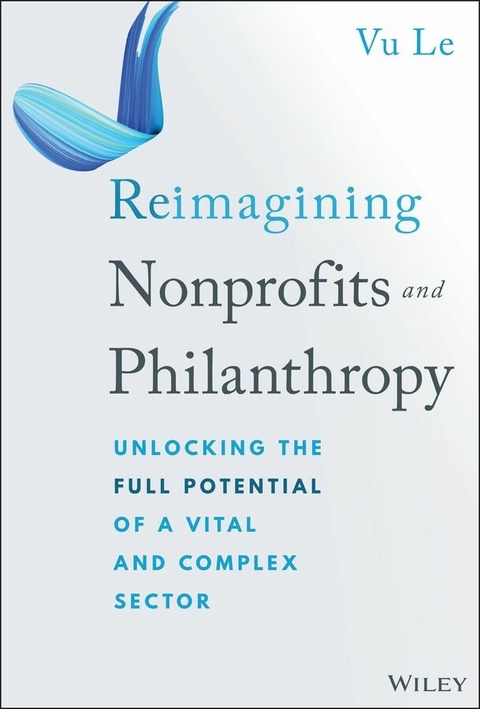
Reimagining Nonprofits and Philanthropy (eBook)
348 Seiten
Wiley (Verlag)
978-1-394-31313-6 (ISBN)
Forward-thinking solutions to the foundational problems plaguing the world of modern nonprofits
Going where many dare not, Reimagining Nonprofit and Philanthropy: Unlocking the Full Potential of a Vital and Complex Sector challenges existing sacred cows across a variety of issues relevant to nonprofit and philanthropy. Each chapter delves into a specific area of work (fundraising, boards, hiring, and so on), analyzes the challenges, and provides concrete solutions for change.
Written by Vu Le, former nonprofit executive and thought leader in the field, this book features leaders doing new things that go against the grain and is written in an easy-to-digest, oftentimes humorous tone. Readers will be left fired up, with their existing notions challenged, ready to flip over some tables and (figuratively) burn some systems down.
Le explores topics including:
- Scarcity, martyrdom, and learned helplessness, separating vision and mission, and 'bizsplaining' to the corporate sector
- The folly of Robert's Rules of Order and reimagining governance through evolutionary and minimally-viable boards
- New leadership decision-making models, shifting away from the hierarchical model into a more distributed one
Reimagining Nonprofit and Philanthropy: Unlocking the Full Potential of a Vital and Complex Sector is an essential read for all nonprofit leaders, professionals, and donors who are looking to completely reimagine the way nonprofits think, operate, and make an impact.
Vu Le is a keynote speaker, blogger, and recognized thought leader in the nonprofit sector. He has 20+ years of experience in the nonprofit world, including being an executive director across two nonprofits for 13 years. He is the founder of Nonprofit AF, a renowned industry blog with global reach.
Forward-thinking solutions to the foundational problems plaguing the world of modern nonprofits Going where many dare not, Reimagining Nonprofit and Philanthropy: Unlocking the Full Potential of a Vital and Complex Sector challenges existing sacred cows across a variety of issues relevant to nonprofit and philanthropy. Each chapter delves into a specific area of work (fundraising, boards, hiring, and so on), analyzes the challenges, and provides concrete solutions for change. Written by Vu Le, former nonprofit executive and thought leader in the field, this book features leaders doing new things that go against the grain and is written in an easy-to-digest, oftentimes humorous tone. Readers will be left fired up, with their existing notions challenged, ready to flip over some tables and (figuratively) burn some systems down. Le explores topics including: Scarcity, martyrdom, and learned helplessness, separating vision and mission, and bizsplaining to the corporate sector The folly of Robert's Rules of Order and reimagining governance through evolutionary and minimally-viable boards New leadership decision-making models, shifting away from the hierarchical model into a more distributed one Reimagining Nonprofit and Philanthropy: Unlocking the Full Potential of a Vital and Complex Sector is an essential read for all nonprofit leaders, professionals, and donors who are looking to completely reimagine the way nonprofits think, operate, and make an impact.
Introduction
When life itself seems lunatic, who knows where madness lies?
To surrender dreams, this may be madness…
Too much sanity may be madness!
But maddest of all is to see life as it is and not as it should be.
—Don Quixote
WHEN MY FAMILY and I arrived in the United States, I was an eight-year-old boy with a terrible haircut, thanks to my father, who had fought against North Vietnam and had been put into reeducation camp. Despite all the challenges he had gone through, Dad still retained unproven confidence in his haircutting skills and still managed to carry his rusty pair of scissors past the refugee camps in the Philippines, across the Pacific Ocean, and through multiple states. He was saving our family desperately needed money.
The result, however, was that every month, at least those first few years, my brothers and I had to sit and endure the butchering of our locks, watching in horror as he transformed our acceptably aloof—dare I say even cool—just-got-out-of-bed looks into monstrosities that had me mocked and ridiculed at school. At least, I think it was mockery and ridicule. I didn't understand English back then. But the pointing and laughing were easy clues.
I dreaded going to school. Each morning, I watched Care Bears, finding comfort in the fluffy, colorful bears, who each had their own personality and unique skills. They lived in a village high above in the sky, in the clouds. When their community faced great danger—from a group of villains that included a furry pig/potato hybrid named Beastly—they did the “Care Bear Stare,” where they lined up in a row, activated the clover or sunshine or other symbol on their stomachs, and produced a powerful rainbow in unison that drove away the bad guys and sometimes healed or fixed whatever had been broken.
I guess that may have been the seed of my nonprofit career. A seed that was watered by other experiences during those first few months in the United States. I think of the morning my mother, trying to motivate me to go to school despite the constant teasing, sent me off with two quarters so I could buy a treat for myself. When I stopped at the convenience store and realized the snacks I wanted would cost more than fifty cents, I broke down, cursing the heavens and weeping in despair. Then I got up, raised my fist defiantly, and vowed to get my mom to double the amount she would give me the next day. And that is my fundraiser origin story.
Jokes aside, it was the kindness shown to my family by the various organizations that would nudge me down this path. They rallied people to bring us pots and pans, forks and spoons, and warm clothing to protect us from a cold we had never imagined, let alone experienced before in our village in the mountains of Vietnam. They helped my parents find jobs and enroll me and my two brothers in school. They hooked us up with a sponsor family who took us for the first time for pizza and to see The Nutcracker, a night we'll always remember for how out of place the five of us felt amidst the unfamiliar colors and sounds and warm cheesy gooeyness.
The kindness my family received had a profound impact on me. These people we didn't know and could barely communicate with, organized by nonprofit organizations we had never heard of, funded by donors and funders we had never met, through their generosity and warmth, restored hope and community to my small family who had left everyone we knew and loved behind. I wanted to pay it forward.
So I went to college, studied psychology, and got a master's in social work, focusing on socioeconomic development, community organizing, and advocacy. I was ready to join the nonprofit sector, put into practice everything I had learned in grad school, and make the world a better place. Though I sometimes strayed from the path, I always knew this sector was where I was meant to be. I wanted to help people the way so many had helped my family. I wanted to build a community. I wanted to be a Care Bear.
I landed a position working at a small organization called the Vietnamese Friendship Association (VFA, now Kandelia), which focused on helping Vietnamese and other recent immigrant kids succeed academically, as well as helping their parents navigate the school system. It had a budget of $14,000, an office the size of a walk-in closet, and several hamburger wrappers someone had put in the solitary filing cabinet.
And I was the only full-time staff member. I had been dropped there by an AmeriCorps-funded program in DC that placed young up-and-coming leaders into various Vietnamese-focused nonprofits across the United States to help them run their programs and strengthen their infrastructure and effectiveness, with the concurrent goal of having many of these young leaders rise through the ranks in the sector. The program drew idealistic kids who defied their families' hopes and dreams that they would end up a doctor or lawyer or engineer, idealists who wanted to make the world better and who were okay with subsisting on spaghetti and bánh mìs several meals a week.
The reality of the nonprofit sector, however, was very different than the academically challenging but comfortable bubble that was my grad school experience. Some of the foundational skills I had learned were very helpful: active listening, empathy, facilitating meetings, crashing various events for free food. But much of the more technical stuff—board governance, fundraising, leadership, and so on—I found was not always applicable in the ways I had been trained.
I remember the first time I wrote a grant proposal. Being an ESL kid who was constantly made fun of for not fully understanding English, I was determined to conquer this weakness, and I worked hard at it by reading all the time, and I prided myself on being a competent writer and always got good grades on term papers and others written assignments. It was a jolt to my ego to get the draft of my first grant proposal back from my mentor. “Vu,” he said, “this is a grant proposal. You have to use grant language. Basically, stop being so flowery and just get to the point.” On reflection, maybe including several references to Don Quixote by Miguel Cervantes was too much.
There would be so many more experiences like this, where my lack of skills and experience, combined with my naiveté about how this sector worked, made me doubt myself and whether I had chosen the right path. I had envisioned, for example, that nonprofits would be supportive of and collaborative with one another, but that didn't always prove to be true. During what I thought was a friendly one-on-one with the executive director of an organization with a similar mission, I could feel palpable disdain.
“How long are you going to stick around?” she asked, “We've seen enough people parachute into our community and then leave when things get difficult.” I reassured her that I was not going anywhere, that I would stay for as long as I was needed. During year two of my placement, I raised enough money that the board hired me on after my program ended and, at the grizzled age of 26, I became the organization's first executive director.
For all the prestige of the title, the ED position came with even more challenges. The Hunger Games were relentless. At an event once, I sat down at a table with a colleague who was a major gifts officer at another organization. She was sitting with a nice elderly couple, who I would realize later were two of her major donors. We had a great conversation where I learned they loved Vietnamese food. “I know a great restaurant,” I said, “we should all go sometime.” The elderly couple turned to my colleague and said, “That sounds fun! Perhaps you can connect us all over email.” She never did. At another event, months later, I ran into her, and she half-jokingly introduced me by saying, “This is Vu, the guy who tried to poach two of my major donors.”
Even when funding was going well, there were frustrations. There was the time a staff member and I were in the conference room, figuratively bashing our heads against the wall because a funder wanted to set limits on how much per hour we could pay the tutors in our afterschool program, but also refused to pony up for planning hours. And the time my board voted down a policy to provide paid family leave, citing the lack of resources, a risk-averse position I knew to be unfounded, as I was the one writing the budget and leading the fundraising.
The most difficult and eye-opening challenges I encountered involved many of the practices our sector considered standard best practices. Not only did they fail for organizations led by marginalized communities, but they were also often harmful and counterproductive. Foundations, which are mostly led by white leaders, for instance, are more likely to fund white-led organizations. Individual donors, who are also mostly white, often respond better to leaders who understand how to navigate dominant culture, and these leaders tend to be white. Capacity-building strategies, meanwhile, are focused on getting orgs led by communities of color to conform to behave like white-led orgs. All of this has coalesced into a series of entangled dynamics that have left organizations and communities like mine behind.
In 2014, after nine years as the executive director at VFA, I stepped down and became the founding ED of Rainier Valley Corps (RVC, now standing for Rooted in Vibrant Communities), a capacity-building and...
| Erscheint lt. Verlag | 6.10.2025 |
|---|---|
| Sprache | englisch |
| Themenwelt | Wirtschaft ► Betriebswirtschaft / Management |
| Schlagworte | Equity • Nonprofit corporations • nonprofit donors • nonprofit fundraising • Nonprofit Governance • nonprofit impact • nonprofit innovation • nonprofit leadership • nonprofit mission • nonprofit sector • nonprofit vision • philanthropy • reimagining nonprofits • roberts rules of order • vu le |
| ISBN-10 | 1-394-31313-6 / 1394313136 |
| ISBN-13 | 978-1-394-31313-6 / 9781394313136 |
| Informationen gemäß Produktsicherheitsverordnung (GPSR) | |
| Haben Sie eine Frage zum Produkt? |
 EPUB (Adobe DRM)
Kopierschutz: Adobe-DRM
Adobe-DRM ist ein Kopierschutz, der das eBook vor Mißbrauch schützen soll. Dabei wird das eBook bereits beim Download auf Ihre persönliche Adobe-ID autorisiert. Lesen können Sie das eBook dann nur auf den Geräten, welche ebenfalls auf Ihre Adobe-ID registriert sind.
Details zum Adobe-DRM
Dateiformat: EPUB (Electronic Publication)
EPUB ist ein offener Standard für eBooks und eignet sich besonders zur Darstellung von Belletristik und Sachbüchern. Der Fließtext wird dynamisch an die Display- und Schriftgröße angepasst. Auch für mobile Lesegeräte ist EPUB daher gut geeignet.
Systemvoraussetzungen:
PC/Mac: Mit einem PC oder Mac können Sie dieses eBook lesen. Sie benötigen eine
eReader: Dieses eBook kann mit (fast) allen eBook-Readern gelesen werden. Mit dem amazon-Kindle ist es aber nicht kompatibel.
Smartphone/Tablet: Egal ob Apple oder Android, dieses eBook können Sie lesen. Sie benötigen eine
Geräteliste und zusätzliche Hinweise
Buying eBooks from abroad
For tax law reasons we can sell eBooks just within Germany and Switzerland. Regrettably we cannot fulfill eBook-orders from other countries.
aus dem Bereich