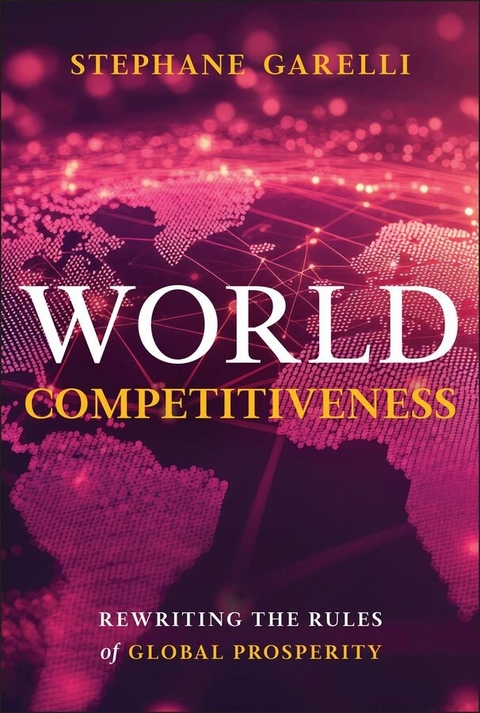
World Competitiveness (eBook)
392 Seiten
Wiley (Verlag)
978-1-394-36680-4 (ISBN)
A fascinating journey into a new paradigm, World Competitiveness, and how it gained such importance in developing global prosperity.
In World Competitiveness: Rewriting the Rules of Global Prosperity, Stephane Garelli, a world-renowned professor who has pioneered this concept, explains what World Competitiveness means and implies, and why it has become such a strategic priority for governments and businesses worldwide.
World Competitiveness gained prominence during the four decades often described as the 'golden era of globalization', stretching from China's 'open door policy' in 1978 to the onset of the COVID pandemic in 2018. Then, people could travel freely, communicate, and share ideas and experiences. Companies invested, manufactured, and traded in previously closed markets. Governments compared and enhanced their strategies. Shared prosperity was the objective.
World Competitiveness, as a field of knowledge, was not researched in libraries but experienced first-hand and on-site through numerous travels and discussions with government and business leaders, and academics. Later, it was conceptualized and theorized.
This book retraces this endeavour, from the origin of competitiveness to the modern world, which is fracturing again. It blends travel experiences, practical examples, and new theories. It is so-what, future-oriented, and above all, positive. Despite recent upheavals, the world economy is fundamentally resilient, and to paraphrase Mark Twain, 'not as bad as it sounds.'
STEPHANE GARELLI is Professor Emeritus of World Competitiveness at IMD Business School and the University of Lausanne, Switzerland. He is the Founder of the World Competitiveness Center, and, among others, a former Managing Director at the World Economic Forum and the Davos Annual Meetings, and chairman of several companies.
A fascinating journey into a new paradigm, World Competitiveness, and how it gained such importance in developing global prosperity. In World Competitiveness: Rewriting the Rules of Global Prosperity, Stephane Garelli, a world-renowned professor who has pioneered this concept, explains what World Competitiveness means and implies, and why it has become such a strategic priority for governments and businesses worldwide. World Competitiveness gained prominence during the four decades often described as the golden era of globalization , stretching from China s open door policy in 1978 to the onset of the COVID pandemic in 2018. Then, people could travel freely, communicate, and share ideas and experiences. Companies invested, manufactured, and traded in previously closed markets. Governments compared and enhanced their strategies. Shared prosperity was the objective. World Competitiveness, as a field of knowledge, was not researched in libraries but experienced first-hand and on-site through numerous travels and discussions with government and business leaders, and academics. Later, it was conceptualized and theorized. This book retraces this endeavour, from the origin of competitiveness to the modern world, which is fracturing again. It blends travel experiences, practical examples, and new theories. It is so-what, future-oriented, and above all, positive. Despite recent upheavals, the world economy is fundamentally resilient, and to paraphrase Mark Twain, not as bad as it sounds.
Introduction A New Knowledge: Competitiveness
The word is a tongue twister. It often makes people uncomfortable. It carries the idea that competitiveness is the law of the strongest: that there is no other aim than winning at all costs. But is this true?
- What Is World Competitiveness?
- What the MIT Department of Economics and Nobel Prize Winners Have to Say
- What Politicians Have to Say
What Is World Competitiveness?
All knowledge stems from two roots: curiosity and frustration.
I was curious to understand how a country generates prosperity and why some nations achieve greater success in this than others.
Why, on the same island – Hispaniola – where Christopher Columbus landed in 1492, is one of the world's poorest countries, Haiti,1 on one side of a 390 km‐long border, and one of the most dynamic economies in the Caribbean and Latin America, the Dominican Republic, on the other?
How is it possible that Mongolia and the Democratic Republic of Congo (DRC),2 both blessed with immense natural resources, generate less prosperity than Singapore or Switzerland – which have none?
My frustration stemmed from studying economics at university, which did not address these questions. As a human or moral science, economics was not considered equal to exact sciences like physics, chemistry, or mathematics.
Scholars privileged quantitative studies and convoluted mathematical formulas that did not seem to explain much but demotivated most students. I was left with the impression that the economy was like plumbing: products and money flowed through pipes; along the way, there were taps – taxes or interest rates – to regulate the flow; mathematical formulas tried to gauge the speed of circulation.
It was intellectually stimulating (well, for some) but did not answer my questions. Alfred Marshall (1842–1924), in his Principles of Political Economy, published in 1890,3 noted that economics should be “a study of mankind in the ordinary affairs of life.” It was time to take the problems that affected people daily seriously. Gary Becker's (1930–2014) research first gave economic credentials to subjects such as discrimination, minorities, crime, or the economics of the family.4 He is the leading theorist on human capital and was awarded the Nobel Prize in 1992.5
And at the national level I wanted to know whether was it possible to integrate a country's various economic and social policies, from macro‐ and micro‐economic perspectives, to determine which lead to greater prosperity?
When I was managing director of the World Economic Forum and the Davos Annual Meetings from 1974 to 1986,6 we were struck by the growing number of business and country leaders beginning to use the term “national competitiveness.” But nobody was talking about the same thing. Moreover, countries were perceived to compete in the same way as companies.
But this is not the whole story. Countries also compete by implementing government policies and building economic and social infrastructures. A nation's competitiveness involves much more than just the collective competitiveness of its companies. Furthermore, governments have a longer term perspective than companies subject to immediate profitability pressures by publishing quarterly results.
We therefore felt it necessary to clarify the subject, especially as we had all the major players in globalization and the competitiveness of companies and nations within Davos.
We decided to follow two parallel paths: the first was to measure and compare all aspects of the competitiveness of nations. This gave rise to the World Competitiveness Reports,7 which quickly established themselves as the benchmark in this field.
Second, we aimed to create a theory of national competitiveness using a “holistic” approach.8 This was primarily done through IMD's Center for World Competitiveness and my professorships at this business school and the University of Lausanne in Switzerland.
In short, since I was not good at plumbing, I decided to focus my attention on the competitiveness of nations.
It was not easy. Paul Krugman, the future Nobel Prize winner in economics, wrote in Foreign Affairs magazine in 1994 that the concept of competitiveness was “simply wrong” and nothing more than “a new name for productivity.”9
We were off to a bad start …
What Is Competitiveness?
Many different and obscure definitions fail to clarify the concept. I have always told my students that once you've mastered a concept, you should be able to define it in one line.
From a generic point of view, here is my definition:
- Competitiveness is the ability to solve problems better than others.
It may be an oversimplification, but it gets to the core of the matter.
“Better” can mean faster, cheaper, higher quality, or more innovative. In general, anything that helps you stand out from the competition and provides better value to users.
Thus, competitiveness lies in the plumber who quickly repairs your sink, the doctor who cures you, the politician who wins an election, the entrepreneur who turns a profit, or the government that enhances the nation's wealth and its citizens' prosperity.
At a national level, competitiveness encompasses the management of all the resources – material, financial, and human – that create collective prosperity and improve living standards for everyone.
You Cannot Compete Alone
Competitiveness inherently suggests rivalry since nations compete to gain or create these resources. Thus, you cannot be competitive in isolation. Competitiveness always involves a comparison with others.
Suppose I run 100 m in 15 seconds (a hypothesis) and, after much effort and training, I improve my time to 13 seconds. In that case, I can be proud of my performance. However, with that time, I will still finish last in the Olympic 100 m final.
Similarly, a government or business leader can boast 3% growth from the previous year. But if their competitors grow at 5%, they are losing at competitiveness.
This was not always easy for politicians to understand. How could their country's economic growth accelerate, yet in our competitiveness rankings, they were losing ground?
The answer was that other countries were accelerating their growth even faster. And this deserved better explanation and a more solid theoretical approach.
What the MIT Department of Economics and Nobel Prize Winners Have to Say
In the early 1980s, I had the chance to visit the Massachusetts Institute of Technology (MIT) Department of Economics. For an economist, it is the temple of knowledge in the field and where you meet the largest number of Nobel Prize winners.
Paul Samuelson
My first visit was to Paul Samuelson, winner of the Nobel Prize in 1970, whose book Economics 10 has inspired generations of economists. It has been reprinted more than 20 times. It was one of the most terrifying meetings of my career. He was sitting behind his desk, with his hair cut into a brush, small glasses, and a piercing gaze.
For 30 minutes, he fired questions at me, practically without giving me time to answer. By the end, I felt like my back was against the wall and that the next question would be: “How do you justify your existence on this earth?”
Paul Samuelson liked to say that he did not need any power other than writing textbooks that would influence the management of the economy. He belonged to that generation of economists who believed that economic laws could be created based on mathematics.
This was not new to me since my Alma Mater, the University of Lausanne, had welcomed Leon Walras11 and Vilfredo Pareto,12 who became famous for their economic equations. However, I have never met a head of government or a business leader who made a decision by referring first to a mathematical formula or a chapter in an economics textbook.
Franco Modigliani
Shortly afterward, I had an appointment with Franco Modigliani,13 who also won the Nobel Prize in Economics in 1985. This meeting was precisely the opposite experience. He was friendly, empathetic, and smiling, as Italians of the highest intelligence often are.
That was precisely my problem. He was so clever that I am unsure I understood everything he told me, especially since his specialty was finance.
However, I remember one of his comments:
Economists cannot predict the future because every time they give an opinion, they impact the environment and change it.
The development of quantum physics probably inspired this comment. According to the uncertainty principle, enunciated by Werner Heisenberg in 1927,14 we cannot know both the speed and position of a fundamental particle. More precisely, the act of observing modifies what we observe.
The same applies to the economic environment. When a leading CEO or economist expresses an opinion on equities, interest rates, or the economic outlook, the market will react accordingly. John Maynard Keynes summed up this effect concerning the stock market:
Successful investing means anticipating the expectations of others.
...| Erscheint lt. Verlag | 6.10.2025 |
|---|---|
| Sprache | englisch |
| Themenwelt | Wirtschaft ► Volkswirtschaftslehre |
| Schlagworte | Economic competition • Global Business • Global competition • global marketplace • global markets • global trade • International business • International Competition • International Competitiveness • International Economics • International Trade |
| ISBN-10 | 1-394-36680-9 / 1394366809 |
| ISBN-13 | 978-1-394-36680-4 / 9781394366804 |
| Informationen gemäß Produktsicherheitsverordnung (GPSR) | |
| Haben Sie eine Frage zum Produkt? |
 EPUB (Adobe DRM)
Kopierschutz: Adobe-DRM
Adobe-DRM ist ein Kopierschutz, der das eBook vor Mißbrauch schützen soll. Dabei wird das eBook bereits beim Download auf Ihre persönliche Adobe-ID autorisiert. Lesen können Sie das eBook dann nur auf den Geräten, welche ebenfalls auf Ihre Adobe-ID registriert sind.
Details zum Adobe-DRM
Dateiformat: EPUB (Electronic Publication)
EPUB ist ein offener Standard für eBooks und eignet sich besonders zur Darstellung von Belletristik und Sachbüchern. Der Fließtext wird dynamisch an die Display- und Schriftgröße angepasst. Auch für mobile Lesegeräte ist EPUB daher gut geeignet.
Systemvoraussetzungen:
PC/Mac: Mit einem PC oder Mac können Sie dieses eBook lesen. Sie benötigen eine
eReader: Dieses eBook kann mit (fast) allen eBook-Readern gelesen werden. Mit dem amazon-Kindle ist es aber nicht kompatibel.
Smartphone/Tablet: Egal ob Apple oder Android, dieses eBook können Sie lesen. Sie benötigen eine
Geräteliste und zusätzliche Hinweise
Buying eBooks from abroad
For tax law reasons we can sell eBooks just within Germany and Switzerland. Regrettably we cannot fulfill eBook-orders from other countries.
aus dem Bereich