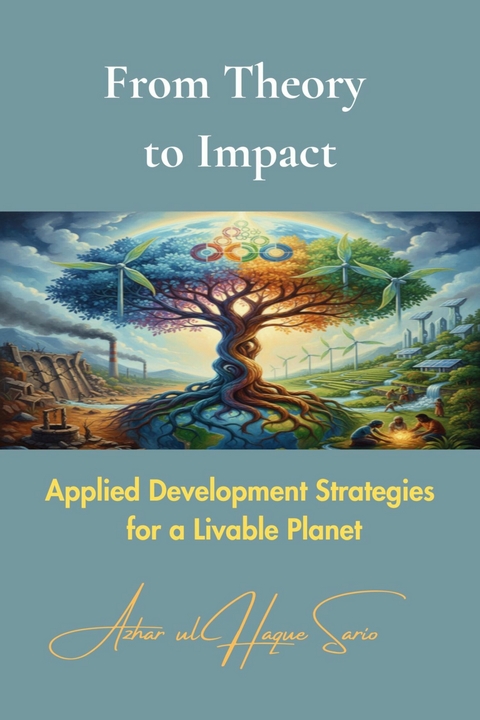
From Theory to Impact (eBook)
204 Seiten
Azhar Sario Hungary (Verlag)
978-3-384-72100-6 (ISBN)
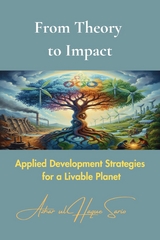
Ready to move beyond abstract theories and see how global development actually works?
Drawing on real-world case studies mirroring the scope of the World Bank's 2024 activities,
From Theory to Impact: Applied Development Strategies for a Livable Planet provides a practical guide to achieving the Sustainable Development Goals (SDGs). This book explores real-world action. Discover how $42 billion was mobilized to support Ukraine's government during active conflict. See how third-party partners deliver essential health and water services in nations like Yemen facing institutional collapse. Journey to India to understand its plan to build a national green hydrogen industry. Learn how the Philippines is digitalizing its government services to improve public administration. Understand how Morocco used pre-arranged insurance to rapidly send funds to 300,000 people after an earthquake. We examine legal reforms in Jordan that remove job restrictions for women. Travel to Viet Nam and see how new rice farming techniques cut emissions while increasing farmer profits by 30%. We analyze Tanzania's results-based financing that helped enroll 1.6 million additional students in school. The book also deconstructs Kenya's project that combined training and grants to benefit over 300,000 youth. It shows how Rwanda expanded electricity access from just 6% in 2009 to over 75% by 2024. From Quito's fully electric metro line serving 400,000 passengers daily to Somalia's successful journey to save $4.5 billion in debt servicing, this is your guide to development in action.
Many books tell you what problems exist. This book shows you how they are being solved. While other texts remain high-level, we unpack the specific strategies, innovative financial instruments, and policy designs that turn goals into reality. You'll learn the mechanics behind Climate Resilient Debt Clauses that allow small states to defer debt after a catastrophe and the design of multi-country programs aiming to bring clean energy to 100 million people in Africa. We break down practical tools like the World Bank Group Guarantee Platform, which aims to boost annual guarantees to $20 billion by 2030 to encourage private investment , and the IDA Private Sector Window that enabled the first utility-scale renewable energy project in Djibouti. This book moves past the jargon to provide a clear-eyed look at the operational details behind successful projects. It is a playbook for policymakers, practitioners, students, and anyone who wants to understand the intricate and inspiring work of building a more livable planet.
Disclaimer: This author has no affiliation with the board and it is independently produced under nominative fair use.
New Frontiers in Mobilizing Private Capital for Development
The Collaborative Blueprint: Deconstructing the Private Sector Investment Lab (SDG 17)
Imagine a conversation. Not just any conversation, but one where the immense power of global finance meets the world's most urgent development needs head-on. This is the essence of the World Bank's Private Sector Investment Lab. It is a bold, and refreshingly direct, experiment in collaboration. At its core, the Lab was created to answer a monumental question: Why aren't the trillions of dollars sitting in the private sector flowing into emerging markets where they are so desperately needed? To find the answer, the World Bank didn't retreat into academic studies or internal reports. Instead, it invited the people who control that capital directly to the table.
The structure is its genius. The Lab is composed of 15 high-level CEOs and Chairs from some of the world's most influential financial institutions—leaders from giants like AXA, BlackRock, HSBC, and Tata Sons. These are not junior representatives; they are the ultimate decision-makers, the very individuals who weigh the risks and rewards of investing billions of dollars every single day. By providing them with a direct line to the World Bank Group's leadership, the Lab deconstructs the traditional, often slow and bureaucratic, model of public-private engagement. It replaces formal, arms-length consultations with a dynamic, ongoing dialogue. This model is built on candor. The private sector leaders are there to give unvarnished feedback, to point out the real-world barriers that stop them from investing in a new power plant in Africa or a water sanitation project in Southeast Asia.
This entire initiative is a powerful embodiment of the United Nations' Sustainable Development Goal 17: Partnerships for the Goals. SDG 17 is the lynchpin of the entire 2030 Agenda, recognizing that no single entity—not governments, not NGOs, and not the private sector alone—can solve immense challenges like poverty, climate change, and inequality. The goal explicitly calls for encouraging and promoting effective public-private partnerships. The Private Sector Investment Lab is not just a partnership on paper; it is a living, breathing mechanism designed to do exactly that. It aims to build a bridge of trust and understanding between two worlds that often speak different languages. The public sector thinks in terms of development impact and policy, while the private sector is driven by risk, return, and efficiency. The Lab serves as the essential translator.
The feedback from these CEOs has been immediate and clear. They pointed to a confusing maze of products, slow processes, and a critical lack of instruments to hedge against risks like currency fluctuations or political instability. They spoke of the need for regulatory certainty, for clear rules of the road that don't change unexpectedly. This is precisely the kind of actionable intelligence the World Bank needs to evolve. The dialogue isn't just about identifying problems; it's about co-creating solutions. The development of the World Bank Group Guarantee Platform, for example, was a direct response to the Lab’s feedback. The private sector said, "Your guarantee products are too fragmented and complex." The World Bank listened and acted. This iterative process—of listening, learning, and reforming in real-time—is what makes the Lab an innovative model. It is transforming the World Bank from a simple lender into a true enabler, an institution that doesn't just fund projects itself but actively works to unlock vastly larger pools of private capital to build a more prosperous and sustainable world for everyone.
The Practical Engine: Evaluating the World Bank Group Guarantee Platform (SDG 9)
If the Private Sector Investment Lab is the collaborative blueprint, then the World Bank Group Guarantee Platform is the powerful engine built from those plans. Launched as a direct outcome of the Lab's dialogue, this platform represents a fundamental overhaul of how the World Bank uses one of its most critical tools for catalyzing private investment: guarantees. In simple terms, a guarantee is a promise. It’s the World Bank telling a private investor, "If you build this crucial piece of infrastructure, we will shield you from specific, unpredictable risks that are beyond your control." This promise can be the deciding factor that turns a project from "too risky" to "bankable."
The platform's core mission is to address the feedback for simplicity and speed. Before its creation, an investor looking for a guarantee from the World Bank Group had to navigate the different offerings of its various arms—like the International Finance Corporation (IFC) and the Multilateral Investment Guarantee Agency (MIGA). It was a complex and often lengthy process. The new Guarantee Platform changes all of that. It acts as a single front door, a "one-stop-shop" where all the guarantee products are consolidated. This streamlined approach makes it dramatically easier and faster for clients to find the right tool for their needs, whether it's protection against breach of contract by a government or risks associated with war and civil disturbance.
The practical application of this platform connects directly to the heart of Sustainable Development Goal 9, which focuses on building resilient infrastructure, promoting inclusive and sustainable industrialization, and fostering innovation. Large-scale infrastructure projects—like power grids, ports, and internet backbones—are the physical foundation of a modern economy. They create jobs, connect people to markets, and provide the essential services needed for a high quality of life. However, these projects are incredibly expensive and can take decades to generate a return. In emerging markets, they also come with heightened risks that can scare away private investors. This is where the Guarantee Platform becomes a game-changer. By mitigating these risks, it lowers the barrier to entry. It encourages a company to invest in building a wind farm, knowing that its investment is protected from certain political shocks. It helps a consortium of banks feel confident in lending money for a new water treatment facility.
The ambition behind the platform is staggering. The World Bank Group has set a target to boost its annual issuance of guarantees to $20 billion by the year 2030. This number isn't just about the guarantees themselves; it's about leverage. A $20 billion guarantee portfolio can be used to mobilize multiples of that amount in private capital—potentially unlocking over a hundred billion dollars for development projects. This is how you move from the billions of dollars available in public development aid to the trillions of dollars in private finance that are truly needed. The platform, therefore, is more than just a financial product. It is a vital mechanism for de-risking the future. It is a practical tool that helps build the roads, power plants, and digital networks that allow industries to grow, innovators to thrive, and societies to prosper, turning the aspirations of SDG 9 into concrete reality.
Sub-topic 8.3: A Spark in the Dark: How the IDA Private Sector Window Ignites New Markets
Imagine trying to start a fire with damp wood. You have the potential for a roaring blaze, but you need something to get it started—a bit of dry tinder, a powerful spark. In the world of finance for the planet's poorest countries, the International Development Association's (IDA) Private Sector Window (PSW) is that spark. It’s a special fund designed to do one thing: venture where traditional private investors are too hesitant to go. It doesn't replace them; it encourages them, holds their hand for the first difficult step, and shows them that a fire can indeed be lit. This is the essence of blended finance, a smart combination of development funds and private capital working together to achieve incredible things.
The PSW operates on a simple but powerful principle: reducing risk. In frontier markets, the perceived risks can feel overwhelming. Political instability, currency fluctuations, lack of a track record, or unfamiliar legal systems can make even the most promising business idea seem like a gamble. Private investors, who are accountable to their shareholders, often look at this landscape and simply say, "No, thank you." The PSW steps in and changes their calculation. It uses concessional funds—money that is more flexible and patient—to absorb some of the initial, scariest risks. This can take the form of a guarantee that covers potential losses, a low-interest loan to get a project off the ground, or an investment that takes the first hit if things go wrong. Suddenly, the gamble looks more like a calculated, manageable investment.
A New Chapter for Small Businesses in the Kyrgyz Republic
Let's look at a real-world example. In the Kyrgyz Republic, small and medium-sized enterprises (SMEs) are the lifeblood of the economy. They create jobs and drive local growth. Yet, they were stuck. They were too small for big international loans and too risky for local banks, which lacked the tools to provide long-term growth capital. The very idea of a private equity fund—a fund that invests directly into promising companies in exchange for a stake in their ownership—was completely new to the country.
This is where the PSW came in, acting as a catalyst. By providing a risk-sharing facility or a foundational investment,...
| Erscheint lt. Verlag | 2.10.2025 |
|---|---|
| Sprache | englisch |
| Themenwelt | Wirtschaft |
| Schlagworte | Case Studies in Economics • Climate finance • Development Finance • Governance reform • International Development • Public Policy • sustainable development |
| ISBN-10 | 3-384-72100-4 / 3384721004 |
| ISBN-13 | 978-3-384-72100-6 / 9783384721006 |
| Informationen gemäß Produktsicherheitsverordnung (GPSR) | |
| Haben Sie eine Frage zum Produkt? |
 EPUB (Ohne DRM)
Digital Rights Management: ohne DRM
Dieses eBook enthält kein DRM oder Kopierschutz. Eine Weitergabe an Dritte ist jedoch rechtlich nicht zulässig, weil Sie beim Kauf nur die Rechte an der persönlichen Nutzung erwerben.
Dateiformat: EPUB (Electronic Publication)
EPUB ist ein offener Standard für eBooks und eignet sich besonders zur Darstellung von Belletristik und Sachbüchern. Der Fließtext wird dynamisch an die Display- und Schriftgröße angepasst. Auch für mobile Lesegeräte ist EPUB daher gut geeignet.
Systemvoraussetzungen:
PC/Mac: Mit einem PC oder Mac können Sie dieses eBook lesen. Sie benötigen dafür die kostenlose Software Adobe Digital Editions.
eReader: Dieses eBook kann mit (fast) allen eBook-Readern gelesen werden. Mit dem amazon-Kindle ist es aber nicht kompatibel.
Smartphone/Tablet: Egal ob Apple oder Android, dieses eBook können Sie lesen. Sie benötigen dafür eine kostenlose App.
Geräteliste und zusätzliche Hinweise
Buying eBooks from abroad
For tax law reasons we can sell eBooks just within Germany and Switzerland. Regrettably we cannot fulfill eBook-orders from other countries.
aus dem Bereich