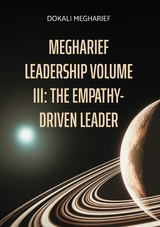
MEGHARIEF LEADERSHIP VOLUME III: The Empathy-Driven Leader (eBook)
402 Seiten
Books on Demand (Verlag)
978-3-7693-9185-5 (ISBN)
Dokali Megharief, PhD is the author of several books, including The Intellect Groups, The Prophecies Kid, The Santa of Roses, Lisa Dreams, Megharief Poetry Anthology, The Legacy and Reflections of Table 77, Mello and Luna Adventures, Harmony Odyssey A Universe Discovery Journey, The Sola System Union and Earth Unification Roadmap, A symphony of Life in Harmony, The Savvy Boys, The survival of Venture Island, Amir Lifelong Journey, Leadership a Lifelong Journey and Leadership in Action, Megharief Leadership Volumes (I-III) Dr. Megharief possesses over fifty years of extensive business experience. He has managed three oil and gas companies, as well as enterprises in automobile manufacturing and distribution, real estate development, hospitality development, financial portfolio management, and FinTech.
Introduction: The Quiet Power That Changes Everything
Empathy is having a moment. From boardrooms to classrooms, from global summits to grassroots movements, the word is invoked as the solution to everything from toxic workplaces to political polarization. It appears in mission statements, TED Talks, diversity trainings, and team off-sites. And yet, for all its ubiquity, empathy often remains misunderstood—tucked away as a sentiment, a nicety, a “soft” quality to counterbalance harder leadership traits, such as decisiveness, authority, or vision.
This volume offers something different.
Volume III of Megharief Leadership makes one bold and urgent claim: empathy is not a break from leadership; it is its beating heart. In this collection of twenty-five chapters, we explore empathy not as an accessory but as a core operating system—one that powers authentic connection, ethical decision-making, inclusive culture-building, and sustainable transformation.
This is not a book about being nice. It’s about how to lead humanely, rigorously, and courageously in complex times—by centering the emotional and relational intelligence that has too long been considered peripheral to power.
We live in an era where traditional models of leadership are revealing their limitations. Charisma without character. Control without connection. Growth without grounding. These are the hallmarks of leadership that may perform well on paper but fail to resonate with the people they aim to serve. We’ve seen what happens when influence outpaces empathy—cultures fracture, people disengage, trust erodes, and innovation stalls.
But when leaders listen before acting, when they lead from attunement rather than assumption, when they honor humanity as fiercely as they pursue results, everything changes.
That is the essence of The Empathic Edge.
Empathy as Mindset, Method, and Movement
Across the chapters that follow, we approach empathy not as a single moment of understanding but as a practice, a design principle, and a relational posture. We begin in Chapter One by dismantling common myths, most notably the outdated belief that empathy weakens decision-making or detracts from performance—quite the opposite. Neuroscience, organizational psychology, and countless field-based examples show that empathy enhances clarity, builds trust, and fuels collaboration. It turns strategy into service.
Chapters Two and Three provide the emotional and cognitive scaffolding for this claim. We learn that empathy is not just a feeling; it’s a biological process involving mirror neurons, emotional regulation, and ethical reasoning. It exists in multiple dimensions: affective empathy (feeling with), cognitive empathy (understanding), and compassionate empathy (acting with care). We also learn that empathy, like any muscle, requires daily practice through reflection, dialogue, curiosity, and courageous presence.
The early chapters guide us from awareness to action, equipping us with tools like body-based awareness, deep listening frameworks, empathy mapping, and story-based inquiry. We see that empathy isn’t something we switch on in a crisis; it’s something we cultivate over time, intentionally and imperfectly.
The Listening Leader and Cultures of Belonging
By Chapter Four, we transition from the personal to the interpersonal, exploring how empathy influences psychological safety and team dynamics. Listening becomes not just a behavior, but a culture-shaping ritual. Leaders learn to model vulnerability, reward candor, and create environments where others can show up fully. Empathy becomes the foundation in which creative risk, resilience, and inclusion take root.
In Chapters Five through Seven, we witness empathy in action across teams and differences. We meet leaders who facilitate empathy-driven rituals: peer storytelling circles, inclusive decision-making sprints, and curiosity-based conflict resolution. We explore cultural humility as the foundation for effective leadership across diverse groups, including those defined by race, gender, generation, and worldview. These chapters remind us that surface-level inclusion fails without emotional resonance—and that empathy, when practiced with integrity, becomes the bridge between difference and dignity.
Empathy, we learn, is not about sameness. It is about witnessing the wholeness of another, even when their experience is unfamiliar.
Boundaries, Ethics, and Emotional Resilience
Of course, empathy is not all sunshine and roses. As Chapter Eight makes clear, empathy without boundaries can backfire. Leaders can fall into over-identification, saviorism, or decision paralysis. They can absorb more than they are equipped to process, leading to burnout or blurred accountability. This chapter introduces the concept of ethical empathy, which involves striking an intentional balance between care and clarity, vulnerability, and responsibility.
Chapters Nine and Ten deepen this conversation, especially in high-stakes environments. Empathy is shown not as softness, but as a stabilizing force during volatility. Leaders learn to hold emotions and direction in tandem, using transparent communication and trauma-informed presence to guide teams through crises, uncertainty, or organizational change.
We see time and again that during upheaval, people don’t just want answers—they want to feel seen. Empathetic leaders offer both.
From Leadership Trait to Organizational Template
In the second half of the volume, empathy begins to scale.
In Chapter Eleven, we explore how organizational change efforts succeed not solely because of top-down visioning, but also because of ground-level empathy—leaders listening to people’s hopes, hesitations, and habits. Chapters Twelve and Thirteen position empathy at the heart of communication and feedback. We learn that the most powerful messages are not the most polished, but the most present: emotionally attuned, story-driven, and honest. And we learn that feedback—when delivered with empathy—becomes a relational act, not a performance critique.
Chapters Fourteen through Sixteen examine motivation, mentorship, and diversity through the lens of empathy. How do leaders truly inspire, rather than incentivize? How do they develop others not by dictating a path, but by co-creating conditions for growth? And how do they transition DEI from a checklist to a culture, from compliance to compassion?
These chapters offer answers through rich case studies and sharp contrasts: organizations where empathy is embodied across all levels, and others where it has been sidelined by speed, fear, or superficiality.
A constant theme emerges that empathy becomes powerful when it moves from episodic expression to embedded structure.
Accountability, Innovation, and the Shadow Side of Empathy
Chapters Seventeen and Eighteen take us into some of empathy’s toughest terrain: performance management and accountability. Too often, leaders err in one of two directions—rigid control without care, or empathy as avoidance. These chapters illustrate how empathetic leaders don’t lower standards; they raise the support around those standards. They give feedback early, with context and care. They invite ownership, rather than enforce obedience.
Similarly, Chapter Nineteen reveals that empathy is not the enemy of innovation; it is the engine of it. Human-centered design, storytelling prototyping, and cross-functional emotional literacy become tools for building not just products, but experiences that matter.
But there’s a warning here, too. When empathy is poorly understood, under-resourced, or deployed unevenly, it can replicate the very harm it aims to heal. These chapters reveal the shadow side of empathy—empathy used manipulatively, selectively, or so expansively that it neglects the self and the system.
The answer? Not to abandon empathy, but to mature it.
Empathy as Culture, Curriculum, and Legacy
The final movement of this volume focuses on scale, sustainability, and succession.
Chapters Twenty through Twenty-Two explore how empathy becomes an integral part of cultural DNA. We learn that empathy must be designed into rituals, onboarding, meeting structures, and team rhythms. Otherwise, it will evaporate in the face of stress or turnover. We’re given tools for building empathetic institutions—from gratitude walls to story circles to inclusive policy design grounded in lived experience.
Chapters Twenty-Three and Twenty-Four turn toward education, arguing that the next generation of leaders must be taught to lead with both head and heart. Performance without presence is no longer sufficient. We meet schools and programs weaving empathy into case studies, service learning, role-play labs, and mentoring ecosystems. And we learn that to teach empathy, we must embody it, not just assign it.
Finally, Chapter Twenty-Five closes this journey, where all leadership journeys must: at the intersection of impact and legacy.
Here, empathy is not presented as a feel-good gesture or a passing fad. It is...
| Erscheint lt. Verlag | 2.10.2025 |
|---|---|
| Sprache | englisch |
| Themenwelt | Wirtschaft |
| Schlagworte | business • CONTINUES LEARNING • HUMANALY CONNECTED • Leadership • Management |
| ISBN-10 | 3-7693-9185-3 / 3769391853 |
| ISBN-13 | 978-3-7693-9185-5 / 9783769391855 |
| Informationen gemäß Produktsicherheitsverordnung (GPSR) | |
| Haben Sie eine Frage zum Produkt? |
 EPUB (Wasserzeichen)
DRM: Digitales Wasserzeichen
Dieses eBook enthält ein digitales Wasserzeichen und ist damit für Sie personalisiert. Bei einer missbräuchlichen Weitergabe des eBooks an Dritte ist eine Rückverfolgung an die Quelle möglich.
Dateiformat: EPUB (Electronic Publication)
EPUB ist ein offener Standard für eBooks und eignet sich besonders zur Darstellung von Belletristik und Sachbüchern. Der Fließtext wird dynamisch an die Display- und Schriftgröße angepasst. Auch für mobile Lesegeräte ist EPUB daher gut geeignet.
Systemvoraussetzungen:
PC/Mac: Mit einem PC oder Mac können Sie dieses eBook lesen. Sie benötigen dafür die kostenlose Software Adobe Digital Editions.
eReader: Dieses eBook kann mit (fast) allen eBook-Readern gelesen werden. Mit dem amazon-Kindle ist es aber nicht kompatibel.
Smartphone/Tablet: Egal ob Apple oder Android, dieses eBook können Sie lesen. Sie benötigen dafür eine kostenlose App.
Geräteliste und zusätzliche Hinweise
Buying eBooks from abroad
For tax law reasons we can sell eBooks just within Germany and Switzerland. Regrettably we cannot fulfill eBook-orders from other countries.
aus dem Bereich