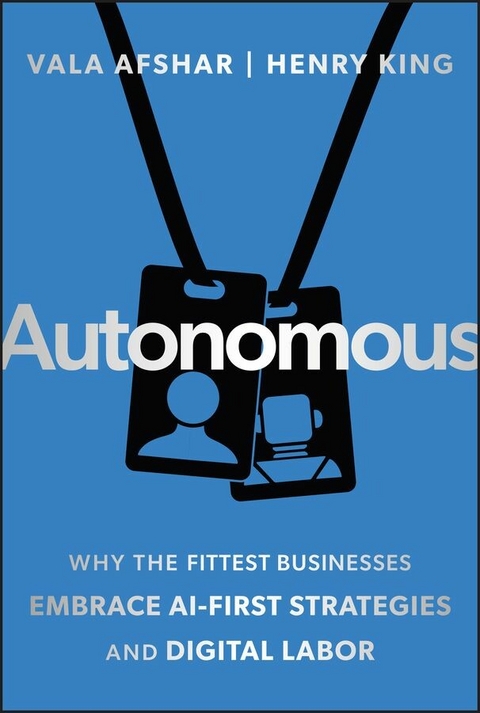
Autonomous (eBook)
309 Seiten
Wiley (Verlag)
978-1-394-35793-2 (ISBN)
A compelling roadmap to building an autonomous business, best positioned to win, using digital labor powered by Agentic and physical AI
An autonomous business is designed to be AI-first in its strategies and operations to maximize value and minimize time to value, and when it is done right it will unlock unprecedented speed, scale and shared success. But getting from one-off AI implementations - where most companies are at today - to autonomy will be neither easy nor obvious. Business leaders will need to challenge all the conventions, standard operating procedures and orthodoxies underpinning businesses designed by humans for humans - which is to say just about all of them! They will need to build digital labor to non-linearly scale the health, conditioning and talent of their teams, business and ecosystem, enabling 24x7x365 continuity and responsiveness, removing blockages and waste that trap or reduce value. They will need to manage the relationships between the two types of intelligent resources, digital and human. They will need to design for AI control and teach human leaders to 'let go of the steering wheel'.
The goal of Autonomous is to further expand the Boundless design principles that have guided the fastest growing companies in the world, and to ready business leaders, strategists and designers for success in the AI economy.
VALA AFSHAR and HENRY KING are the acclaimed co-authors of the bestselling book Boundless. With a combined 60+ years of experience, both are award-winning executives and technology practitioners specializing in business strategy, digital transformation, cloud computing, CRM, data, and AI technologies.
VALA AFSHAR is currently Chief Digital Evangelist at Salesforce, where he advises customers on the rise of Agentic AI and the future of advanced technologies. Previously, he has served as Vice President of Engineering, Chief Customer Officer, and Chief Marketing Officer. Recognized as a leading industry thought leader, Vala boasts over a million followers on X and LinkedIn, holds multiple U.S. patents, writes a weekly column for ZDNET, and has hosted the popular enterprise podcast DisrupTV for over a decade.
HENRY KING is an Innovation Strategist and Chief Information Officer with a distinguished career at Salesforce, Accenture, Deloitte Consulting, and other top technology firms. He is also a regular blog columnist and trusted advisor to organizations navigating digital transformation and AI adoption.
Together, as proven authors, technology practitioners, and advisors, Afshar and King are uniquely positioned to offer leaders, strategists, and designers actionable insights for positioning their companies for success in the age of AI.
A compelling roadmap to building an autonomous business, best positioned to win, using digital labor powered by Agentic and physical AIAn autonomous business is designed to be AI-first in its strategies and operations to maximize value and minimize time to value, and when it is done right it will unlock unprecedented speed, scale and shared success. But getting from one-off AI implementations - where most companies are at today - to autonomy will be neither easy nor obvious. Business leaders will need to challenge all the conventions, standard operating procedures and orthodoxies underpinning businesses designed by humans for humans which is to say just about all of them! They will need to build digital labor to non-linearly scale the health, conditioning and talent of their teams, business and ecosystem, enabling 24x7x365 continuity and responsiveness, removing blockages and waste that trap or reduce value. They will need to manage the relationships between the two types of intelligent resources, digital and human. They will need to design for AI control and teach human leaders to let go of the steering wheel . The goal of Autonomous is to further expand the Boundless design principles that have guided the fastest growing companies in the world, and to ready business leaders, strategists and designers for success in the AI economy.
Introduction
The fittest companies in the world are Autonomous companies. With management committed to future-proofing their organizations, they are building a digital labor force powered by Agentic artificial intelligence (Agentic AI) to nonlinearly scale the health, conditioning, and talent of their teams, business, and ecosystem. They are enabling 24 × 7 × 365 continuity and responsiveness, removing blockages and waste that trap or reduce value creation and positioning themselves for Boundless business success in an AI-first economy. They are machine-led and human-assisted, no longer vice versa. This is what it means for a business to be Autonomous. This is what it takes to be the fittest.
Our goal in writing this book is to persuade business leaders, strategists, and designers that this evolution of AI’s role from digital tool to digital labor, and humans’ role from operational control to mission control, is real and urgent. We aim to lay out the implications of this evolution and help them transform their companies from being human-first to becoming AI-first. We have developed seven key insights for this transformation, and our book is focused on explaining and exploring each one to prepare leaders for the journey to Autonomy.
The Seven Key Insights
Let’s discuss the insights.
Insight 1: In an AI-powered economy, the companies that are the fittest (best positioned to win) are Autonomous using digital labor.
What does it mean for companies to be fit in the AI economy? We believe that the answer is that they need to be fit in the sense of being adaptable to the ever-changing needs of the customer, the market, and the economy as a whole, and in the more usual sense nowadays of being in top physical shape. This means being healthy, conditioned, and talented. The fittest companies are healthy without blockages or waste slowing them down and destroying value; they are conditioned to perform at a high level, at speed that is routine, not a matter of heroics. They are talented, employing a digital workforce alongside their human one to create a new, hybrid resource pool that takes what’s best from both types of intelligence. And they prioritize AI-first strategies and designs to generate nonlinear or exponential outcomes. The fittest companies have leaders that are committed to the future and are willing and able to let go of the steering wheel to enable those nonlinear outcomes to happen. We have a word for the fittest companies in the age of AI: Autonomous.
Insight 2: Blockages are the number one cause of death in living organisms and businesses alike. Autonomous companies are living organisms that are immune to blockages.
A healthy living organism, from complex ones like humans to the individual cells that we’re composed of, is one that optimizes flow. Optimal flows of matter, energy, and information between the organism and its environment, and flows within the organism itself, keep us all alive and healthy.
Optimal flow is also essential to the health or optimal functioning of a whole variety of machines and systems. From the flow of electricity that animates nearly all systems nowadays, to hydraulic flows, data flows, fuel flows, airflow, and so on, our constructed and built world relies on uninterrupted flow to work properly.
This same principle of optimal flow also applies to business. Healthy companies have optimal flows of money, raw materials, electricity, expertise, data, and other resources coming in and flows of value to the customer coming out (product, service, information, and so on), as well as flows of money back out to providers, investors, and so on. When these flows are obstructed, business suffers in all sorts of ways. Blockages cause the deterioration and even death of companies of all shapes and sizes.
Insight 3: Autonomous companies have operating models for decision dominance and action at machine speed and scale (mSUDA).
Overall health is a prerequisite for fitness but conditioning is what sets Autonomous companies apart and enables them to perform at the highest level. They are able to act at speed routinely because they are built on mSUDA (machine-scale Sense, Understand, Decide, Act). mSUDA is the operating model for decision dominance and competitive advantage in the AI age, tuned to minimize the gap between sensing any event, like a customer query or competitor pricing change or supplier inventory shortage for instance, and acting on it. Adopting mSUDA requires predictive, Generative, Agentic, and physical AI-powered solutions, driving the evolution of enterprise applications from systems of records to systems of engagement and from there to systems of action and impact.
Insight 4: Autonomous companies are hyper-talented, integrating human and digital resources and building deep relational intelligence.
At the core of all successful businesses are successful relationships: relationships built on trust and commitment, providing moments of delight, delivering mutual and sustained value. The advent of AI as digital labor, as an integrated part of the workforce, will bring its own relationship opportunities and challenges. Relational intelligence (RI) is the ability to design, cultivate, nurture, and enhance successful relationships in the age of AI and smart machines. RI integrates human individuality, creativity, and empathy with the efficiencies, contextual awareness, and data-driven insights of AI agents at machine scale and speed to deepen the connections that matter most, with customers, employees, and with other valued stakeholders.
AI brings a new talent pool to the company, enabling new levels of performance at speed and scale previously unimagined. These resources need to be integrated and harnessed thoughtfully, not randomly assigned to stand-alone pain points, to increase the effectiveness and performance of the whole.
Insight 5: Adopting an AI-first strategy is the only path from assistive to Autonomous capabilities, producing nonlinear, exponential outcomes.
Conventionally, airplanes were designed with an inherent compromise between stability and performance. Human pilots, even the most skilled and experienced, have a limit to the degree of instability they can handle in their aircraft. But the aircraft have a limit in their performance when their stability is maximized. In other words, human limitations put constraints on the kind of airplanes and their performance that could be built. Fly-by-wire systems removed or at least significantly reduced that compromise, leading to extraordinary developments in speed, stealth, maneuverability, recoverability, and more, and future AI enhancements to those systems, known as intelligent flight control systems, promise to extend the possibilities of aircraft still further.
When we look at business through this lens, we realize that there are other human qualities that we have always considered neutral or actually beneficial that might now be regarded as limitations in the age of AI. Experience may not be so relevant when AI systems can learn complex tasks quickly and improve their performance continuously. Effort may not be so relevant when AI can work 24 × 7 × 365 without reward. Corporate hierarchies and management practices might not be so relevant when AI can choreograph, orchestrate, and mentor without higher salary, better perks, or a larger office. Many of the ways in which we do business are now up for grabs. An Autonomous company is designed for AI and machine strategies first, and in the future will likely be designed by them, too.
Insight 6: Becoming an Autonomous business requires the seven Boundless principles shaping the mindset and business operating model.
Autonomous companies will rest on the principles of connection, integration, distribution, Autonomy (naturally enough), mobility, continuity, and shared success. Agentic AI means new and more connections. Data is the lifeblood of AI success and integration is key to data access. Distribution becomes automated and scaled. Mobility and continuity accelerate Autonomy, and shared success now applies to human and digital labor alike, enabling a shift in focus from economies of scale to ecosystems of success.
We introduced these principles in our previous book Boundless to describe a business mindset that is the opposite of conventionally siloed organizations. We’ve since realized that these very principles are the perfect frame on which to build the AI-first company.
Insight 7: Taking our hands off the steering wheel: the road to Autonomous maturity for AI, the company, and its humans requires bold leadership and a new playbook.
Companies will not transform from human-led to AI-led Autonomous companies overnight. We have created a seven-level maturity model to help companies anticipate and plan and track their expansion of digital labor and progress toward Autonomy, with two main phases and inflection points at which the impact of AI becomes nonlinear. A car’s autonomous capabilities provide only incremental, linear value to the human driver while they are in the driver’s seat with their hands on the steering wheel but have exponentially greater potential as soon as those conditions are removed. In the same way, the impact of AI on an organization will only be incremental until a level of Autonomous maturity is achieved at which point we can only begin to imagine what might be possible if we cede operational control to our new digital colleagues and collaborators and...
| Erscheint lt. Verlag | 30.9.2025 |
|---|---|
| Sprache | englisch |
| Themenwelt | Wirtschaft ► Betriebswirtschaft / Management ► Unternehmensführung / Management |
| Schlagworte | Agentic AI • AI Business • AI competition • AI customers • AI Economy • AI employees • AI relationships • autonomous business • business competition • business insights • Business Optimization • Business Process • digital labor • Human Centric AI |
| ISBN-10 | 1-394-35793-1 / 1394357931 |
| ISBN-13 | 978-1-394-35793-2 / 9781394357932 |
| Informationen gemäß Produktsicherheitsverordnung (GPSR) | |
| Haben Sie eine Frage zum Produkt? |
 EPUB (Adobe DRM)
Kopierschutz: Adobe-DRM
Adobe-DRM ist ein Kopierschutz, der das eBook vor Mißbrauch schützen soll. Dabei wird das eBook bereits beim Download auf Ihre persönliche Adobe-ID autorisiert. Lesen können Sie das eBook dann nur auf den Geräten, welche ebenfalls auf Ihre Adobe-ID registriert sind.
Details zum Adobe-DRM
Dateiformat: EPUB (Electronic Publication)
EPUB ist ein offener Standard für eBooks und eignet sich besonders zur Darstellung von Belletristik und Sachbüchern. Der Fließtext wird dynamisch an die Display- und Schriftgröße angepasst. Auch für mobile Lesegeräte ist EPUB daher gut geeignet.
Systemvoraussetzungen:
PC/Mac: Mit einem PC oder Mac können Sie dieses eBook lesen. Sie benötigen eine
eReader: Dieses eBook kann mit (fast) allen eBook-Readern gelesen werden. Mit dem amazon-Kindle ist es aber nicht kompatibel.
Smartphone/Tablet: Egal ob Apple oder Android, dieses eBook können Sie lesen. Sie benötigen eine
Geräteliste und zusätzliche Hinweise
Buying eBooks from abroad
For tax law reasons we can sell eBooks just within Germany and Switzerland. Regrettably we cannot fulfill eBook-orders from other countries.
aus dem Bereich