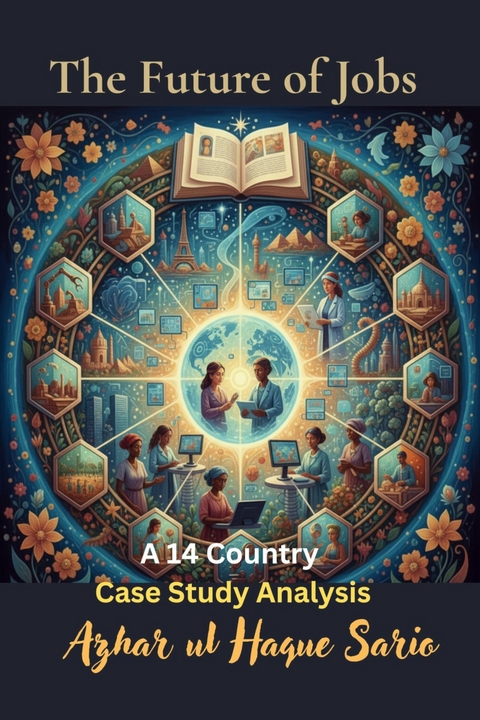
The Future of Jobs (eBook)
204 Seiten
Azhar Sario Hungary (Verlag)
978-3-384-71942-3 (ISBN)
What does the future of work actually look like on the ground, beyond the headlines?
This book takes you on a global journey to find out. We visit 14 different countries to see their unique stories. Each nation faces a distinct set of challenges and opportunities. We explore how Germany is mixing automation with its green transition. We see how Japan uses robotics to deal with an aging population. Then, we travel to Nigeria, where a vibrant youth population is building a digital future from the ground up. You will discover the United Arab Emirates' ambitious plan to move beyond an oil-based economy. We analyze Mexico's manufacturing boom from nearshoring. We look at South Korea's hyper-automated society. From the industrial might of China to the post-Brexit world of the United Kingdom, each chapter is a detailed case study. This isn't just theory about AI and jobs. It is a real-world look at the strategies, policies, and cultural forces shaping how we will work for decades to come.
Many books discuss the future of jobs in broad, abstract terms, often focusing on a single country or a single technology. This book is different. Its true value comes from its direct, comparative analysis. By placing 14 unique economies side-by-side, it reveals there is no one-size-fits-all solution to the challenges of automation, AI, and the green revolution. You will understand why the 'Just Transition' in South Africa's coal country is fundamentally different from Canada's clean energy future. This approach moves beyond generic predictions and provides a grounded, nuanced perspective. It delivers a practical playbook of diverse global strategies in action, offering readers a far deeper and more realistic understanding of the economic crosscurrents that are reshaping our world.
Disclaimer: The author has no affiliation with any official board or entity discussed within, and this book is an independent analysis produced under nominative fair use.
Singapore - The Smart Nation's Blueprint for a Future-Ready Workforce
1. "SkillsFuture": A National Movement for Lifelong Learning
In the global imagination, Singapore often appears as a gleaming, hyper-efficient metropolis—a city of the future, built on logic and long-term planning. But beneath the shimmering glass towers and immaculate public gardens lies the nation's most crucial resource, the one it has cultivated with more care than any other: its people. Understanding this is key to understanding "SkillsFuture," which is far more than just a government program. It is a national movement, a cultural shift, and Singapore's ambitious bet on its own citizens as the ultimate engine of its future prosperity.
It all began with a simple, yet daunting, realization. In a world being constantly reshaped by technology, automation, and globalization, the old model of education—study hard for the first twenty years of your life and then work for the next forty—was becoming obsolete. A university degree, once a ticket for a lifetime career, was now just the starting point. The skills that were valuable yesterday could be redundant tomorrow. For a small island nation with no natural resources to fall back on, the adaptability and relevance of its workforce were not just an economic advantage; they were a matter of survival.
This is the soil from which SkillsFuture grew. Launched in 2015, it was a profound statement from the government: we will invest directly in you, our people, for your entire life. It was a new social contract. The government's role wasn't just to provide education at the beginning of life but to be a lifelong partner in learning.
At its core, the initiative is beautifully simple. Every Singaporean aged 25 and above was given an initial $500 in SkillsFuture Credit. This wasn't a voucher with complicated terms or a rebate you had to claim back. It was real, dedicated money in a personal learning account, accessible via the national digital identity portal, Singpass. The message was clear: this is yours. Use it to learn something new. The choice was left entirely to the individual. You could take a course in digital marketing, coding, or data analytics to boost your career. Or you could learn baking, a new language, or floral arrangement to pursue a personal passion. The government periodically tops up these credits, reinforcing the idea that learning never stops.
This individual credit was just the beginning. The movement has since expanded into a comprehensive ecosystem. The SkillsFuture Enterprise Credit was introduced to encourage employers, especially small and medium-sized enterprises (SMEs), to invest in both their employees' training and their own business transformation. It was a clever way to ensure that upskilling wasn't just an individual responsibility but a shared goal between companies and their staff.
Perhaps one of the most impactful elements is the SkillsFuture Mid-Career Support Package. This is where the policy shows its deeply human side. It directly addresses the anxieties of workers in their 40s and 50s, who are often the most vulnerable to technological disruption. They have experience, but their skills may be aging. They have financial commitments, making a career change terrifying. This package provides substantial subsidies for mature workers to enroll in career transition programs, helping them reskill for new roles in growing industries. It’s a powerful safety net, turning the fear of redundancy into an opportunity for a second wind.
The impact of SkillsFuture isn't just measured in the number of courses taken; it's seen in the subtle but profound shift in the national mindset. The conversation in homes and workplaces has changed. Lifelong learning is no longer a niche concept for the academically inclined; it's a mainstream topic. It has normalized the idea of a 50-year-old accountant learning Python, a factory supervisor taking a course on robotics, or a retail assistant reskilling for a job in e-commerce. It fosters a culture of curiosity and resilience.
Of course, the journey is not without its challenges. With thousands of approved courses, some citizens feel a "paradox of choice," unsure of what skills will truly be valuable. There have been debates about the quality of some training providers and whether the credits are always used for meaningful, career-enhancing skills. But these are the expected growing pains of such a monumental undertaking. The government continues to refine the system, providing better career guidance and curating courses more closely with industry needs.
Ultimately, SkillsFuture is Singapore's answer to an uncertain future. It is a declaration that a nation's greatest asset is the potential locked within its people. It’s a system built on the belief that everyone, regardless of their age or background, deserves the chance to learn, adapt, and grow. It's not just about building skills; it's about building a future-proof population, one course, one person at a time.
2. Living in a "Smart Nation": The Integration of Technology in Everyday Life and Work
To visit Singapore today is to step into a living laboratory for the future of urban life. The term "Smart Nation" might sound like a futuristic marketing slogan, but in Singapore, it is a tangible reality woven into the very fabric of daily existence. It’s not about technology for its own sake—a dazzling showcase of gadgets and gizmos. Instead, it’s a deeply pragmatic and people-centric vision: to use data and digital solutions to solve real-world problems, create a more efficient society, and ultimately, improve the quality of life for every citizen.
The journey of a resident through this smart ecosystem often begins with a single, powerful tool: Singpass. What started as a simple login credential for government websites has evolved into a sophisticated National Digital Identity. It's the secure digital key that unlocks the entire city. Stored on your smartphone, it is your ID card, your signature for digital documents, your gateway to banking, and your access pass to healthcare records. It’s the foundational pillar upon which the Smart Nation is built, creating a seamless and trusted link between the citizen and the state.
Imagine a typical day. You wake up and need to get to work. You don't just guess when the bus will arrive. An app on your phone provides real-time tracking with pinpoint accuracy, allowing you to leave your home at the last possible minute. The traffic light system you pass through isn't on a simple timer; it uses sensors and AI to analyze traffic flow, adjusting signal timings to minimize congestion and keep the city moving.
At lunchtime, you head to a bustling hawker center. There's no fumbling for cash. You simply scan a QR code at the stall with your phone, and the payment is made instantly. This nationwide e-payment system, known as PayNow, has made cashless transactions the norm, from the smallest neighborhood shop to the largest department store. It’s fast, hygienic, and incredibly convenient.
Later, you feel unwell. Instead of taking time off work to queue at a clinic, you might use a telehealth service for a virtual consultation with a doctor. If you need to access your medical history, it's all securely stored in your HealthHub account, accessible via your Singpass. This centralized system means that no matter which doctor or hospital you visit in Singapore, your health records can follow you, ensuring continuity of care and preventing dangerous medical errors.
This digital integration extends to the most fundamental aspects of life, including housing. The Housing and Development Board (HDB), which houses over 80% of the population, is pioneering "smart homes." These new apartments are equipped with smart distribution boards and sockets that allow residents to monitor their energy and water usage from an app, helping them save money and be more environmentally friendly. In homes with elderly residents, sensors can be installed to monitor for falls or unusual periods of inactivity, sending alerts to family members or caregivers, providing peace of mind and allowing seniors to live independently for longer.
For businesses, the Smart Nation initiative has slashed through bureaucracy. Registering a company, applying for licenses, or filing taxes—processes that once required mountains of paperwork and physical visits to government offices—can now be done online in a fraction of the time through centralized business portals. This efficiency makes the country an even more attractive place for entrepreneurs and multinational corporations to operate.
However, this deeply integrated digital life is not a utopia without its complexities. The immense amount of data generated by these systems raises legitimate questions about privacy and surveillance. Singaporeans are engaged in an ongoing conversation about the trade-offs between the convenience of a smart city and the right to personal data privacy. The government has responded by enacting robust data protection laws and emphasizing a "security-by-design" approach in all its digital platforms.
Another significant challenge is ensuring digital inclusion. In a society that is aging rapidly, how do you make sure that senior citizens who are not "digital natives" are not left behind? This is being tackled through a dedicated "Digital for Life" movement, which deploys digital ambassadors to community centers and libraries to teach essential skills, from using a smartphone to...
| Erscheint lt. Verlag | 30.9.2025 |
|---|---|
| Sprache | englisch |
| Themenwelt | Wirtschaft |
| Schlagworte | ARTIFICIAL INTELLIGENCE IMPACT • automation in the workplace • Economic Policy • Future of Work • Global Economics • Green economy • workforce development |
| ISBN-10 | 3-384-71942-5 / 3384719425 |
| ISBN-13 | 978-3-384-71942-3 / 9783384719423 |
| Informationen gemäß Produktsicherheitsverordnung (GPSR) | |
| Haben Sie eine Frage zum Produkt? |
 EPUB (Ohne DRM)
Digital Rights Management: ohne DRM
Dieses eBook enthält kein DRM oder Kopierschutz. Eine Weitergabe an Dritte ist jedoch rechtlich nicht zulässig, weil Sie beim Kauf nur die Rechte an der persönlichen Nutzung erwerben.
Dateiformat: EPUB (Electronic Publication)
EPUB ist ein offener Standard für eBooks und eignet sich besonders zur Darstellung von Belletristik und Sachbüchern. Der Fließtext wird dynamisch an die Display- und Schriftgröße angepasst. Auch für mobile Lesegeräte ist EPUB daher gut geeignet.
Systemvoraussetzungen:
PC/Mac: Mit einem PC oder Mac können Sie dieses eBook lesen. Sie benötigen dafür die kostenlose Software Adobe Digital Editions.
eReader: Dieses eBook kann mit (fast) allen eBook-Readern gelesen werden. Mit dem amazon-Kindle ist es aber nicht kompatibel.
Smartphone/Tablet: Egal ob Apple oder Android, dieses eBook können Sie lesen. Sie benötigen dafür eine kostenlose App.
Geräteliste und zusätzliche Hinweise
Buying eBooks from abroad
For tax law reasons we can sell eBooks just within Germany and Switzerland. Regrettably we cannot fulfill eBook-orders from other countries.
aus dem Bereich