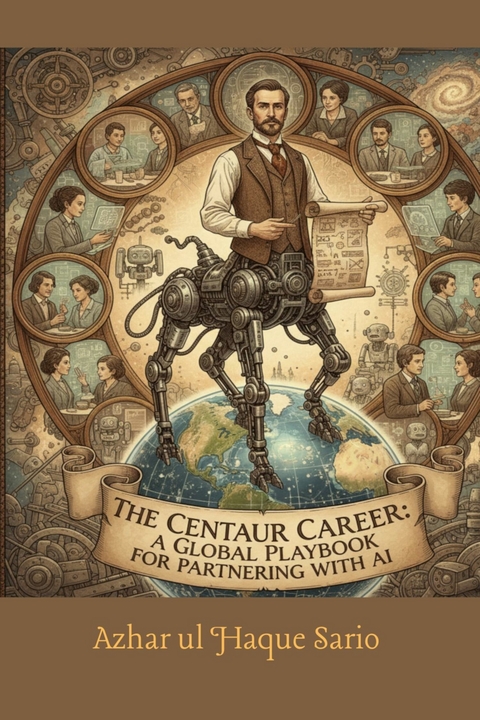
The Centaur Career (eBook)
206 Seiten
Azhar Sario Hungary (Verlag)
978-3-384-71902-7 (ISBN)
Are you ready to thrive in the age of AI? This book is your global playbook.
This book introduces the concept of the 'Centaur Career.' It's a new way of working not against AI, but with it. We take you on a journey around the world. You will discover how professionals are already succeeding. We start with the AI superpowers. See how the United States fosters the Centaur as an entrepreneur. Then, we explore China's Centaur as an industrial strategist. Next, we visit the industrial powerhouses. In Germany, the Centaur is a precision engineer. Japan's Centaur acts as a productivity catalyst. The United Kingdom uses this partnership for public service innovation. The tour continues with the emerging giants, who are leapfrogging into the future. You'll learn from Brazil's civic technologists and Singapore's lifelong learners. We see futurists in the United Arab Emirates. Canada provides a model as an ethical steward. Finally, Australia shows us the pragmatic implementer. This guide provides a clear map for your own professional journey, no matter where you are.
While many books on artificial intelligence are either too technical or focus only on fear and hype, The Centaur Career offers a refreshingly practical and optimistic alternative. Its true advantage is its unique global perspective, moving beyond the typical Silicon Valley-centric narrative. Instead of just talking about abstract concepts, this book provides a concrete playbook filled with real-world case studies from ten different countries across various stages of economic development. It shows you how people are augmenting their skills today, offering actionable strategies you can apply to your own career. It's not about predicting the future; it's about preparing you for the present and helping you build a resilient, future-proof career by partnering with technology.
Disclaimer: The author has no affiliation with any boards or entities mentioned in this book. It is an independently produced work under the principle of nominative fair use.
Part I: The AI Superpowers – Setting the Global Stage
The United States – The Centaur as Entrepreneur
The National Blueprint: A Market-Led Race for Dominance
The United States has articulated a clear and ambitious vision for its role in the future of artificial intelligence. This vision is not one of participation, but of leadership. The official strategy, laid out in national action plans, aims for nothing less than "unquestioned and unchallenged global technological dominance." This goal is the North Star guiding a uniquely American approach to a global technological revolution. Unlike the state-directed industrial policies of other nations, the U.S. blueprint is fundamentally a market-led framework. It is designed to empower and unleash the nation's greatest asset in this domain: its vibrant, innovative, and well-funded private sector.
The core philosophy is that the government should not be the primary driver of innovation, but its most powerful facilitator. This strategy rests on three foundational pillars: first, accelerating innovation; second, building out American AI infrastructure; and third, leading in international diplomacy and security related to AI. Together, these pillars form a comprehensive plan to create the most fertile ground in the world for AI development. The government sees its role as clearing the path, providing the fuel, and setting the rules of the road, while the private sector builds and drives the technological engine. This approach is a calculated bet on the dynamism of American capitalism, believing that a decentralized, competitive ecosystem will out-innovate and outperform any top-down, centrally-planned model in the long run. It is a strategy built on speed, agility, and the relentless pursuit of the next breakthrough, positioning the U.S. to not just compete, but to set the pace for the rest of the world.
Accelerating Innovation and Global Leadership
A key component of the American strategy is the aggressive promotion and export of its domestic AI technology. The plan is to establish American technology as the undisputed global standard, a goal pursued through the export of secure, full-stack AI solutions. This is a crucial concept. A "full-stack" solution encompasses every layer of the technology, from the physical hardware like advanced semiconductor chips to the complex large language models, and finally to the user-facing software applications. By encouraging allies and partners to adopt this entire ecosystem, the United States aims to create a deeply integrated network built on American innovation.
This is not merely a commercial strategy; it is a powerful instrument of international diplomacy and security. When a country adopts the American AI stack, it also tends to adopt the implicit standards, ethical guidelines, and security protocols embedded within it. This creates a technological alliance that reinforces diplomatic ties and promotes a shared vision for the responsible use of AI, one that stands in contrast to the models promoted by authoritarian regimes. The emphasis on "secure" solutions is paramount. It is a commitment to providing partners with technology that is resilient, trustworthy, and safe from manipulation by adversaries. In a world where digital infrastructure is becoming as critical as physical infrastructure, this strategy positions the U.S. as the premier provider of the foundational technology that will power the 21st-century global economy. It is a forward-looking policy that seeks to lead not by decree, but by becoming the indispensable technological partner for nations around the world.
Building the Physical Foundation for a Digital Future
The artificial intelligence revolution is not just happening in the cloud; it is built on a massive physical foundation here on Earth. AI requires two things in immense quantities: computational power and data. Providing these requires a colossal investment in physical infrastructure, specifically advanced data centers and state-of-the-art semiconductor fabrication plants, or "fabs." Recognizing this, the U.S. strategy focuses heavily on systematically removing the obstacles that could slow down the construction of this critical infrastructure. The primary engine of progress is seen as a private sector fueled by the world's deepest and most sophisticated pools of venture capital. The government's role, therefore, is to clear the path and fuel the engine.
This translates into concrete policy actions aimed at streamlining the permitting process and cutting through federal regulations that are perceived as hindering development. In the global race for AI supremacy, speed is a decisive factor. A delay of a year in building a new chip fab or a hyperscale data center can mean the difference between leading the next wave of innovation and falling behind. The government's push to accelerate these projects is a direct acknowledgment of this reality. It represents a partnership where the private sector risks billions in capital to build these facilities, and the public sector provides the regulatory certainty and speed required to make those investments viable. This approach is designed to ensure that the physical heart of the AI revolution beats strongest on American soil, securing the supply chains and computational resources necessary to maintain its technological edge for years to come.
Investing in Human and Knowledge Capital
Ultimately, technology is a human endeavor. The most advanced hardware and sophisticated algorithms are inert without the brilliant minds to create, manage, and improve them. The final, and perhaps most critical, piece of the American AI strategy is a deep and sustained investment in both human and knowledge capital. The blueprint emphasizes robust workforce development, primarily through the creation of dynamic public-private partnerships. These collaborations are designed to build a pipeline of talent that can meet the evolving demands of the AI industry. This involves companies working directly with universities to shape curricula, government funding for STEM education at all levels, and initiatives aimed at upskilling and retraining the existing workforce.
Alongside building human capital, the strategy calls for significant investment in AI-enabled scientific research. This is a recognition that AI is not just a product, but a fundamental tool of discovery. By applying AI to complex challenges in fields like medicine, materials science, and climate change, the U.S. aims to spark a new era of scientific breakthroughs. This creates a powerful virtuous cycle. Breakthroughs in science, enabled by AI, can lead to new industries and economic growth. The insights gained from applying AI to scientific problems can, in turn, lead to new innovations in AI itself. This dual investment in people and research is the long-term component of the plan. It aims to ensure that the United States not only has the infrastructure and capital to lead in AI today but also cultivates the talent and generates the foundational knowledge needed to continue innovating and leading for decades to come.
The Centaur in Action: Augmenting Value in Legacy Industries
The rise of artificial intelligence often conjures images of futuristic startups and disruptive technologies poised to completely overhaul the way we live and work. While that narrative holds some truth, a more immediate and arguably more impactful story is unfolding not in Silicon Valley garages, but within the established corridors of America’s legacy industries. This is the story of the Centaur model—a powerful partnership where human expertise is augmented, not replaced, by AI. This isn't a theoretical future; it's a practical, bottom-line-enhancing reality that is already generating tangible value in fields like logistics, finance, and healthcare. The model operates on a simple, elegant principle: delegate the exhaustive, computational, and data-heavy tasks to machines, thereby freeing human professionals to focus on what they do best—strategy, critical thinking, nuanced judgment, and creative problem-solving.
Logistics: The Brain and the Brawn of a Modern Supply Chain
The world of logistics is a symphony of moving parts, a complex dance of timing, capacity, and routing that has long been a monumental challenge for human planners. The sheer volume of variables—from traffic patterns and weather forecasts to fuel costs and delivery windows—makes true optimization nearly impossible for the unaided human mind. This is where the Centaur model has found fertile ground to create immense value.
At Walmart, a company whose success hinges on supply chain mastery, this partnership is in full effect. A logistics manager there collaborates with a sophisticated, in-house AI system to orchestrate one of the largest trucking fleets in the world. In the past, this manager’s role would have been highly tactical, consumed by the granular details of individual routes and schedules. Today, their role has been elevated to that of a strategist. The AI system processes an avalanche of real-time data, analyzing millions of potential combinations to propose the most efficient routes and load configurations for every truck. It can determine the optimal path to minimize mileage, avoid traffic, and ensure trucks are as full as possible on every leg of their journey.
The human manager doesn't just press a button, however. They provide the essential oversight and real-world wisdom the AI lacks. They can review the AI’s suggestions and make strategic adjustments. Perhaps the AI is unaware of a local festival...
| Erscheint lt. Verlag | 29.9.2025 |
|---|---|
| Sprache | englisch |
| Themenwelt | Wirtschaft |
| Schlagworte | Artificial Intelligence • career development • Future of Work • Global Business Strategy • Human AI Collaboration • Technology and Innovation • Workforce Augmentation |
| ISBN-10 | 3-384-71902-6 / 3384719026 |
| ISBN-13 | 978-3-384-71902-7 / 9783384719027 |
| Informationen gemäß Produktsicherheitsverordnung (GPSR) | |
| Haben Sie eine Frage zum Produkt? |
 EPUB (Ohne DRM)
Digital Rights Management: ohne DRM
Dieses eBook enthält kein DRM oder Kopierschutz. Eine Weitergabe an Dritte ist jedoch rechtlich nicht zulässig, weil Sie beim Kauf nur die Rechte an der persönlichen Nutzung erwerben.
Dateiformat: EPUB (Electronic Publication)
EPUB ist ein offener Standard für eBooks und eignet sich besonders zur Darstellung von Belletristik und Sachbüchern. Der Fließtext wird dynamisch an die Display- und Schriftgröße angepasst. Auch für mobile Lesegeräte ist EPUB daher gut geeignet.
Systemvoraussetzungen:
PC/Mac: Mit einem PC oder Mac können Sie dieses eBook lesen. Sie benötigen dafür die kostenlose Software Adobe Digital Editions.
eReader: Dieses eBook kann mit (fast) allen eBook-Readern gelesen werden. Mit dem amazon-Kindle ist es aber nicht kompatibel.
Smartphone/Tablet: Egal ob Apple oder Android, dieses eBook können Sie lesen. Sie benötigen dafür eine kostenlose App.
Geräteliste und zusätzliche Hinweise
Buying eBooks from abroad
For tax law reasons we can sell eBooks just within Germany and Switzerland. Regrettably we cannot fulfill eBook-orders from other countries.
aus dem Bereich