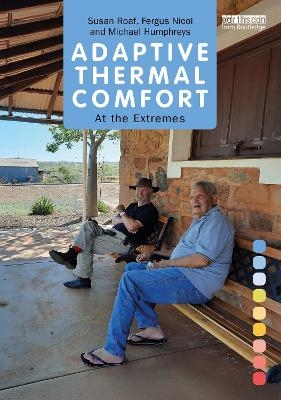
Adaptive Thermal Comfort
Routledge (Verlag)
978-0-367-13769-4 (ISBN)
- Noch nicht erschienen (ca. April 2026)
- Versandkostenfrei
- Auch auf Rechnung
- Artikel merken
To remain comfortable in a world of evermore extreme weather events and climate trends, we need a building revolution. Building designers, owners, managers, and occupants must prepare now for future climates with new ways to stay comfortable indoors. This book is a compendium of information on comfort that provides an overview of the complexity of the many ways that comfort is achieved in buildings. It outlines the impacts and implications of current design practices on greenhouse gas emissions from buildings and the health and well-being of people in them. In reality, many modern buildings, and particularly homes, are already failing in various ways. During extreme weather events, they overheat. During power outages, many buildings do not even remain habitable. During the COVID pandemic, cross-infections between occupants were rife in buildings like hospitals and hotels without opening windows. As energy prices soared and globally economies flatlined, many found themselves unable to pay for high-cost comfort solutions and so either had to change their lifestyles and expectations or learn to live with discomfort. Underlying many of the growing global problems is the trend towards an overdependence on mechanical systems to produce comfort, coupled with a decrease in the passive climatic performance of the buildings themselves. Both factors are resulting in a generation of increasingly un-resilient buildings.
The theory of adaptive thermal comfort states that people adapt to those temperatures they normally occupy, and if they become uncomfortable, they tend to change themselves or their surroundings to return to comfort, if they are able or can afford to. This is the third of three volumes, which builds on the practical and theoretical foundations of the subject laid out in the first two volumes. It builds on their premises to shape a new and better roadmap going forward for imagining, designing, and constructing adaptable buildings, and for the behavioural lifestyle changes needed to prepare humanity to survive and thrive comfortably in the very different weather and climates ahead.
Susan Roaf is Emeritus Professor of Architectural Engineering at Heriot Watt University. Raised in Malaysia and the Australian bush and educated in Britain, she has lived and worked as an architect, anthropologist, and archaeologist in Iran, Iraq, Pakistan, California, and Antarctica, experiences that colour her unique understanding of buildings and comfort in different climates and cultures and that inspired her work on adapting buildings and cities to a heating world. She pioneered UK building–integrated solar technologies and eco-design and, with Nicol and Humphreys, has promoted adaptive thermal comfort globally. Her expertise in ancient technologies informed some of her 23 books and other publications, all aimed at better understanding performance in the past, present, and future. Fergus Nicol is an award-winning leader in the field of adaptive thermal comfort, having started as a physicist at the Building Research Establishment in the 1960s. He moved on to work with the UK Medical Research Council and into teaching before leaving both to start the radical book shop Bookmarks. Returning to research in 1992, he is now Emeritus Professor in a number of universities and a top cited scholar across his many publications. He led influential pan-European and Pakistan studies on comfort, and he leads NCEUB, the Network for Comfort and Energy Use in Buildings. He co-founded and ran the Windsor Conferences on Comfort and is internationally respected for his support of fellow researchers and students. Michael Humphreys is known for his pioneering work on the adaptive approach to comfort. He was Head of Human Factors at the Building Research Establishment and has been a Research Professor at Oxford Brookes University. His scientific interests are the methodology of field studies of environmental comfort, the structure and statistical modelling of human adaptive behaviour, and the interactions between the several aspects of the indoor environment.
DEDICATION
PREFACE
ACKNOWLEDGEMENTS
COMFORT IN BUILDINGS
Chapter 1. Designing for Comfort at the Extremes
Chapter 2. Dangerous Curves: The Overheating Buildings Problem
PEOPLE AND COMFORT
Chapter 3. How Bodies Adapt
Chapter 4. How People Adapt
BUILDINGS AND COMFORT
Chapter 5. How People Adapt in Buildings
Chapter 6. Comfort Clouds
COMFORT AND CULTURES
Chapter 7. Comfort, Cultures, and Customs
Chapter 8. Comfort Colonialism
THERMAL HEARTBEATS OF BUILDINGS
Chapter 9. The Thermal Heartbeats of Buildings
Chapter 10. Killer Buildings: Heatwaves
Chapter 11. Killer Buildings: Cold
ECOLOGY AND COMFORT
Chapter 12. Ecology of Comfort
Chapter 13. Heat Flows and Ecological Engineering
Chapter 14. Harvesting Comfort From Landscapes
Chapter 15. Mining Comfort From the Earth
Chapter 16. Thermal Mass and Comfort
Chapter 17. Harvesting Comfort From Sky Cycles
Chapter 18. Air, Radiation, and Comfort
Chapter 19. Thermal Landscaping of Buildings
DESIGNING FOR A HOTTER CLIMATE
Chapter 20. Reconnecting Designers to Climates
Chapter 21. Firmness, Commodity, and Delight
Chapter 22. Designing Thermally Well-Behaved Buildings
Chapter 23. Thermal Delight in Design
COMFORT AND WELLBEING
Chapter 24. Comfort and Well-Being: Physical Health
Chapter 25. Well-Being: All About the Mind
Chapter 26. Emotional Comfort and Social Well-Being
Chapter 27. Spiritual Comfort and Beliefs
Chapter 28. Adaptable Buildings = Adaptive Comfort
APPENDICES
| Erscheint lt. Verlag | 6.4.2026 |
|---|---|
| Zusatzinfo | 21 Tables, color; 147 Line drawings, color; 86 Halftones, color; 233 Illustrations, color |
| Verlagsort | London |
| Sprache | englisch |
| Maße | 174 x 246 mm |
| Gewicht | 453 g |
| Themenwelt | Technik ► Bauwesen |
| Wirtschaft ► Betriebswirtschaft / Management | |
| ISBN-10 | 0-367-13769-0 / 0367137690 |
| ISBN-13 | 978-0-367-13769-4 / 9780367137694 |
| Zustand | Neuware |
| Informationen gemäß Produktsicherheitsverordnung (GPSR) | |
| Haben Sie eine Frage zum Produkt? |
aus dem Bereich