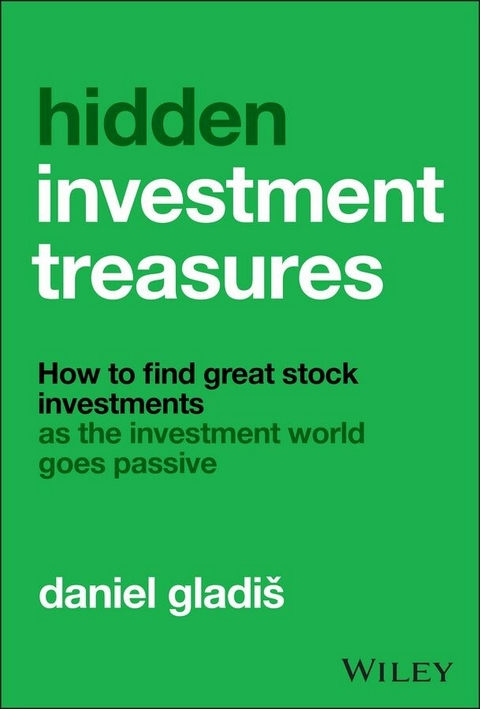
Hidden Investment Treasures (eBook)
292 Seiten
Wiley (Verlag)
978-1-394-34481-9 (ISBN)
Practical, expert guidance on identifying active investment opportunities in a stock market dominated by passive investors
In Hidden Investment Treasures: How to Find Great Stock Investments as the Investment World Goes Passive, veteran portfolio manager Daniel Gladi?, CFA, delivers a foundational and inspiring new playbook for actively capturing higher returns at lower risk in a market dominated today by passive money.
Gladi? walks you through real investment cases exemplifying how to take advantage of growing inefficiency in the financial markets. He demonstrates specific analytical techniques and strategic reasoning essential to uncovering underpriced securities that can yield superior long-term returns.
Gladi? explains:
- How diligent active investors should dig where passive money fails to flow
- Where value lurks in sectors and firms seen as too boring, little known, unpopular, complicated, or small
- Fundamental metrics, tools, and perspectives for recognizing underpriced stocks
- Applying analysis, discipline, and patience to buy at the right price
- How company managements create-or destroy-shareholder value through capital allocation, acquisitions, and personal temperament
Written for individual investors and professionals, Hidden Investment Treasures is a must-read for stock pickers, value investors, equity analysts, and wealth managers seeking to improve long-term investment returns in today's market.
DANIEL GLADI? is the founder of and a portfolio manager at Vltava Fund, a global equity fund. He has over 30 years' experience in investing and is a bestselling author and a leading figure in the Czech capital markets.
Practical, expert guidance on identifying active investment opportunities in a stock market dominated by passive investors In Hidden Investment Treasures: How to Find Great Stock Investments as the Investment World Goes Passive, veteran portfolio manager Daniel Gladi , CFA, delivers a foundational and inspiring new playbook for actively capturing higher returns at lower risk in a market dominated today by passive money. Gladi walks you through real investment cases exemplifying how to take advantage of growing inefficiency in the financial markets. He demonstrates specific analytical techniques and strategic reasoning essential to uncovering underpriced securities that can yield superior long-term returns. Gladi explains: How diligent active investors should dig where passive money fails to flow Where value lurks in sectors and firms seen as too boring, little known, unpopular, complicated, or small Fundamental metrics, tools, and perspectives for recognizing underpriced stocks Applying analysis, discipline, and patience to buy at the right price How company managements create or destroy shareholder value through capital allocation, acquisitions, and personal temperament Written for individual investors and professionals, Hidden Investment Treasures is a must-read for stock pickers, value investors, equity analysts, and wealth managers seeking to improve long-term investment returns in today's market.
Chapter 1
Why?
It has been a while since my previous two books on investing came out. The first edition of Learn to Invest was released in 2004, and the first edition of Stock Investing was published in 2014. When I think about how many people have written to me since that time saying that these books have helped them to get started in investing, I realize that I could not have wished for anything better and that the two books may well have achieved their primary goal. Even though I have been asked over and over again for more than 20 years when I am going to write another book, I had considered the writing of books to be a closed chapter for me. Both books still sell well, so their contribution and potential are not yet exhausted, and I also didn't want to be among those authors who churn out one thing after another without really having anything new to say. Besides, I write a letter to the shareholders of our investment fund every quarter. It's also available to the public and has a very large readership from all over the world, and I see it as a kind of open book on a continuing basis. So, no more books. I was very clear on that point, and I believed it for a long time. On the other hand, I knew that when I read something that other investors write, or when I follow what they say, what they present at various investment conferences and so on, I'm always most interested in their particular investments and the reasons that led them to make these. In the stock investing that I prefer and that we also practice at Vltava Fund, while the more general topics concerning investment philosophies and strategies, various macroeconomic views, or debates about trends in economies and in the world as a whole are interesting, what ultimately concerns us when all is said and done is always the specific investments we make and why we make them.
An investment portfolio is a collection of individual investments. Among the tens of thousands of possibilities available to investors in the markets, we must find our way to each of these individually. We need to find them, understand them, analyze them, value them, determine the level and types of their associated risks, and then be able to compare them against one another in order to select the few that will be included into the portfolio. This occurs over and over and over again. Consisting as it does of a search for individual stocks, such an approach to investing necessarily is dominated by factors specific to each company under consideration. What is its type of business, the level and sustainability of its competitiveness, the quality of its management, the probability with which its future fate and potential can be predicted, its risk, and, of course, the relationship between its share price and its intrinsic value? Broader themes, such as the state of the economy and its growth, the ups and downs of individual sectors, inflation, interest rates, currency risk, and so forth have rather marginal influence in the selection of individual investments. Therefore, what always interests me most about other investors are their specific investments and, most of all, if they can explain the rationale behind each of them. Seeking out this information provides me the greatest added value and the best opportunity to continue learning.
Up until now, I have not written a book that would both describe our individual investments and, for each one of them, explain why we made it, what were our reasons, and how we went about analyzing it. A thought began gradually taking shape in my mind that maybe I should try to write for myself something that I look for most from other investors. Psychologists might say that I have open shapes in my head. While it is true that I always describe my reasons for each investment in the Vltava Fund on an ongoing basis through my letters to shareholders, they could be better detailed in a book and made seamlessly available to readers in a single place. Also contributing to my decision finally to take the plunge and start writing is the fact that the market environment for selecting individual stock investments is better today for value investors than it ever has been through the entirety of my investing lifetime. I started investing in the spring of 1993, and since that time I've been in the markets uninterruptedly every day. Indeed, in all those 31 years, the conditions for selecting individual stock investments have never been more favorable than they are now. How is that possible? The simple answer is that it's because there are fewer investors trying to do so. That means the level of competition among those investors is less and so they have the entire wide field open to themselves. There has never been anything like it before. Value investors today must feel like athletes who enter a competition and see that almost no one else is trying to win. They scarcely could ask for anything more.
Let me try to explain two things that are important for understanding the overall situation. I first will explain conceptually what a value investor is, and then I will describe how it could be that so few of them remain and why that is almost a godsend for them.
How We Got to This Point
Investment literature sometimes tries to classify investors into groups according to their investment strategies. Then it talks about investors who profess strategies known as growth, value, growth at a reasonable price (GARP), momentum, dividend, income, contrarian, socially responsible, activist, and I don't know what all else. I never really liked this categorization because it is too vague. The different classifications do not have precise definitions, sometimes they overlap, and some of the names can be misleading. This is precisely the case for value investing strategies. Value investing is often described as a strategy whereby investors buy stocks that have low P/Es (price to earnings, which is the ratio of share price to earnings per share) or have low P/BVs (price to book, which is the ratio of share price to book value per share), stocks in companies that are not growing much and that tend to be more established and stable businesses. Growth investment strategies are often presented in contrast to value, with these investors typically characterized as looking for younger and sometimes smaller companies that have above-average growth potential and so they are willing to pay higher prices for their shares.
Value investing as we understand it, and as it should be interpreted, is not related to what earnings multiples an investor is willing to pay or whether they prefer more established and stable companies versus companies with rapid growth. Value investing means that the investor is consistently careful to buy shares at prices that are lower than their value. The expected growth of a company always plays an important role in estimating value, and value investors can buy any stock if they can demonstrate to themselves through rigorous analysis that the ratio of price to value is attractive. The fact that a company is growing rapidly does not automatically mean that its value also is growing. One can find many examples of rapidly growing companies wherein that growth is literally destroying value. On the flip side, there is no automatic guarantee that companies whose shares trade at low earnings multiples will be good investments. Again, there are plenty of examples where nominally cheap stocks have turned out to be so-called “value traps.” No stock can be rejected or accepted simply on the basis of whether it trades at low or high multiples of earnings or of cash flows or based upon whether the company is growing fast or slow. In all cases, an attempt should be made to estimate the intrinsic value of the company and then to compare this with the share price. In our understanding, this is true value investing. At Vltava Fund, we consider ourselves value investors, but, if you look at what we hold, our portfolio is made up almost exclusively of growth companies. There is no contradiction in this. We define a growth company for our purposes as one whose intrinsic value is increasing at a rate of at least 10% per year. Such a growth rate is well above average compared to the stock market as a whole. Some investors, including some of the greatest legends in the business, even say that all investing is value investing, because all investing must necessarily be striving to buy investments at prices below their intrinsic values. Any other approach, they say, should not be called investing at all. I definitely am inclined toward that view. It makes a lot of sense to me and applies to all types of investment, not just stock investments.
Then why are there so few value investors these days? Market developments in recent years, and especially an upsurge in passive investing, have contributed to this. All stock market participants can be divided into active and passive. Active investors seek out individual stock opportunities for investment according to their individual attractiveness and then construct their portfolios around these. Passive investing is the polar opposite of active investing. It does not strive to select individual investments. Passive investors are not really interested in how much a stock is worth or how much they pay for it, because they put their money into investment instruments that by their composition replicate some index. These are most often index funds or exchange-traded funds (ETFs). Indices are constructed by various methods. Most of these combine subjective rules drawn up by the people who create the index with automatic calculations that often take into account how much a stock costs and what its market...
| Erscheint lt. Verlag | 26.9.2025 |
|---|---|
| Sprache | englisch |
| Themenwelt | Wirtschaft ► Betriebswirtschaft / Management |
| Schlagworte | Active Investing • active investing guide • Fundamental Analysis • investing guide • investing tips • Investment Analysis • Investment Strategy • picking securities • securities selection • Stock Picking • Value Investing • value investing guide |
| ISBN-10 | 1-394-34481-3 / 1394344813 |
| ISBN-13 | 978-1-394-34481-9 / 9781394344819 |
| Informationen gemäß Produktsicherheitsverordnung (GPSR) | |
| Haben Sie eine Frage zum Produkt? |
 EPUB (Adobe DRM)
Kopierschutz: Adobe-DRM
Adobe-DRM ist ein Kopierschutz, der das eBook vor Mißbrauch schützen soll. Dabei wird das eBook bereits beim Download auf Ihre persönliche Adobe-ID autorisiert. Lesen können Sie das eBook dann nur auf den Geräten, welche ebenfalls auf Ihre Adobe-ID registriert sind.
Details zum Adobe-DRM
Dateiformat: EPUB (Electronic Publication)
EPUB ist ein offener Standard für eBooks und eignet sich besonders zur Darstellung von Belletristik und Sachbüchern. Der Fließtext wird dynamisch an die Display- und Schriftgröße angepasst. Auch für mobile Lesegeräte ist EPUB daher gut geeignet.
Systemvoraussetzungen:
PC/Mac: Mit einem PC oder Mac können Sie dieses eBook lesen. Sie benötigen eine
eReader: Dieses eBook kann mit (fast) allen eBook-Readern gelesen werden. Mit dem amazon-Kindle ist es aber nicht kompatibel.
Smartphone/Tablet: Egal ob Apple oder Android, dieses eBook können Sie lesen. Sie benötigen eine
Geräteliste und zusätzliche Hinweise
Buying eBooks from abroad
For tax law reasons we can sell eBooks just within Germany and Switzerland. Regrettably we cannot fulfill eBook-orders from other countries.
aus dem Bereich