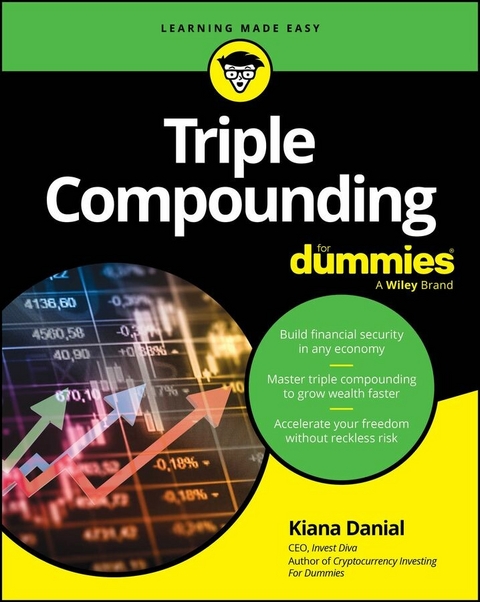
Triple Compounding For Dummies (eBook)
453 Seiten
For Dummies (Verlag)
978-1-394-34826-8 (ISBN)
Unlock financial growth with this jargon-free guide to the art of compounding interest
Triple Compounding For Dummies helps beginning and seasoned investors and business owners alike take advantage of compounding interest, compounding continuity, compounding dividends, as well as other methods of compounding that can be used to create a wealth ecosystem.
This book breaks down complex financial concepts, showing you how to maximize returns through the power of triple compounding, a strategy that can exponentially increase wealth over time. Triple compounding leverages the exponential growth of your investments, savings, and interest to create a snowball effect of wealth accumulation. With practical steps to follow, real-life examples, and expert advice, you can achieve financial freedom and secure a prosperous future.
- Learn the fundamentals of triple compounding and how it differs from traditional compounding
- Discover strategies to maximize your returns through disciplined investing and smart financial decisions
- Read real-life case studies showcasing the transformative impact of triple compounding on long-term wealth
- Get practical advice on how to start applying triple compounding principles today, regardless of your current financial situation
Whether you're a seasoned investor or just starting out, you'll find valuable tips and clear explanations of how triple compounding can significantly enhance your financial outcomes.
Kiana Danial is the author of Cryptocurrency Investing For Dummies and CEO of Invest Diva. She's an award-winning, internationally recognized personal investing and wealth management expert who has been featured in The Wall Street Journal, Fox Business, CNN, and other outlets.
Unlock financial growth with this jargon-free guide to the art of compounding interest Triple Compounding For Dummies helps beginning and seasoned investors and business owners alike take advantage of compounding interest, compounding continuity, compounding dividends, as well as other methods of compounding that can be used to create a wealth ecosystem. This book breaks down complex financial concepts, showing you how to maximize returns through the power of triple compounding, a strategy that can exponentially increase wealth over time. Triple compounding leverages the exponential growth of your investments, savings, and interest to create a snowball effect of wealth accumulation. With practical steps to follow, real-life examples, and expert advice, you can achieve financial freedom and secure a prosperous future. Learn the fundamentals of triple compounding and how it differs from traditional compounding Discover strategies to maximize your returns through disciplined investing and smart financial decisions Read real-life case studies showcasing the transformative impact of triple compounding on long-term wealth Get practical advice on how to start applying triple compounding principles today, regardless of your current financial situation Whether you're a seasoned investor or just starting out, you'll find valuable tips and clear explanations of how triple compounding can significantly enhance your financial outcomes.
Chapter 1
Understanding Different Types of Compounding
IN THIS CHAPTER
Comparing the fundamental meanings of compounding and investing
Getting an overview of how triple compounding works
Exploring the time frame needed to hit your financial goals with basic compounding
Understanding how triple compounding can accelerate your portfolio
So, you’ve picked up this book, and your first question is probably this: “What the heck is a triple compounding, anyway? Is it just a marketing buzzword? How is it different than normal compounding?” Simply stated, triple compounding is a method practiced by almost all self-made millionaires and billionaires like Robert Kiyosaki, Dave Ramsey, Grant Cardone, Cathie Wood, Kevin O’Leary, Oprah Winfrey, and even Warren Buffett to create generational wealth within their lifetime, even though they all have the same 24 hours as you and I.
It’s the core philosophy that has helped them accelerate their financial growth. However, they rarely talk publicly about the details of the ecosystem they’ve created to help accelerate their financial success; instead, they point to only one element of their triple-compounding ecosystem — such as budgeting, real estate, index funds, media influence, or entrepreneurship — as the key to their success.
When you look into how the wealthy really make money, you realize they’ve all developed a sophisticated triple-compounding ecosystem. It’s the ecosystem as a whole that creates accelerated financial growth, not any one product, service, investment strategy, or person. You can’t try to take the ecosystem apart and measure its pieces in isolation.
Gone are the days when you could just go to college, get a good job, and retire on your 401(k) investment portfolio. If you’re looking to accelerate your financial freedom, you should look into building a triple-compounding ecosystem that compounds multiple investment assets simultaneously. As you discover in this book, two out of three of these assets are not traditional financial instruments. In this chapter, I explain what compounding is and how compounding is different from traditional investing.
HOW I LEARNED ABOUT COMPOUNDING
I first heard this word during the 2008 market crash when I was studying electrical engineering in Japan and moonlighting as a guest on a popular Japanese TV show where we discussed current events.
It was a massive global economic recession. Businesses were going bankrupt, and people were losing their jobs. We were talking about the recession on one of our shows, and one of my panelists, an economics expert, said something I’d heard of without knowing what it meant.
He said governments are printing money to save the economy, which, to me, sounded like a good thing — more money! — until he explained what really happens when governments print more money. He said that when the government prints money to bail out corporations and hand out stimulus checks, inflation goes higher.
Inflation, which is why your parents paid way less for a gallon of milk than you do, is designed to lower the value of your money every year. So, every moment your money sits in the bank, you’re losing money. That means leaving your money in the bank is kind of like setting your money on fire. He said the best way to prevent your money from losing value is to start compounding.
Defining Compounding
The word compound originates from the Latin word componere, which means “to put together” or “to combine.”
Imagine that you have a small snowball. You start at the top of a snowy hill and roll that snowball down the hill. As it rolls, it picks up more snow and gets bigger. The longer it rolls, the more snow it collects, causing it to get bigger faster and faster. (See Figure 1-1.)
Compounding works like that, but instead of snow, the growth happens to money. Let’s say you invest some money, and it earns a little bit of interest, which is like extra money. Now, the next time you earn interest, you earn it not just on your original money but also on the extra money you made before. So, just like the snowball gets bigger as it rolls, your money grows faster over time because you’re earning more and more on top of what you already earned.
Source: triplecompounding.com
FIGURE 1-1: The snowball effect of compounding.
I like to say compounding is kind of like making your money make money babies (see Figure 1-2), and then those money babies make money grandbabies, and the grandbabies make great-grandbabies, which helps your wealth grow bigger and faster over time.
The best thing about compounding is that it prevents your money from losing its value to inflation, so 20 years from now, you can still afford to live comfortably.
Source: triplecompounding.com
FIGURE 1-2: Making your money make babies with compounding.
Relying on Money Managers Won’t Cut It Anymore
Once I found out about compounding during the 2008 market crash, I got very excited to start using it to stop the devaluation of my money. But I knew nothing about money. I had no idea how financial markets worked. It all sounded risky, and I was so scared I would lose everything.
I asked around a little bit and concluded that the best thing I could do was to find a financial advisor to manage my money for me and compound it on my behalf. I thought it would be better than having my money sit in the bank.
I thought these money managers with all their fancy C-level titles would not only have my best interest at heart but also be the key to me getting rich and making my money continuously grow so I could be set for life. With this in mind, I trusted a money manager with all my money.
As it turned out, it didn’t work out the way I expected. Throughout the years, I noticed my portfolio was not only not growing but shrinking.
I got skeptical and started to look more into how money managers and financial advisors make money. What I found out absolutely infuriated me. I found out that the money managers had their partners’ best interests in mind.
They invested my money in stuff that made them compounded income through commissions they get from their partners and companies they invest my money in, instead of what would make me money. Then, they were taking a commission off what little money I was making, too!
So, they were earning from compounding, and I was paying for compounding. This is called reverse compounding. It’s when you pay compounded income instead of earning it. Flip to Chapter 5 to discover all the different things you could be reverse-compounding right now.
What I found to be very concerning about giving your hard-earned cash to money managers is that 96 percent of them underperform the market average. The market average refers to the overall performance of a group of stocks or other financial assets that represent a particular market or sector. The market average return is around 8 percent to 12 percent per year. Money managers underperform that, which means my money was barely growing with my money manager’s fund.
What’s even crazier about this statistic is that the other 4 percent of money managers who are supposedly doing okay change yearly! That means no money manager consistently does better than the market average. They’re supposed to be the so-called financial experts, but they actually lose money compared to the market average and then charge you a commission for completely mismanaging your money.
Although this commission is typically only 1 percent to 1.2 percent over your lifetime, it can compound to over 28 percent using the same law of compounding. But instead of making your money grow, you’re reverse-compounding, paying Wall Street bros at a compounded rate, which could add up to millions of dollars over time.
In addition, if you need to get your money out of the money managers’ fund for any reason, you have to pay a hefty penalty. I found this out the hard way when, years later, I got fired from my job. I really needed my money back to pay rent. But when I called my money manager to pull the money out, he said — based on the 500-page terms and conditions agreement I had signed years before — I had to pay a 75 percent penalty if I chose to take my money out earlier than the date that was agreed upon.
Here’s an example: If you’d put in $100,000, you would have come out with $25,000 thanks to this early withdrawal penalty. On top of that, they had also mismanaged my money, so what I left there with them was even lower than the initial amount I had given them.
Although the terms and conditions and the penalty rate may differ depending on the money management firm, this can be a huge blow to the security of your financial future.
This is why you will be better off investigating the triple-compounding methods I describe in this book to take control of your financial future and accelerate your freedom.
How I Discovered Triple Compounding
After getting fired from my job and facing the reality of how my money manager mismanaged my money, as I describe in the previous section, I finally decided to take matters...
| Erscheint lt. Verlag | 24.9.2025 |
|---|---|
| Sprache | englisch |
| Themenwelt | Sachbuch/Ratgeber ► Beruf / Finanzen / Recht / Wirtschaft ► Geld / Bank / Börse |
| Wirtschaft ► Betriebswirtschaft / Management | |
| Schlagworte | Asset Management • compounding interest • compound interest • compound interest book • Early Retirement • earning interest • high net worth • investing for retirement • investment strategies • Triple compounding • triple compounding book • wealth building |
| ISBN-10 | 1-394-34826-6 / 1394348266 |
| ISBN-13 | 978-1-394-34826-8 / 9781394348268 |
| Informationen gemäß Produktsicherheitsverordnung (GPSR) | |
| Haben Sie eine Frage zum Produkt? |
 EPUB (Adobe DRM)
Kopierschutz: Adobe-DRM
Adobe-DRM ist ein Kopierschutz, der das eBook vor Mißbrauch schützen soll. Dabei wird das eBook bereits beim Download auf Ihre persönliche Adobe-ID autorisiert. Lesen können Sie das eBook dann nur auf den Geräten, welche ebenfalls auf Ihre Adobe-ID registriert sind.
Details zum Adobe-DRM
Dateiformat: EPUB (Electronic Publication)
EPUB ist ein offener Standard für eBooks und eignet sich besonders zur Darstellung von Belletristik und Sachbüchern. Der Fließtext wird dynamisch an die Display- und Schriftgröße angepasst. Auch für mobile Lesegeräte ist EPUB daher gut geeignet.
Systemvoraussetzungen:
PC/Mac: Mit einem PC oder Mac können Sie dieses eBook lesen. Sie benötigen eine
eReader: Dieses eBook kann mit (fast) allen eBook-Readern gelesen werden. Mit dem amazon-Kindle ist es aber nicht kompatibel.
Smartphone/Tablet: Egal ob Apple oder Android, dieses eBook können Sie lesen. Sie benötigen eine
Geräteliste und zusätzliche Hinweise
Buying eBooks from abroad
For tax law reasons we can sell eBooks just within Germany and Switzerland. Regrettably we cannot fulfill eBook-orders from other countries.
aus dem Bereich