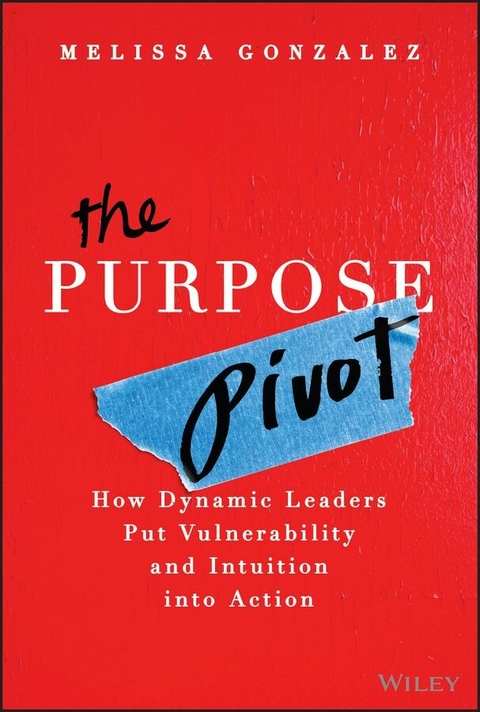
The Purpose Pivot (eBook)
291 Seiten
Wiley (Verlag)
978-1-394-32948-9 (ISBN)
Stories, experiences, and lessons from dynamic leaders to help you take the next step forward
Standing at the nexus of health & wellness and leadership, The Purpose Pivot: How Dynamic Leaders Put Vulnerability and Intuition into Action takes a dive deep into exclusive shared stories, experiences, and learnings of successful women, helping readers navigate their own leadership journey whether it be at work, at home, or within themselves personally. Inspired by author Melissa Gonzalez's wake-up call of a life-threatening medical emergency that required emergency surgery in the middle of the night, this book opens a dialogue to demystify aspects of our health, both physically and mentally, from invisible illnesses like chronic fatigue to outdated beliefs one needs to shed in order to evolve into our best selves.
Some of the powerful ideas explored in this book include:
- The power of intuition and trusting your gut, the beauty in our body fighting for us, and reprioritizing our own hierarchy of needs
- Finding grace and normalizing a slower approach, addressing PTSD from events in the past, and completing the cycle of restoration
- Assessing your own love, fear, and doubts about yourself, creating 'power phrases', and becoming your own Vibe Director
With helpful worksheets included to start making magic happen as soon as today, The Purpose Pivot is an essential read for anyone seeking empowerment on their journeys to actualization.
MELISSA GONZALEZ is a visionary strategist, known for harnessing insights to elevate positioning. A seasoned entrepreneur whose companies have been acquired twice, and a former Wall Street executive, she is widely celebrated for her insatiable curiosity and commitment to helping others thrive. Now channeling her strategic expertise into well-being, she inspires a reimagined model of leadership-one grounded in purpose.
Stories, experiences, and lessons from dynamic leaders to help you take the next step forward Standing at the nexus of health & wellness and leadership, The Purpose Pivot: How Dynamic Leaders Put Vulnerability and Intuition into Action takes a dive deep into exclusive shared stories, experiences, and learnings of successful women, helping readers navigate their own leadership journey whether it be at work, at home, or within themselves personally. Inspired by author Melissa Gonzalez s wake-up call of a life-threatening medical emergency that required emergency surgery in the middle of the night, this book opens a dialogue to demystify aspects of our health, both physically and mentally, from invisible illnesses like chronic fatigue to outdated beliefs one needs to shed in order to evolve into our best selves. Some of the powerful ideas explored in this book include: The power of intuition and trusting your gut, the beauty in our body fighting for us, and reprioritizing our own hierarchy of needs Finding grace and normalizing a slower approach, addressing PTSD from events in the past, and completing the cycle of restoration Assessing your own love, fear, and doubts about yourself, creating power phrases , and becoming your own Vibe Director With helpful worksheets included to start making magic happen as soon as today, The Purpose Pivot is an essential read for anyone seeking empowerment on their journeys to actualization.
1
Trusting Your Gut: Embracing Intuition as a Leadership Tool
January 10, 2024, is a date I will always remember.
I was jolted out of my sleep in excruciating pain. Leading up to that time, my inner voice had been telling me “something is not okay,” and for the weeks I laid in a hospital bed across the country from my home, I hadn't even remembered the Post‐it Note I had written just weeks earlier.
It was a note I wrote with my family on December 25, 2023, as we openly spoke about a “Better You Challenge” we would do together. One person said daily planks, another said she will brush her dogs' teeth daily, another said hydrate more regularly. My note said, “Better Gut Health” and I admittedly wasn't sure how I would accomplish this, but I had planned on a month‐long cleanse, starting on January 10, 2024.
Starting that cleanse took on a whole new meaning on January 10, 2024, when I was jolted out of my sleep at three in the morning, rushed to the ER just two hours later, and underwent emergency surgery by 1 p.m. because my intestines had twisted 365 degrees, and I was hours away from going into septic shock.
My woman's intuition had been speaking to me for over a year, and I wasn't fully listening. All I knew was that something was off and what was manifesting inside was getting louder and louder.
Often described as the ability to instinctively understand without conscious reasoning, intuition has long been undervalued, or not fully believed in modern society. However, through real‐world narratives and scientific insights, you can see how it serves as a profound force that shapes decisions, fosters resilience, and transforms lives. This chapter explores that impact, interweaving personal stories like mine with studies from psychology, neuroscience, and emotional intelligence. From the duality of cognitive processes explained by William James to the rapid decision‐making capabilities highlighted by Malcolm Gladwell, intuition can be a dynamic and indispensable tool to harness. Paired with practices like mindfulness, breathwork, and heightened emotional intelligence, “trusting your gut” can offer a pathway to greater self‐awareness, creativity, and purpose in both personal and professional domains. In this chapter we will explore the correlation between trusting your gut and intuition, the role of emotional intelligence, why we often ignore the signs, and how to break those habits.
“I need a timeout in life,” wrote Shirley Ramos Roseman, author of Thoughts of a Butterfly, on a piece of paper in 2009, four days before she had a stroke at the age of 29.
When we explore the power of intuition, it can often feel abstract. By studying both time and history, we find numerous demonstrations that intuition exists in a very real way. In Shirley's case her gut and her inner self were speaking to her, not so dissimilarly to how mine was speaking to me. On the outside she was a burgeoning mortgage broker, she was social, thriving, and in her stride, but inside she very much knew something was off and her body was asking her for a break.
Shirley would later learn that she had a hole in her heart and that a blood clot traveled through that hole and made its way to her brain. She'd had a stroke. She was fortunate to be awakened by the tireless ringing of her phone as her mom frantically looked for her when she didn't show up for her brother's party. But Shirley's recovery wasn't seamless, and she needed to evaluate and make life adjustments. While she didn't understand how to decipher what her inner self was whispering to her pre‐stroke, what it did open was an awakened spirituality. It opened a closer connection with her thoughts and her actions. It led her to write feverously each day, to slow down, and it taught her to listen more intently to what her mind and body were telling her.
Emotional Intelligence and Intuition
The word “intuition” comes from the Latin intuir, which means “knowledge from within.” It is often defined as the ability to understand something instinctively, without the need for conscious reasoning. It involves quick judgments based on prior experiences and knowledge.1,2 The power of intuition is supported by a blended combination of psychological insights, neuroscience, and real‐world applications, and our openness to receive and listen to the thoughts that penetrate our minds. It takes not only an awareness but a certain level of emotional intelligence and human cognition to trust the energy.
While it was once shrugged upon and dismissed by scientists, the opportunity of intuition is being embraced more widely today. Through the advent of social media demystifying what intuition means and the sharing of more use cases and examples (some from those as young as three years old), there is a growing openness to the dialogue around the power of intuition. Scientists who study cognitive behaviors have begun to think of intuition as a set of nonconscious cognitive and affective processes. While the outcome of these processes is often difficult to articulate and is not based on deliberate thinking, the processes have validity and have been proven to be effective.
If we look at the studies of Malcolm Gladwell,3 his research suggests that intuitive decisions can be made in seconds, if we allow it. And those decisions can be as accurate as analytical ones in certain situations, especially when under pressure, based on one's subconscious processing of information—tapping back on prior experiences, knowledge, and the gut. Through his study and analysis, Gladwell suggests that our brains are capable of synthesizing vast amounts of data rapidly, allowing us to recognize patterns and draw conclusions without conscious deliberation.
Couple Gladwell's studies with the insights of William James,4 a philosopher and psychologist who was instrumental in establishing Harvard's psychology department in the late 1800s, who believed that cognition takes place in duality—on one end of the spectrum it takes place in an associative manner that is more spontaneous and “effortless,” and on the other side it takes place in a rational manner that is analytical with concerted effort and more methodical. He viewed intuition as a way of knowing that bypasses analytical reasoning, allowing individuals to grasp concepts or truths quickly and often without conscious awareness. James also suggested that intuition is informed by past experiences and emotions, enabling people to make judgments based on a holistic perception of a situation. This of course begs larger questions when we see intuition displayed in very young children, but also validates the possibilities of its innate possibilities.
In his work, James also argues that this instinctive knowledge can be as valid as rational thought and recognizes intuition as a powerful cognitive tool that complements rational processes in navigating life's complexities.
However, to embrace intuition, it is not experiences and knowledge alone that enable the action of acting upon it. It also takes the maturation of emotional intelligence. Emotional intelligence (EQ) is linked to the act of intuitive decision‐making. People who demonstrate high EQ are often more attuned to their feelings and those of others, enhancing their intuitive capabilities.5 It has been shown that women tend to be more attuned to our EQ than our male counterparts, as we tend to score higher than men in areas of empathy, interpersonal relationships. and social responsibility.6 But still we too often dismiss or suppress our intuition capabilities.
Neuroscience of Intuition and Why We Ignore the Signs
In my case, my intuition and my EQ were telling me I was not myself, yet I suppressed both. And if I listened with more acceptance and urgency, I could have been making wiser decisions for my well‐being sooner. Why does this happen? Is ignoring the signs more human nature than not?
Scientifically, the right‐brain and the left‐brain relationship pulls on our tensions of logic and creativity. Studies in neuroscience suggest that intuitive thinking is associated with the brain's ability to process information unconsciously, often utilizing the left hemisphere (logic) more than the right (creativity).7 In his book Descartes' Error: Emotion, Reason, and the Human Brain, Damasio explores the interplay between emotion and cognition in decision‐making and the tension between the right and left brain.
It's not a perfect balance, and depending on our natural affinities and tendencies, some of us are more naturally predisposed to logic and some to creativity. Those more heavily weighted in creativity have a more organic openness to exploration and acceptance of the less tangible and therefore embrace new experiences with more comfort. For those who live more in logic, the unknown and the seemingly inexplicable are harder to grasp and accept. When we have more freedom from logic, we are more likely to trust in and react from intuition, or what may feel like more impulse decisions.
Let's put this in practice. Have you had a jittery feeling in the morning but were not sure what you felt so anxious about? Have you ever felt more “off” in your day and instead of pausing to say, “Maybe there is a reason I keep dropping things, or...
| Erscheint lt. Verlag | 23.9.2025 |
|---|---|
| Sprache | englisch |
| Themenwelt | Wirtschaft ► Betriebswirtschaft / Management |
| Schlagworte | intuition leadership • self doubt • Self love • woman leadership • Women Empowerment • women experiences • women fear • women fulfillment • women lessons • women needs • women ptsd • women self help • Women Stories • women work |
| ISBN-10 | 1-394-32948-2 / 1394329482 |
| ISBN-13 | 978-1-394-32948-9 / 9781394329489 |
| Informationen gemäß Produktsicherheitsverordnung (GPSR) | |
| Haben Sie eine Frage zum Produkt? |
 EPUB (Adobe DRM)
Kopierschutz: Adobe-DRM
Adobe-DRM ist ein Kopierschutz, der das eBook vor Mißbrauch schützen soll. Dabei wird das eBook bereits beim Download auf Ihre persönliche Adobe-ID autorisiert. Lesen können Sie das eBook dann nur auf den Geräten, welche ebenfalls auf Ihre Adobe-ID registriert sind.
Details zum Adobe-DRM
Dateiformat: EPUB (Electronic Publication)
EPUB ist ein offener Standard für eBooks und eignet sich besonders zur Darstellung von Belletristik und Sachbüchern. Der Fließtext wird dynamisch an die Display- und Schriftgröße angepasst. Auch für mobile Lesegeräte ist EPUB daher gut geeignet.
Systemvoraussetzungen:
PC/Mac: Mit einem PC oder Mac können Sie dieses eBook lesen. Sie benötigen eine
eReader: Dieses eBook kann mit (fast) allen eBook-Readern gelesen werden. Mit dem amazon-Kindle ist es aber nicht kompatibel.
Smartphone/Tablet: Egal ob Apple oder Android, dieses eBook können Sie lesen. Sie benötigen eine
Geräteliste und zusätzliche Hinweise
Buying eBooks from abroad
For tax law reasons we can sell eBooks just within Germany and Switzerland. Regrettably we cannot fulfill eBook-orders from other countries.
aus dem Bereich