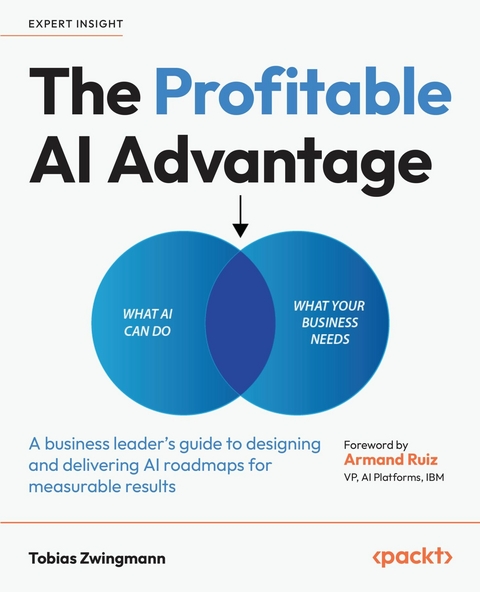
Profitable AI Advantage (eBook)
292 Seiten
Packt Publishing (Verlag)
978-1-83620-588-3 (ISBN)
Artificial Intelligence has the power to dramatically enhance business performance-but knowing where to begin can be overwhelming. The Profitable AI Advantage offers a clear, actionable roadmap for business leaders, entrepreneurs, and CTOs to identify, design, and scale profitable AI initiatives. You'll learn how AI expands margins by reducing costs, increasing throughput, minimizing risk, and unlocking new revenue streams-without incurring proportional costs.
Instead of relying on complex financial models, this guide presents simple thresholds, cost caps, and quick-sizing techniques you can apply to your own financials. The book moves efficiently from foundational AI concepts to practical applications, covering predictive AI, generative AI, and agent-based tools.
Frameworks like the Pain Points and Bottlenecks Canvas and the Integration-Automation AI Framework help you identify high-impact opportunities, design use cases, build roadmaps, and prototype solutions quickly and cost-effectively. With real-world case studies from seasoned AI expert Tobias Zwingmann, you'll sidestep pitfalls, streamline implementation, and drive measurable P&L impact.
By the end, you'll be equipped to scale AI strategically, align your teams, and boost decision-making, productivity, and competitive edge.
Take your business to the next level by strategically implementing AI in your business functions where it makes most sense and unlock transformative gains over time without breaking your bankKey FeaturesSimplify complex AI concepts with clear explanations tailored for business leadersLearn how to assess AI opportunities and align them with business goals for maximum impactScope and build your first AI prototypes to gain traction quicklyPurchase of the print or Kindle book includes a free PDF eBookBook DescriptionArtificial Intelligence has the power to dramatically enhance business performance-but knowing where to begin can be overwhelming. The Profitable AI Advantage offers a clear, actionable roadmap for business leaders, entrepreneurs, and CTOs to identify, design, and scale profitable AI initiatives. You'll learn how AI expands margins by reducing costs, increasing throughput, minimizing risk, and unlocking new revenue streams-without incurring proportional costs. Instead of relying on complex financial models, this guide presents simple thresholds, cost caps, and quick-sizing techniques you can apply to your own financials. The book moves efficiently from foundational AI concepts to practical applications, covering predictive AI, generative AI, and agent-based tools. Frameworks like the Pain Points and Bottlenecks Canvas and the Integration-Automation AI Framework help you identify high-impact opportunities, design use cases, build roadmaps, and prototype solutions quickly and cost-effectively. With real-world case studies from seasoned AI expert Tobias Zwingmann, you ll sidestep pitfalls, streamline implementation, and drive measurable P&L impact. By the end, you ll be equipped to scale AI strategically, align your teams, and boost decision-making, productivity, and competitive edge.What you will learnIdentify and leverage AI opportunities in your businessCreate actionable AI roadmaps and implement them incrementallyScale AI operations to enhance business functionsDesign and evaluate AI use cases through feasibility assessmentsRecognize AI trends to quickly prototype and iterate AI solutionsManage AI projects and teams effectively without deep technical skillsUnderstand fundamental concepts of modern AI, including Generative AI, LLMs, and predictive modelsWho this book is forDesigned for business leaders, CTOs, and entrepreneurs aiming to integrate AI into their business practices. Ideal for those seeking to understand and leverage AI for strategic advantages without deep technical expertise.]]>
1
Understanding the AI Revolution
Did you ever check your favorite social media app only to find your feed flooded with headlines like:
- RIP product designers.
- This AI side hustle makes $1,579/day.
- This new AI will replace software engineers.
At least in my AI bubble, that’s what my feed looks like every day. A new model here. Another revolution there. Given the buzz on the web, you would bet your house that the AI revolution is in full swing.
However, my last few years of AI consulting have taught me that the reality is quite different. AI adoption remains a challenge and the vast majority of business leaders struggle to bring their (expensive) AI prototypes to (even more expensive) production scenarios.
Here’s how a typical AI project runs for a typical, mid-sized, established B2B company.
The company hears about the potential of AI in optimizing a given process and decides to invest in an AI solution. They engage an IT consulting firm, which charges them $15,000 for an AI strategy deck. The deck outlines a vision of how AI could transform their business over the next 10 years in fluffy words. Excited by this vision, the CEO greenlights a prototype project. The consulting firm charges another $20,000 to develop a basic proof of concept using some historical (or perhaps even made-up) data. The prototype shows promising results and now everyone gets really excited.
But then comes the reality check. To put this prototype into production, the company needs to integrate the AI solution with its existing system landscape, which requires significant customization and new data pipelines. They would also need to train their staff on how to use and interpret the AI predictions. And finally, they would need to establish governance processes to monitor and maintain the AI system over time. With all these requirements in mind, the consulting firm presents a quote for this production implementation that is around 10 times the cost of the prototype.
The CEO no longer greenlights the project. Instead, they want to see a detailed ROI breakdown and proof that the solution will actually work as expected. Neither ever happens; the project stalls and becomes another casualty of what I call the prototyping trap.
This scenario is all too common. A survey by Gartner found that only 53% of AI prototypes make it to production. The rest get stuck in this innovation theater, where companies can point to their AI experiments as evidence of their digital transformation efforts but fail to translate these experiments into tangible business value.
So while companies are trying to figure it out, the hype around AI has filled the pockets of large IT consulting firms. Accenture predicted $900 million in additional revenue in a single quarter due to AI. BCG expected Generative AI (GenAI) to contribute 20% of its revenue in 2024. For McKinsey, AI was the top driver for business growth in 2024. These firms have capitalized on the AI gold rush, offering their (often expensive) services to help companies navigate the complex landscape of AI adoption.
But for many companies, the reality of AI adoption has been a sobering experience. When ChatGPT launched in late 2022, it felt as if AI development suddenly accelerated at an unimaginable pace. GPT-4’s release in March 2023 set expectations sky-high for what was to come. Many anticipated that even more powerful models would quickly emerge, AI development would become unstoppable, and AI would rapidly transform every industry. The hype created an atmosphere of both excitement and fear, with many feeling that they were on the cusp of a transformation they couldn’t control. (Does anyone still remember the big call to pause AI development?)
But the reality of AI’s impact has been quite different from these big expectations. The gap between the AI revolution we were promised and the one that’s actually unfolding is significant, and understanding this gap is crucial for navigating the true AI landscape.
When we dig deeper into the state of AI adoption, we find a paradox.
According to McKinsey, AI adoption in enterprises has surged from 33% in 2023 to 65% in 2024. On the surface, this looks like an impressive leap. But when we look at the depth of adoption, we see a different picture. Only 8% of companies have adopted AI in more than five business functions. The vast majority are only scratching the surface of AI’s potential.
This shallow adoption is, to a large part, because of the prototyping trap I outlined above. It keeps companies stuck in the experimentation phase with AI. They’ve invested in pilots and proofs of concept, but struggle to scale these use cases to production. Even companies that have successfully navigated (or bought their way out of) the prototyping trap are not immune to setbacks.
McDonald’s launched an automated chatbot that it had to pull back in 2024 following a viral TikTok video that highlighted errors, such as adding bacon to ice cream, mistakenly ordering hundreds of dollars worth of chicken nuggets, and confusing caramel ice cream with multiple stacks of butter.
A similar case happened to Air Canada, which decided to pull back its AI customer support chatbot after needing to take legal responsibility for the wrong answers this chatbot gave to a customer.
And it’s not only chatbots. Back in 2021, the real estate platform Zillow shut down its AI-powered service Zillow Offers after its bad predictions contributed to a $500m loss and 2,000 laid-off employees.
Case studies like this have led to growing skepticism and, in some cases, budget cuts for AI initiatives. Gartner calls this the trough of disillusionment - the phase where initial hype gives way to disappointment as the technology fails to meet inflated expectations.
These challenges stem from several factors. We will further explore these throughout this book. But one of the most important reasons for gap between expectations and reality is that organizations lack the maturity to effectively adopt AI. They face hurdles on both the technical front, such as data quality and infrastructure readiness, and the non-technical front, particularly in terms of culture and skills. A survey by IBM found that the skills gap is the top barrier to AI adoption, cited by 33% of respondents. Besides that, the regulatory landscape around AI is starting to take shape, and it’s already impacting implementation, especially in regions like the EU. The EU’s AI Act, for example, classifies certain AI systems as high-risk and subject them to strict requirements around transparency, human oversight, and risk management. This adds another layer of complexity and cost to AI adoption.
Finally, measuring the progress and impact of AI initiatives remains a challenge. Unlike traditional software projects, the ROI of AI can be hard to quantify, especially in the short term. This makes it difficult for companies to justify large-scale investments in AI.
So, are AI projects doomed to failure?
Absolutely not! But real AI progress often comes in a shape that does not make the headlines. For example, biotech company Moderna publicly disclosed that over 750 AI-powered assistants are used by over 80% of the 5,000 employees in their organization to achieve an impact that would otherwise require a team of 100,000 if they operated in the old biopharmaceutical ways - a huge achievement that was left relatively unnoticed compared to other AI breakthroughs covered by media.
We will explore many more case studies like this throughout this book.
But let’s first talk about Why AI matters for non-tech business leaders?
As you’ve seen and will continue to discover - AI adoption isn’t as simple as buying a new IT tool. Adopting AI successfully is a journey, and this journey must be owned and driven by business leaders, not IT. In the next chapters, we’ll explore how IT can be the enabler of AI-powered business transformation but not the key driver.
Instead, business leaders must take ownership of their AI roadmaps themselves. How will AI impact work in their departments? What processes will be affected? How can they ensure every employee is onboard? Where’s the profit? This applies to every leader in an organization. AI roadmaps will be needed for marketing, legal, manufacturing, operations, and beyond. No one is building these roadmaps for these teams unless the business leaders themselves do. Business leaders understand the core needs of their area of responsibility - be it a large business unit, a small team, or a certain product of the company. While IT and engineering departments typically focus on implementation rather than vision, business leaders must bridge that gap to ensure AI initiatives align with strategic goals and the practical needs of the business.
This requires a critical assessment and ongoing iteration along the roadmap. This book will guide you in creating and executing such a roadmap. Without ownership of your AI roadmap, your company risks being stuck in the shiny toy phase-buying AI tools and launching small projects that have, at best, a minor impact on the business.
Owning your AI roadmap or failing to do so - will significantly impact your business’s competitive position in the market. The world around you is in fast motion, so simply maintaining the status quo is no longer enough. If you don’t act, you’re effectively...
| Erscheint lt. Verlag | 26.9.2025 |
|---|---|
| Vorwort | Armand Ruiz |
| Sprache | englisch |
| Themenwelt | Informatik ► Theorie / Studium ► Künstliche Intelligenz / Robotik |
| Wirtschaft ► Betriebswirtschaft / Management ► Unternehmensführung / Management | |
| ISBN-10 | 1-83620-588-0 / 1836205880 |
| ISBN-13 | 978-1-83620-588-3 / 9781836205883 |
| Informationen gemäß Produktsicherheitsverordnung (GPSR) | |
| Haben Sie eine Frage zum Produkt? |
 EPUB (Ohne DRM)
Digital Rights Management: ohne DRM
Dieses eBook enthält kein DRM oder Kopierschutz. Eine Weitergabe an Dritte ist jedoch rechtlich nicht zulässig, weil Sie beim Kauf nur die Rechte an der persönlichen Nutzung erwerben.
Dateiformat: EPUB (Electronic Publication)
EPUB ist ein offener Standard für eBooks und eignet sich besonders zur Darstellung von Belletristik und Sachbüchern. Der Fließtext wird dynamisch an die Display- und Schriftgröße angepasst. Auch für mobile Lesegeräte ist EPUB daher gut geeignet.
Systemvoraussetzungen:
PC/Mac: Mit einem PC oder Mac können Sie dieses eBook lesen. Sie benötigen dafür die kostenlose Software Adobe Digital Editions.
eReader: Dieses eBook kann mit (fast) allen eBook-Readern gelesen werden. Mit dem amazon-Kindle ist es aber nicht kompatibel.
Smartphone/Tablet: Egal ob Apple oder Android, dieses eBook können Sie lesen. Sie benötigen dafür eine kostenlose App.
Geräteliste und zusätzliche Hinweise
Buying eBooks from abroad
For tax law reasons we can sell eBooks just within Germany and Switzerland. Regrettably we cannot fulfill eBook-orders from other countries.
aus dem Bereich