


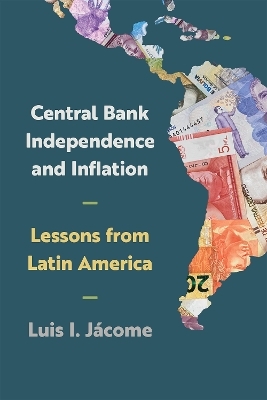
Central Bank Independence and Inflation
Lessons from Latin America
Seiten
2026
Georgetown University Press (Verlag)
978-1-64712-687-2 (ISBN)
Georgetown University Press (Verlag)
978-1-64712-687-2 (ISBN)
- Noch nicht erschienen (ca. Mai 2026)
- Versandkostenfrei
- Auch auf Rechnung
- Artikel merken
A history of the institutional reform of monetary policy in Latin America, with lessons for today
After years of macroeconomic instability, central bank independence (CBI) is playing a pivotal role in achieving low inflation worldwide. But in some nations—including Brazil, Colombia, Hungary, India, Mexico, Türkiye, and the United States— central banks have been blamed for focusing only on fighting inflation at the expense of economic growth.
Central Bank Independence and Inflation argues that countries must continue supporting the independence of central banks to keep inflation in check and hence promote long-run economic growth. Jácome analyzes the evolution of CBI in Latin America from its creation in the 1920s to the present day. He warns against requiring central banks to print money to finance fiscal deficits, because it hinders economic growth. He creates a database of central bank independence to track its evolution and provides empirical evidence of a negative correlation with inflation.
Deeply grounded in history, Central Bank Independence and Inflation warns against the consequences of weakening this institutional arrangement. It is the first book to provide a historical account of Latin America's CBI and will be a valuable resource for those interested in monetary policy.
After years of macroeconomic instability, central bank independence (CBI) is playing a pivotal role in achieving low inflation worldwide. But in some nations—including Brazil, Colombia, Hungary, India, Mexico, Türkiye, and the United States— central banks have been blamed for focusing only on fighting inflation at the expense of economic growth.
Central Bank Independence and Inflation argues that countries must continue supporting the independence of central banks to keep inflation in check and hence promote long-run economic growth. Jácome analyzes the evolution of CBI in Latin America from its creation in the 1920s to the present day. He warns against requiring central banks to print money to finance fiscal deficits, because it hinders economic growth. He creates a database of central bank independence to track its evolution and provides empirical evidence of a negative correlation with inflation.
Deeply grounded in history, Central Bank Independence and Inflation warns against the consequences of weakening this institutional arrangement. It is the first book to provide a historical account of Latin America's CBI and will be a valuable resource for those interested in monetary policy.
Luis I. Jácome, PhD, is a faculty member at the Walsh School of Foreign Service of Georgetown University and an international consultant on central banking policies. He was previously governor of the Central Bank of Ecuador and is co-author of Challenges for Central Banking: Perspectives from Latin America (2016).
| Erscheint lt. Verlag | 5.5.2026 |
|---|---|
| Zusatzinfo | 56 Figures; 45 Tables, unspecified |
| Verlagsort | Washington, DC |
| Sprache | englisch |
| Maße | 152 x 229 mm |
| Themenwelt | Wirtschaft ► Betriebswirtschaft / Management ► Finanzierung |
| Betriebswirtschaft / Management ► Spezielle Betriebswirtschaftslehre ► Bankbetriebslehre | |
| ISBN-10 | 1-64712-687-8 / 1647126878 |
| ISBN-13 | 978-1-64712-687-2 / 9781647126872 |
| Zustand | Neuware |
| Informationen gemäß Produktsicherheitsverordnung (GPSR) | |
| Haben Sie eine Frage zum Produkt? |
Mehr entdecken
aus dem Bereich



aus dem Bereich
Warum unser Geld stirbt und wie Sie davon profitieren
Buch | Hardcover (2024)
FinanzBuch Verlag
CHF 41,95
Praxisnahe Einführung mit zahlreichen Fallbeispielen börsennotierter …
Buch | Softcover (2020)
Vahlen (Verlag)
CHF 34,85
denken und handeln wie ein professioneller Trader
Buch | Softcover (2023)
Vahlen, Franz (Verlag)
CHF 51,65


