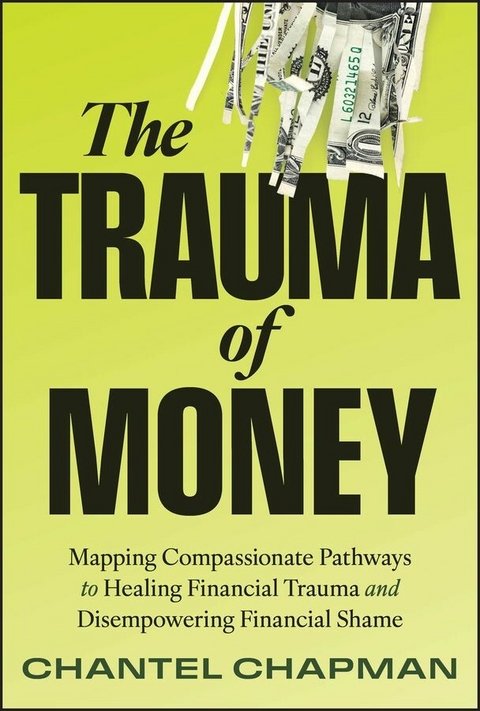
The Trauma of Money (eBook)
420 Seiten
Wiley (Verlag)
978-1-394-30069-3 (ISBN)
A handbook to disempower the trauma standing between individuals and their financial wellbeing
The Trauma of Money: Mapping Compassionate Pathways to Healing Financial Trauma and Disempowering Financial Shame offers a comprehensive exploration of the Trauma of Money Method?, an innovative six-phase approach to decrease shame and increase discernment around money. It spotlights the myriad causes of financial trauma, tracing its roots to their generational, relational, societal, and systemic origins, and guides readers in understanding how trauma directly impacts our financial behaviors. Changing the narratives that come with these traumas is the first step in recognizing that true financial literacy hinges on this foundational healing. This book includes research-based modalities to transform readers' approaches to finances, including somatic trauma healing, narrative therapy, cognitive behavioral therapy, mindfulness, internal family systems, addiction recovery therapies, biomimicry, systems change and financial psychology. It also includes practical tools such as:
- Reflection questions and prompts to intentionally evolve our relationship with money and scarcity as well as tools for addressing financial shame
- Methods to identify and shift away from trauma responses like financial fawning, somatic exercises to regulate the nervous system, and ways to reprogram our subconscious
- Approaches to reclaim and deepen the commitment to our money values and integration activities that can be used with clients
The Trauma of Money: Mapping Compassionate Pathways to Healing Financial Trauma and Disempowering Financial Shame is an illuminating, effective resource for financial advisors and planners, mental health professionals, entrepreneurs, or anyone seeking to move out of automatic trauma responses and into their financial power.
CHANTEL CHAPMAN is the CEO and Founder of The Trauma of Money Institute, a financial literacy and psychoeducation program certifying professionals in trauma-sensitive approaches to finance and scarcity. She has over twenty years' experience in the fields of traditional finance, fintech, and financial recovery and psychoeducation. She's also a member of the National Task Force for Economic Justice.
A handbook to disempower the trauma standing between individuals and their financial wellbeing The Trauma of Money: Mapping Compassionate Pathways to Healing Financial Trauma and Disempowering Financial Shame offers a comprehensive exploration of the Trauma of Money Method , an innovative six-phase approach to decrease shame and increase discernment around money. It spotlights the myriad causes of financial trauma, tracing its roots to their generational, relational, societal, and systemic origins, and guides readers in understanding how trauma directly impacts our financial behaviors. Changing the narratives that come with these traumas is the first step in recognizing that true financial literacy hinges on this foundational healing. This book includes research-based modalities to transform readers' approaches to finances, including somatic trauma healing, narrative therapy, cognitive behavioral therapy, mindfulness, internal family systems, addiction recovery therapies, biomimicry, systems change and financial psychology. It also includes practical tools such as: Reflection questions and prompts to intentionally evolve our relationship with money and scarcity as well as tools for addressing financial shame Methods to identify and shift away from trauma responses like financial fawning, somatic exercises to regulate the nervous system, and ways to reprogram our subconscious Approaches to reclaim and deepen the commitment to our money values and integration activities that can be used with clients The Trauma of Money: Mapping Compassionate Pathways to Healing Financial Trauma and Disempowering Financial Shame is an illuminating, effective resource for financial advisors and planners, mental health professionals, entrepreneurs, or anyone seeking to move out of automatic trauma responses and into their financial power.
Introduction
There's a considerable gap between financial education and trauma recovery, a gap many of us get stuck in – no matter how much money we have.
I wrote this book for anyone looking to understand why that is and who wants to shift their relationship with money. This includes people on all sides of the financial spectrum – the haves, the have-nots, and those who fall somewhere in between. This book also serves as a compass for mental health practitioners, finance experts, and other professionals confronting financial distress with their clients, providing tangible insights to help them implement the Trauma of Money (TOM) Method with compassion and dignity.
MONEY TRAUMA IS INCOME-AGNOSTIC
A common misunderstanding is that this book is intended to serve only people who lack financial resources. Not so. The truth is, trauma occurs across all income levels, and any trauma can affect how we behave with money, even experiences that have nothing to do with money.
It's one reason Dr. Moira Somers, a financial psychologist, author, speaker, and family wealth consultant whose work I admire and respect, asked me to present the TOM Method to her colleagues when they were working as a special interest group within the American Psychological Association. This group comprises a collection of professionals who are intimately familiar with the complexities and challenges associated with significant financial wealth. Dr. Somers and I both agree that increased financial wealth can amplify existing personal traits, or as she says, “Money is an accelerant … it makes you more of who you are.”1
If you're someone with unhealed attachment wounds, scarcity and trauma in your lineage, or part of a systemically marginalized group, this may manifest as unhelpful money behaviors that affect your well-being.
Our dominant economic culture encourages the false belief that more money means fewer problems, when in reality, sometimes it's the opposite. While everyone's experience is different, we have plenty of examples of financial wealth holders who are “unhappy, scattered, and dysregulated around money,” shares Tommy Rosen, an addiction recovery expert working with people across various income brackets who are engaged in his Recovery 2.0 program.
Like so many of us, financial wealth holders may have unresolved wounding that unconsciously drives their behaviors with money. If left addressed, these financial dysregulations and unhelpful money disruptions, which are really symptoms of an underlying problem, are likely to persist.
CAVEATS AND LIMITATIONS
The original scope of this book was much larger, but to spare you from an encyclopedia-sized read, I had to make some strategic cuts. This topic is so layered and complex it could encompass several volumes. It’s entirely likely I won’t fully do it justice (as if such a thing exists). However, I want to encourage you to take this exploration deeper.
In these pages, you'll find numerous financial, psychological, historical, and systemic threads you may choose to investigate further. No one book could succinctly or sufficiently cover a subject as delicate and nuanced as economic justice, nor could it responsibly present every single intersection people have with money. I've intentionally chosen to center the voices of those who often go unheard, focusing on the stressors and themes we see most often in our teaching spaces.
As such, this book will feature multiple voices, each with varying perspectives – from the very academic to the culturally anchored. While I acknowledge this may be overwhelming or disorienting to some, the TOM Method doesn't work without fully embracing this wide spectrum of lived experience.
Further, while I understand that this book is but a drop in the ocean, I believe, as Rumi does, that there's an entire ocean in a drop. By this I mean that the work needed to heal the generational and ongoing injustices in our world is vast and as essential to our well-being as water itself. However, I hope this contribution sparks a collective curiosity that moves us in the direction of change, fueling us for the long road ahead.
WHO AM I? (AND WHO I'M NOT)
Like everyone else, I've been conditioned to interpret and engage with the world through a specific gendered, cultural, and social lens. While I aim to be ever mindful of that influence and limited scope, I inevitably operate with knowledge and experience gaps that preclude me from speaking as the one true authority on money. I leave that important task to you, reader. You are the author of your own financial well-being; I simply wrote this book.
Though I did work in the financial industry for many years, I'd say my most relevant experience is the highs and lows of the trauma I've lived through and the recovery journey it's led me on.
I fully believe that I wouldn't have been able to create the TOM Method without that trauma. As many people with neurodivergence and complex post-traumatic stress disorder report, I've become particularly adept at pattern recognition. My hypervigilance is actually part of what made it possible to weave together the many otherwise siloed modalities that you will experience in this book. My wound-turned-skill is just one example of the post-traumatic growth that's possible when we transmute our traumas and use them in service of a greater good.
Anyone who knows me can also attest that I'm passionate about neuroscience. My friend Dani recently reflected to me that my party trick is telling people random facts about their brains and explaining why we may do things from an evolutionary standpoint. (Having admitted that, I fully expect an avalanche of party invites to arrive after this book is published!) Unfortunately, I am not a neuroscientist. I am also not a doctor, a psychologist, or an investment advisor. Nothing in this book should be construed as financial, medical, or legal advice.
Still, I often wish I hadn't needed to make the difficult choice between pursuing my dream career as a neuroscientist and making ends meet. But the fact is that growing up in poverty and facing certain barriers made my preferred path inaccessible. This book will explore those obstacles, and perhaps shed light on why the TOM Method would have looked so different if I'd been trained in a single discipline.
I believe taking a reductionist view of our relationship with money can oversimplify the real driving forces behind our financial behaviors. We're complex creatures who face many potential layers of trauma. This work is a mapping of all the underexplored intersections and healing approaches that affect our relationship with money. And like any good map, it's always being updated.
What I do know is that looking at our money defenses is best approached from a holistic, but ultimately self-determined, place. I've made a point to interview and reference experts from a variety of fields so you can dive into the areas that interest you most. I encourage you to be discerning and step into the role of your own curious and compassionate scientist or explorer.
Because I believe in the power of vulnerability to help us connect on a human level, let me also share this about the process of writing this book: I received the publishing contract from Wiley on the exact due date of what was to be my first child – a pregnancy I had tragically lost just four months prior. That loss was followed by many more endings, deaths, and significant life transitions. In many ways, this book became an opportunity to birth something else – a part of me – into the world.
As difficult as the experiences were during the book-writing process, and in some of the personal stories I share here, I can't help but recognize how deeply they shaped the good in my life. The isolation and shame I once felt about money ultimately led me to build a community-centered business that fosters belonging for everyone. These painful moments pushed me to reclaim my financial values and move closer toward the life and communities that I want to be a part of, especially in my relationship with money. I hope some version of this becomes true for you, too.
SEEKING SELF-DETERMINATION AND DISCERNMENT
I can earnestly say I believe us all to be financial experts. The hierarchical approach that exalts financial professionals as the only credible experts was one of the biggest issues I saw in the financial education space. Of course they have expertise, but it shouldn't devalue anyone's lived experience with money. If you come out of reading this book embodying the belief that you can be trusted with money, I'll know I've done something right.
As Vanessa Roanhorse says, “No matter how much money or expertise you have, [it] does not make up for [the] level of lived experience, wisdom and knowledge that comes from…people who know, because they've experienced the problem and solution so intimately.”2 She's an incredible economic justice leader and creator of Rematriating Economies, a program training Indigenous women to become professional financial leaders, and you'll meet her in Chapter 13.
I'll say that again: we are all finance experts, no matter what society, our parents, or the financial industry says. It's our lived experiences that create our relationship with money, and those are forever invaluable. Sure, we may carry unevolved beliefs and behaviors that may no longer be serving us....
| Erscheint lt. Verlag | 16.9.2025 |
|---|---|
| Sprache | englisch |
| Themenwelt | Sachbuch/Ratgeber ► Beruf / Finanzen / Recht / Wirtschaft ► Geld / Bank / Börse |
| Wirtschaft ► Betriebswirtschaft / Management | |
| Schlagworte | addiction recovery money • biomimicry money • cbt money • financial literacy • financial trauma • ifs money • money mindfulness • money psychology • money scarcity • money shame • Money therapy • money trauma • subconscious money |
| ISBN-10 | 1-394-30069-7 / 1394300697 |
| ISBN-13 | 978-1-394-30069-3 / 9781394300693 |
| Informationen gemäß Produktsicherheitsverordnung (GPSR) | |
| Haben Sie eine Frage zum Produkt? |
 EPUB (Adobe DRM)
Kopierschutz: Adobe-DRM
Adobe-DRM ist ein Kopierschutz, der das eBook vor Mißbrauch schützen soll. Dabei wird das eBook bereits beim Download auf Ihre persönliche Adobe-ID autorisiert. Lesen können Sie das eBook dann nur auf den Geräten, welche ebenfalls auf Ihre Adobe-ID registriert sind.
Details zum Adobe-DRM
Dateiformat: EPUB (Electronic Publication)
EPUB ist ein offener Standard für eBooks und eignet sich besonders zur Darstellung von Belletristik und Sachbüchern. Der Fließtext wird dynamisch an die Display- und Schriftgröße angepasst. Auch für mobile Lesegeräte ist EPUB daher gut geeignet.
Systemvoraussetzungen:
PC/Mac: Mit einem PC oder Mac können Sie dieses eBook lesen. Sie benötigen eine
eReader: Dieses eBook kann mit (fast) allen eBook-Readern gelesen werden. Mit dem amazon-Kindle ist es aber nicht kompatibel.
Smartphone/Tablet: Egal ob Apple oder Android, dieses eBook können Sie lesen. Sie benötigen eine
Geräteliste und zusätzliche Hinweise
Buying eBooks from abroad
For tax law reasons we can sell eBooks just within Germany and Switzerland. Regrettably we cannot fulfill eBook-orders from other countries.
aus dem Bereich