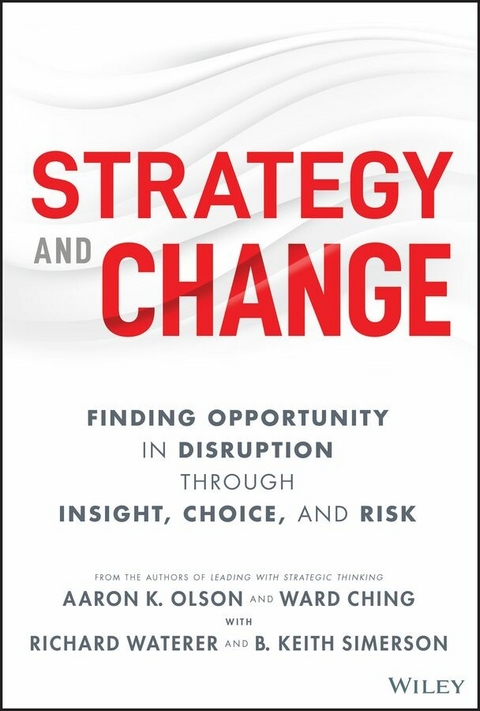
Strategy and Change (eBook)
313 Seiten
Wiley (Verlag)
978-1-119-98872-4 (ISBN)
A powerful guide to becoming a strategic leader who makes insightful business decisions and manages risk in volatile and unpredictable environments
Written by a team of seasoned strategy consultants, Strategy and Change: Finding Opportunity in Disruption Through Insight, Choice, and Risk delivers an insightful playbook on recognizing relevant patterns, making consistently sound business decisions, and effectively managing risk in a world defined by disruption and volatility. This follow-up to the authors' first book, Leading with Strategic Thinking, covers major business developments and trends occurring since 2015. It explores disruption from technological advancements, like generative AI, as well as unforeseen crises, like the global COVID-19 pandemic.
In this book, readers will find invaluable insights into:
- The four ways to lead strategy in today's complex business environment: visionary leadership, directive leadership, incubating leadership, and collaborative leadership
- How to analyze problems and make decisions that achieve short- and long-term success
- New methods to evaluate hazards as both threats and opportunities in a marketplace that has become increasingly disruptive and unpredictable
Grounded in the latest research and real-world case studies, Strategy and Change earns a well-deserved spot on the bookshelves of all executives, consultants, and entrepreneurs seeking proven guidance to navigate the new world of business. It's also an invaluable resource for risk management professionals, academics, and early-career professionals involved in strategy and leadership.
AARON K. OLSON is Executive Vice President at Aon, where he has held various leadership roles focused on client engagement, corporate strategy, organizational effectiveness, and talent management. Aaron serves as adjunct faculty at Northwestern University teaching graduate and executive courses on strategy and leadership.
WARD CHING is an Adjunct Professor of Risk Management at the University of Southern California Marshall Business School where he teaches courses in enterprise risk management and disruptive risk innovation. Ward led the Strategic Solutions and Innovation Practice at Aon, where he focused on client risk strategy development, advanced decision analytics and alternative risk finance.
RICHARD WATERER is the Global Risk Consulting Leader at Aon. In this role, he is responsible for leading a team of 1,500 full-time risk consultants, helping clients to identify and quantify risk, select and implement strategies around risk transfer, retention and mitigation, and provides post-loss consulting.
B. KEITH SIMERSON, EdD, provides consultation, executive coaching, and advisory services in the areas of strategic leadership and strategy formulation and execution. He is on the adjunct faculty of Northwestern University's School of Education and Social Policy where he teaches graduate courses on strategy and leadership.
A powerful guide to becoming a strategic leader who makes insightful business decisions and manages risk in volatile and unpredictable environments Written by a team of seasoned strategy consultants, Strategy and Change: Finding Opportunity in Disruption Through Insight, Choice, and Risk delivers an insightful playbook on recognizing relevant patterns, making consistently sound business decisions, and effectively managing risk in a world defined by disruption and volatility. This follow-up to the authors' first book, Leading with Strategic Thinking, covers major business developments and trends occurring since 2015. It explores disruption from technological advancements, like generative AI, as well as unforeseen crises, like the global COVID-19 pandemic. In this book, readers will find invaluable insights into: The four ways to lead strategy in today's complex business environment: visionary leadership, directive leadership, incubating leadership, and collaborative leadership How to analyze problems and make decisions that achieve short- and long-term success New methods to evaluate hazards as both threats and opportunities in a marketplace that has become increasingly disruptive and unpredictable Grounded in the latest research and real-world case studies, Strategy and Change earns a well-deserved spot on the bookshelves of all executives, consultants, and entrepreneurs seeking proven guidance to navigate the new world of business. It's also an invaluable resource for risk management professionals, academics, and early-career professionals involved in strategy and leadership.
Introduction
GOOGLE CEO SUNDAR Pichai was facing tough questions during his grueling three-and-a-half-hour congressional testimony on a December morning in 2018. He was speaking to the US House Judiciary Committee, whose members were concerned about the company's data collection practices. Some were skeptical of his answers as he struggled to provide straightforward descriptions of the technical and at times Byzantine methods by which the company processed, used, and stored the vast troves of sometimes sensitive data collected from its users.
Pichai was wrestling with a challenge familiar to executives at the time: how to capitalize on the rapid digitization of user-generated content while navigating increasing concerns from the public about who should ultimately own and control that information.
This challenge was compounded by the dramatic pace of technological and competitive change. In just 20 years, Google had gone from its humble beginnings in a dorm room on the campus of Stanford University to being one of the largest and most influential companies in a global marketplace. Despite this historic rise, Pichai knew that its fall could happen even more quickly. The same technological trends that fueled its success could be harnessed by the next startup looking to redefine the very market that Google pioneered.
When pressed that morning to explain the company's practices, Pichai emphasized their focus on giving customers control. He described a service called Google Takeout, established to let users export their personal information from Google and transfer it to another provider:
We started this effort as early as 10 years ago, building [portability] for many of our products. We started an office in Chicago with the expressed goal of providing users with this Takeout capability. I think we were quite unique in starting to work on that as a company, but there's more effort we plan to do there.1
Google Takeout was a key part of Google's story that day, meant to highlight the company's good-faith efforts to give users control of their personal information. Indeed, it was a critical component to a broader defense against accusations of anticompetitive behavior. While a federal judge ultimately declared the company to be a monopoly in late 2024, due to contracts related to browser dominance, Google Takeout was an unqualified success, serving as the catalyst for an industry-wide adoption of data portability standards. As of this writing, you can export your own data by visiting takeout.google.com.
The origins of Google Takeout hold important lessons for executives looking to navigate the kind of challenges faced by Sundar Pichai. We wrote about its creation in 2015 as part of our examination of the relationship between strategy and leadership.2 It is the story of one Google engineer, Brian Fitzpatrick, whose personal mission fulfilled an objective of Google's CEO and ultimately affected how billions of people use internet services today.
More broadly, Google's decision to launch Takeout stands out when viewed in the context of its time. Google embraced data portability in a hypercompetitive marketplace where using personal data to enable customer lock-in was an industry standard practice in a highly lucrative, rapidly evolving industry. It illustrates the broader challenge we'll explore in this book: how organizations and those who lead them can navigate difficult choices that balance risk and reward in the face of increasing complexity and disruptive change.
For executives tasked with managing shareholder value, most of those decisions can be filtered through the lens of two variables—maximizing revenue and managing cost. At the same time, experienced executives weigh two additional factors—opportunity and risk. These factors form heuristics—mental shortcuts for decision-making—both conscious and assumed that guide decisions up and down the organization. That said, a well-honed instinct isn't always well suited to the kinds of novel questions and market shifts brought by disruptive change.
Even for the best executives, choices have become more challenging. Issues of data management and regulatory risk are just two of the complex trends that organizations face today. As in the case of Google, the consequences are amplified by a steady stream of new technologies that challenge existing practices even as they open the door for breakthrough innovation. Most of the leaders we've spoken with agree—regardless of industry or sector—organizations face an onslaught of disruptive events in an increasingly interconnected world.
A Global Perspective
Every four years, the US National Intelligence Council (NIC) produces a report on the state of world affairs and the implications of existing trends for future decades. First published in February of 1997,3 the NIC “Global Trends” report has evolved to become one of the most rigorous assessments of its kind. For our purposes, reviewing the report—and how it has evolved over the course of 30 years—serves as a useful entry point for exploring the volatility and disruptive change that executives must consider.
The 2021 report opens with five themes that underpin a central thesis that at every level society and organizations face cause for concern:
- Global challenges: Shared challenges—including climate change, disease, financial crises, and technology disruptions—are likely to manifest more frequently and intensely in almost every region and country. These challenges, which often lack a direct human agent or perpetrator, will produce widespread strains on states and societies as well as shocks that could be catastrophic.
- Fragmentation: The difficulty of addressing these transnational challenges is compounded in part by increasing fragmentation within communities, states, and the international system. Paradoxically, as the world has grown more connected through communications technology, trade, and the movement of people, that very connectivity has divided and fragmented people and countries.
- Disequilibrium: The scale of transnational challenges, and the emerging implications of fragmentation, are exceeding the capacity of existing systems and structures, highlighting the third theme: disequilibrium. There is an increasing mismatch at all levels between challenges and needs with the systems and organizations to deal with them.
- Contestation: A key consequence of greater imbalance is greater contestation within communities, states, and the international community. This encompasses rising tensions, division, and competition in societies, states, and at the international level. Many societies are increasingly divided among identity affiliations and at risk of greater fracturing. Relationships between societies and governments will be under persistent strain as states struggle to meet rising demands from populations.
- Adaptation: Finally, adaptation will be both an imperative and a key source of advantage for all actors in this world. […] The most effective states are likely to be those that can build societal consensus and trust toward collective action on adaptation and harness the relative expertise, capabilities, and relationships of nonstate actors to complement state capacity.4
Later in the report, these themes are brought to life through five scenarios for what the world might look like in 2040, each a specific configuration of power and influence presented “to widen the aperture to the possibilities.”
These themes give us a lot to think about. This is magnified when we compare the latest report to the NIC's original “Global Trends” report, authored in 1997. That first publication described China in skeptical terms:
By dint of its size, regional sweep, economic growth, territorial claims, and insistence on being taken seriously as a major foreign policy player, China will preoccupy US policymakers through 2010 and beyond. While China has the potential to become the region's dominant military power, it is beset by significant internal problems that in our judgment will preclude it from becoming so during this time frame. Indeed, many of the global trends we highlighted—population (and strains associated with urbanization), energy demands, and food—are domestic issues for China. As a result, its military modernization and power-projection capabilities will increase only gradually. The Chinese central government will continue to have difficulties collecting revenues to fund its programs. With 70% of its population still in agriculture, China has a long way to go to develop a modern economy on a nationwide basis.5
Fast-forward to today, and China is a global superpower central to the NIC's analysis, with further complexity arising from a notable emphasis on nonstate actors like corporations and ideological communities.
The major themes of the NIC “Global Trends” report and the evolving nature of the report's findings over time leave us with one unavoidable conclusion: the issues leaders face today have become more complicated and the decisions more challenging.
Strategic Leadership in a Complex and Volatile World
These two examples, Google Takeout and the NIC “Global Trends” report, serve as an important backdrop for the issues we'll explore in this book. In Google, we see the impact when leaders set a bold strategy and empower individuals to drive change. In the...
| Erscheint lt. Verlag | 16.9.2025 |
|---|---|
| Sprache | englisch |
| Themenwelt | Wirtschaft ► Betriebswirtschaft / Management ► Unternehmensführung / Management |
| Schlagworte | Business Strategy • Executive Development • generative ai business • leadership advice • Leadership case studies • leadership development • Leadership Research • Leadership Training • Management strategies • problem solving leadership |
| ISBN-10 | 1-119-98872-1 / 1119988721 |
| ISBN-13 | 978-1-119-98872-4 / 9781119988724 |
| Informationen gemäß Produktsicherheitsverordnung (GPSR) | |
| Haben Sie eine Frage zum Produkt? |
 EPUB (Adobe DRM)
Kopierschutz: Adobe-DRM
Adobe-DRM ist ein Kopierschutz, der das eBook vor Mißbrauch schützen soll. Dabei wird das eBook bereits beim Download auf Ihre persönliche Adobe-ID autorisiert. Lesen können Sie das eBook dann nur auf den Geräten, welche ebenfalls auf Ihre Adobe-ID registriert sind.
Details zum Adobe-DRM
Dateiformat: EPUB (Electronic Publication)
EPUB ist ein offener Standard für eBooks und eignet sich besonders zur Darstellung von Belletristik und Sachbüchern. Der Fließtext wird dynamisch an die Display- und Schriftgröße angepasst. Auch für mobile Lesegeräte ist EPUB daher gut geeignet.
Systemvoraussetzungen:
PC/Mac: Mit einem PC oder Mac können Sie dieses eBook lesen. Sie benötigen eine
eReader: Dieses eBook kann mit (fast) allen eBook-Readern gelesen werden. Mit dem amazon-Kindle ist es aber nicht kompatibel.
Smartphone/Tablet: Egal ob Apple oder Android, dieses eBook können Sie lesen. Sie benötigen eine
Geräteliste und zusätzliche Hinweise
Buying eBooks from abroad
For tax law reasons we can sell eBooks just within Germany and Switzerland. Regrettably we cannot fulfill eBook-orders from other countries.
aus dem Bereich